Wednesday, November 13, 2013

Arriving Too Soon to a Theater Near You

            In recent remarks to the National Broadcasting Company, Secretary of State John Kerry expressed his dissatisfaction with the official stories of President Kennedy’s assassination.  On Sunday, November 10, 2013, N.B.C.’s David Gregory asked Kerry to elaborate on his statement that, “To this day, I have serious doubts that Lee Harvey Oswald acted alone.”  Understandably reluctant to be labelled a conspiracy theorist, Kerry refused to be drawn out; but it was still a telling exchange: 
            Kerry:  No.  I just have a point of view.  And I’m not going to get into that.  It’s — you know, it’s not something that I think needs to be commented on, and certainly not at this time.
            Gregory:  Do you think the conspiracy theories — his involvement with Russia, motivation from the Soviet Union or Cuba — are valid at some level?

            Unfortunately, but somewhat predictably, Gregory asked about foreign motivation for the murder.  Apparently, he is unaware that all of the crimes committed in support of the lone assassin story were perpetrated by domestic entities. 
            In 1963, murder of the President was not a federal offense; jurisdiction for the assassination rested in Texas.  Consequently, the removal of Kennedy’s body from Dallas was a crime.  The Russians didn’t do that; the Secret Service did.  The autopsy at Bethesda Naval Hospital, where the prosectors were ordered to remain silent on pain of court martial, was a crime; but the Navy did that, not the Cubans.  Gangsters didn’t make up the story about alleged assassin Lee Oswald going to Mexico City in September of 1963; the C.I.A. did that.  Those crimes, and many more, were committed to protect Kennedy’s killers. 
            In a nutshell, the official history of the crime goes like this.  “We’re innocent; it was that guy over there with the $3 rifle.”[1]  Millions of people found that claim to be ridiculous; so, a dozen years later, the perpetrators changed their alibi.  “We’re innocent, but we think the mob might have been involved.”
            The Warren Commission was an accessory after the fact to the murder of J.F.K.  The House Select Committee on Assassinations was an accessory after the fact to two murders — John Kennedy and Dr. Martin Luther King.
            The Commission and Committee stories are fairy tales.  Yet, some people who discounted the first story nevertheless bought the second version!  Author and syndicated radio and tv host Thom Hartmann is one of those people.  On November 12, 2013, Hartmann appeared with Amy Goodman on Democracy Now! and briefly discussed the assassination:
            Hartmann:  Yeah, yeah.  The — with virtual certainty, I can say that, you know, it was the mob who killed Jack Kennedy.  At that — in that context, I mean, there was involvement of others within our government and whatnot, but principally it was the mob…
             “[O]thers within our government and whatnot” were involved, but organized crime killed the President.  Hartmann is virtually certain of that. 
            He can’t explain the Magic Bullet Theory or the Magic Ammunition Clip Theory.  He doesn’t know where the spent shells found in the Texas School Book Depository went.  He can’t explain why x-rays of the President’s skull don’t show an entrance wound in the back of Kennedy’s head.  He can’t explain any details of the crime.  But he is virtually certain that gangsters did it.  His book, Legacy of Secrecy: The Long Shadow of the JFK Assassination, is being made into a movie starring Leonardo DiCaprio.
                        Goodman:  And when is the movie coming out?
                        Hartmann:  We’ll see.  Hopefully next year.


[1]  That’s not a joke.  The Mannlicher-Carcano rifle supposedly used in the shooting sold for three bucks wholesale.  “Oswald” bought it retail for twelve and change.

Labels: , , , , ,

Saturday, November 02, 2013

Stale Air

            The approaching anniversary of President Kennedy’s assassination was certain to bring with it new tales of how the U.S. intelligence apparatus did not kill him.  And sure enough, a new we-didn’t-do-it account of the murder landed in bookstores this fall — A Cruel and Shocking Act:  The Secret History of the Kennedy Assassination, by investigative reporter Philip Shenon. 
            Dave Davies interviewed Shenon for the N.P.R. program Fresh Air, broadcast on October 28, 2013.  Unfortunately, like many other interviewers on this topic, Davies apparently knows nothing of any importance about the case.  So when Shenon launched into the F.B.I.’s role in the investigation, Davies was unable to ask a single insightful question. 

            Shenon:  Very early on, I mean within 48 hours of the assassination, FBI Director J. Edgar Hoover determines in his own mind that Oswald acted alone, there was no conspiracy, there’s really not much to investigate here…

            In reality, Hoover had no doubt that there was a conspiracy.  
            The C.I.A. reported that Oswald went to Mexico City in September of 1963 and contacted the Cuban and Russian embassies.  The Agency had photos of “Oswald” in Mexico City and recordings of “Oswald’s” phone calls.  Within 48 hours of the assassination, President Johnson asked Hoover about that trip.

            Johnson:  Have you established any more about the visit to the Soviet Embassy in Mexico in September?
            Hoover:  No, that’s one angle that’s very confusing for this reason.  We have up here the tape and the photograph of the man who was at the Soviet Embassy using Oswald’s name.  That picture and the tape do not correspond to this man’s voice, nor to his appearance.  In other words, it appears that there is a second person who was at the Soviet Embassy down there[1]  (Italics added.)

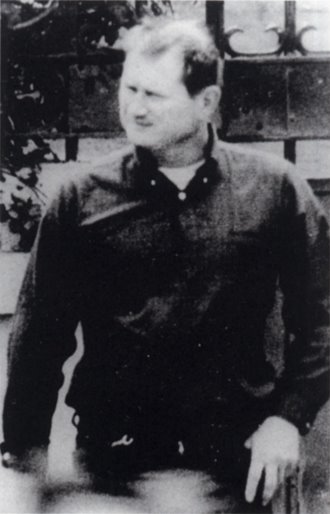
(Left:  "Oswald" in Mexico City)
            Hoover had proof, photographs and tape recordings, that someone impersonated Oswald in Mexico City.  In September of 1963, Oswald was a nobody.  Why would someone want to impersonate him?
            In the interview, Shenon repeated one myth after another — that the missing autopsy photos were held by Robert Kennedy; that Jacqueline Kennedy chose to have the autopsy conducted at Bethesda Naval Hospital; that Jack Ruby insisted there was no conspiracy; that Oswald was under surveillance in Mexico City; that he met with a K.G.B. officer responsible for assassinations in the west; that the F.B.I and the C.I.A. didn’t connect the dots;[2] that the Zapruder film was a “clock of the assassination”; that Lyndon Johnson thought Fidel Castro was behind the murder…
            The only genuinely instructive part of the interview concerned the influence of Oliver Stone’s movie, JFK.  Public response to the movie prompted the President John F. Kennedy Assassination Records Collection Act of 1992 which resulted in the release of millions of pages of documents.  Shenon said that his own research benefitted from that material, but I find his assertion very hard to believe.
            Philip Shenon told N.P.R. that the destruction of evidence in the case was a major theme of his book.  The F.B.I. and the C.I.A. lied about the crime, but they only did so because they had failed to prevent the assassination and wanted to cover their butts.  There was no conspiracy. 
            I would remind investigative reporter Philip Shenon that the removal of President Kennedy’s body from Dallas was a crime.  The autopsy was a crime.  The destruction of evidence was a crime.  The fabrication of evidence was a crime.  The federal government didn’t have jurisdiction in the case and the Warren Commission didn’t have the legal authority to classify evidence, so that entire process was a crime.  Thank goodness there was no conspiracy!  I’d hate to think all those crimes were committed to protect Kennedy’s killers.


[1]  Deb Reichmann, “Oswald no longer thought to be voice on tape,” Chicago Sun-Times, 11/22/1999, p. 20.  Reichmann’s title was a bit odd; Oswald was never thought to be the voice on those tapes.  Intelligence analyst John Newman quoted the same phone call between Johnson and Hoover in his 1995 book, Oswald and the CIA.
[2]  The C.I.A. absolutely connected the dots in Mexico City because they invented those dots.  C.I.A. officer David Atlee Phillips admitted in 1978 that there was no evidence Oswald was photographed in Mexico City or that he visited the Soviet Embassy.  In fact, there is no evidence that he went to Mexico City at all.

Labels: , , , , , ,

Tuesday, September 24, 2013

From Where We Were to Where We Are

1898     Remember the Maine.  Cuba was fighting for independence from Spain; the United States was looking for a pretext to intervene.  The U.S.S. Maine blew up and sank in Havana harbor.  The U.S. blamed Spain and thus began the Spanish-American War.  The U.S. acquired Puerto Rico and, for a time, the Philippines.

1941     The Japanese attack Pearl Harbor.  Hawaii commanders General Walter Short and Admiral Husband Kimmel are impugned for dereliction of duty but denied courts martial.  Between ‘41 and ‘45, nine investigations follow.  Congress will eventually release a 39-volume compilation of evidence and testimony.

1942     The office of Coordinator of Information becomes the Office of Strategic Services, forerunner of the Central Intelligence Agency.

Early 50s     The C.I.A. begins a heavily funded effort to gain influence in the arts and media.  The program will last nearly 20 years.  In the late 1950s, the Select Committee on Improper Activities in Labor and Management, the [John] McClellan Committee, investigates the influence of organized crime.  Senator John F. Kennedy sits on the Committee, and Robert F. Kennedy serves as counsel.  In R.F.K.’s subsequent book, The Enemy Within, he describes what he calls the Private Government.

1951     With the help of officer Everette Howard Hunt, Jr., the C.I.A. acquires film rights to George Orwell’s novels, Animal Farm and 1984.

1959     The U.S. begins anti-Cuba plots.  These will lead to Operation Zapata, the 1961 Bay of Pigs invasion, and to conspiracies to kill Fidel Castro.

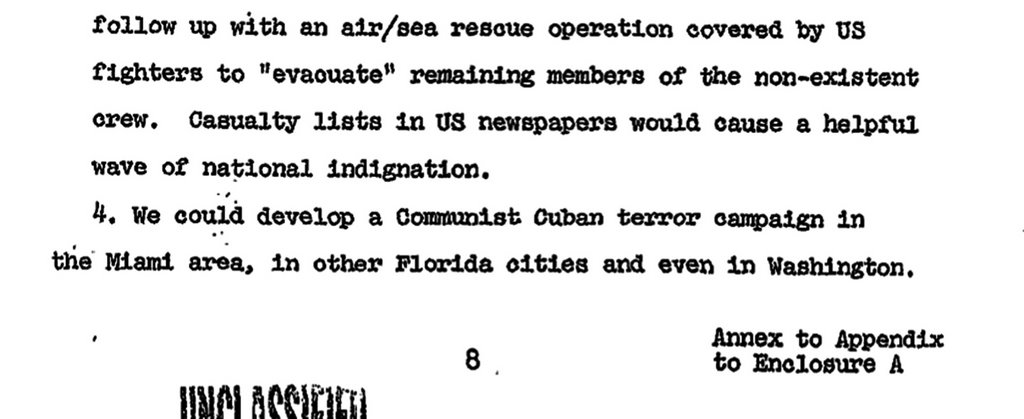
1962     The Joint Chiefs of Staff present Defense Secretary Robert McNamara with a report on Operation Northwoods — proposals for creating pretexts for action against Cuba, including some “Remember the Maine” scenarios.

1964     The President’s Commission on the Assassination of President John F. Kennedy, the Warren Commission, issues a report and 26 volumes of evidence and testimony.  The U.S.S. Maddox is apparently attacked in the Gulf of Tonkin by the Vietnamese.  The ensuing Gulf of Tonkin Resolution effectively transfers war powers from Congress to the presidency.

1968     Reverend Doctor Martin Luther King, Jr. is killed in Memphis, allegedly by James Ray.  Senator and presidential hopeful Robert F. Kennedy is shot to death in Los Angeles, allegedly by Sirhan Sirhan.

1970     Everette Howard Hunt, Jr. “retires” from the Agency to take a job with the Robert R. Mullen Company.  James McCord also retires to strike out on his own.  Both men will soon figure prominently in the Watergate scandal.

1971     The Pentagon Papers reveal the secret history of the Vietnam war.  The U.S.S. Maddox had been part of Operation Plan 34A.  34A included bombings by Thai pilots flying U.S. planes, coastal raids, and kidnappings; the military denies that provocation was the goal.  The wording of the Gulf of Tonkin Resolution was prepared by unidentified figures in the administration four months before the “attacks” occurred.

1977     Carl Bernstein reports on intelligence assets in the news media.  The New York Times reports on the Agency’s role in the publication of over 1000 books.

1979     The House Select Committee on Assassinations issues a report and 24 volumes of evidence and testimony in the murders of President Kennedy and Dr. King.  The Committee concludes that conspiracies were behind the crimes but is curiously unable to pin down details.  The Department of Justice remains inert.  Critical documents on the assassinations are classified for 50 years.

The 1980s     American hostages in Iran are released on the day President Ronald Reagan takes office.  Exposure of the Iran-contra-cocaine operation will continue into the 1990s.

1985     Liberty Lobby, the publisher of Spotlight, prevails against a defamation suit brought by Everette Howard Hunt, Jr.  A Spotlight article concerned Hunt’s lack of an alibi for November 22, 1963, and a possible C.I.A. strategy of “limited hang-out” during the House Select Committee on Assassinations hearings.  If the Committee learned too much or broke free of control, Hunt could be sacrificed.

1988     The investigative files on the murder of Senator Robert F. Kennedy are opened only to find they have been eviscerated.

The 1990s become the Decade of Disclosure.  New details emerge in the J.F.K. murder, Pearl Harbor, the Gulf of Tonkin Incident, Operation Zapata, the killing of Malcolm X, and other events.

1991     Oliver Stone’s movie, JFK, ignites intense interest in the assassination of President Kennedy.  Congress responds in 1992 with powerful new disclosure legislation.  By the time the Assassinations Records Review Board expires in 1998, they have compiled an archive of over 4.5 million pages, covering a breath-taking range of details.

1993     Elderly and ailing Loyd Jowers confesses his part in the King assassination on A.B.C.’s Prime Time with Sam Donaldson.  Jowers names others involved, some of them Memphis policemen.

1995     Critical documents on Pearl Harbor are declassified, including a 1940 action proposal from the Office of Naval Intelligence which laid out an 8-step plan to provoke the attack.  In the next few years, Congress and the military will posthumously exonerate Short and Kimmel without admitting foreknowledge of the attack.

1996     300 surviving Vietnamese commandos, recruited decades ago by the C.I.A., are belatedly compensated for their work in Op Plan 34A, which included the “attacks” in the Gulf of Tonkin.  The legislatively arranged payments prevent a trial.  A second group of commandos is paid for Op Plan 35A.

1998     James Ray dies in prison.     1999 — Loyd Jowers is found guilty in a civil suit brought by the King family, who ask for $100 in damages.     2000 — Jowers dies without ever facing questioning from state or federal authorities.

2001     Vice-President Dick Cheney heads secret meetings on energy.  The committee maps oil fields and drilling sites in Iraq and develops a list of buyers.  Henry Kissinger is named in a suit by the survivors of Chilean General Rene Schneider.  The next day, some planes crash into some buildings.

2002     U.S. survivors of Japan’s attack on the Philippines seek compensation.  They were not evacuated in 1941 so the Japanese would not suspect the U.S. had broken the Japanese codes.  Canada, England, Norway, Singapore, and Australia have already made payments to their citizens captured by Japan.  Congressional investigative documents on the murder of Dr. King remain secret.  In California, where Sirhan Sirhan is imprisoned for the murder of Robert Kennedy, a writ of habeas corpus is inching its way through the courts.  The U.S. and England agree to “fix intelligence” around the coming attack on Iraq.

2004     The aging and ailing Everette Howard Hunt, Jr. makes a written and tape-recorded confession of his knowledge of the conspiracy to kill J.F.K.  Hunt names others involved — Frank Sturgis, David Atlee Philips, Cord Meyer, David Morales, and more — all connected to the C.I.A.  Hunt dies three years later; his son discloses the tape-recording; and Hunt’s confession doesn’t make the evening news. 

2008     Oil industry executive Richard Cheney considers plans to start a war with Iran by having U.S. forces, disguised as Iranians, fire on U.S. forces.  (The J.C.S. had a similar scheme in mind for Cuba in 1962.)  Halliburton moves to Dubai, beyond the reach of U.S. enforcement agencies.  The bank bailouts begin.

2013     45th anniversary of the murders of Dr. King and Senator Kennedy.  50th anniversary of the murder of President Kennedy.

Labels: , , , , , , , , , ,

Friday, August 17, 2012

Hunting Witches with Ayn Rand

            In 2009, after the election of Barack Obama, Paul Ryan reiterated his great admiration for Ayn Rand, the high priestess of greed.  According to Ryan, Rand’s work shows clearly the moral justification for capitalism.  (http://crooksandliars.com/leah-nelson/true-confessions-i-was-ayn-rand-fangir)

            In The Fountainhead and Atlas Shrugged, Rand depicts a world run by an elite, the prime movers of society, to whom all lesser persons ought to be grateful.
            It should not be surprising, then, that Ayn Rand appeared before the House Un-American Activities Committee in 1947 as a friendly witness against communist influences in Hollywood.  Nor should it be surprising that she really didn’t know what she was talking about.
            At the request of HUAC, Rand watched a movie, Song of Russia, produced by Louis B. Mayor in 1943.  She then told the committee her reactions.  She described it as a work of propaganda that inaccurately portrayed life in the Soviet Union.  
            The hero of the movie, an American conductor played by Robert Taylor, goes to Russia — first to Moscow and then to a farming village.  In Moscow, he finds large, clean, prosperous-looking buildings.  He dines at a splendid restaurant.  He sees no bread lines, no ragged children.  Rand told HUAC that in the village:

You see the happy peasants.  You see they are meeting the hero at the station with bands, with beautiful blouses and shoes, such as they never wore anywhere.  You see children with operetta costumes on them and with a brass band which they could never afford.  You see the manicured starlets driving tractors and the happy women who come from work singing.  You see a peasant at home with a close­up of food for which anyone there would have been murdered.  If anybody had such food in Russia in that time he couldn't remain alive, because he would have been torn apart by neighbors trying to get food…
— www.noblesoul.com/orc/texts/huac.html

            The movie also shows peasants freely practicing their religious beliefs, scenes for which Rand expressed justifiable distain.
            In fact, Rand’s account of the movie was accurate in all but the most important respect. 
            Song of Russia was indeed propaganda — because it was one of three movies commissioned by the United States government to counteract prior propaganda and present our World War II ally in a favorable light.  Hollywood did its patriotic duty and made:

Song of Russia, Mission to Moscow, and North Star, written by Lillian Hellman.  Hellman’s script was extensively rewritten.  The words “socialism” and “communism” were deleted; the ending was changed; songs were added; the movie very nearly became a musical Western!  During the Red Scare following World War II, North Star, as tepid as it was, was cited as an example of communist influence in the film industry.  National Telefilm Associates bought North Star and completely sterilized it.  Every use of the word “comrade” was cut; footage of Soviet intervention into Hungary was spliced in; a voice-over warned about the growing danger in the East.  (Dan Georgakas, “The Revisionist Releases of North Star,” Cineaste, April 1996, Vol. 22, #1, p. 46)  The transition was complete.  A claim about the chocolate ration was changed.
How the West was Lost, Jerrold Smith

            The investigations of Hollywood to expose imaginary communist subversion actually served as cover for the very real infiltration of the movie industry by the Central Intelligence Agency and the Federal Bureau of Investigation.  However unwittingly, Ayn Rand served their cause.
            Catholic Republican Vice-Presidential candidate Paul Ryan has recently found it expedient to distance himself from atheist Ayn Rand.  Nevertheless, Paul Ryan is still out there, still hunting witches.  He seeks higher office, the better to pursue them.

Labels: , , ,

Monday, November 26, 2007

The Trap

Q: What do Sigmund Freud, Edward Bernays, the Central Intelligence Agency, Milton Friedman, game theory, the Cold War, R. D. Laing, Prozac, Margaret Thatcher, Bill Clinton, Isaiah Berlin, Henry Kissinger, al Qaeda, Michael Ledeen, economic models of human interactions, and shock therapy have in common?

A: They are all part of a remarkable series of B.B.C. documentaries on social engineering by filmmaker Adam Curtis: The Century of the Self,* The Power of Nightmares, and The Trap. Curtis examines the evolving theories of human motivation as they have been applied by admen, politicians, and intelligence agencies over the last 80 years. The result is a broad and disturbing view of the beliefs behind modern social control mechanisms.

From Sigmund Freud to market theories to fundamentalism, notions held by humans about humans have grown ever more abstract and therefore ever more removed from human experience. Furthermore, widely held beliefs have a certain Pygmalion effect** whether or not they are true. Therefore, they present the risk of incestuous influence — the tendency of institutions to believe their own propaganda or to craft stories to promote narrow interests. Organizational principles in one sphere of human activity do not necessarily carry over into other realms. For example, game theory used by the U.S. and Russia to reduce the threat of nuclear war was based on the assumption that an opponent will always cheat. (If the goal was to avoid war, I’m not sure the Russians were our “opponents”; but that is a question for another time.) Curtis shows how market models of control based on a similar assumption — that people are entirely motivated by self-interest — lead to atomization of society and denial of community.***

So, as the world hurtles backward to 1984, take some time to watch Curtis’s films. After all, if both the “good guys” and the “bad guys” knowingly benefit from the same belief system, maybe it’s time to rethink the system.


The Century of the Self:

Part 1 Part 2 Part 3 Part 4


The Power of Nightmares:

Part 1 Part 2 Part 3


The Trap is available at:

http://adamcurtistrap.blogspot.com/

and

http://www.goodreads.ca/adamcurtis/


____________________
* See “Why Are We In Iraq,” The Chair-Herding Pictures, 3/21/2007
** In Greek mythology, Pygmalion was a prince of Cyprus and a sculptor. He fell in love with a statue of a woman he named Galatea. The goddess Aphrodite granted Pygmalion’s wish and brought the statue to life.
*** It also invites corruption. Consider Enron. Executives were rewarded for improving the company’s bottom line, but that did not lead to efficiency. It led to executives gaming the system to maximize personal profits. They made a killing by killing the company.

____________________

Labels: , , , , , , ,

Wednesday, November 21, 2007

Lies My TV Told Me

A week or so ago, while I was watching WTTW in Chicago, the station ran a “teaser” — a preview of an upcoming show. Commentator John Callaway had interviewed Tim Weiner about Weiner’s new book, Legacy of Ashes: The History of the CIA. But when I heard them talking about President John Kennedy, my heart sank. The anniversary of Kennedy’s murder was approaching. I realized that it was time once again for main-stream media to smear the Kennedys.

Weiner offered the ridiculous claim that we will probably never really know what happened to J.F.K. and denied that declassified files shed any new light on the assassination, thereby proving he hadn’t done any homework. Then he accused John and Robert Kennedy of using the C.I.A. to threaten or kill foreign leaders.

Callaway didn’t do any homework, either. He did not, for example, ask Weiner about C.I.A. officer Everette Howard Hunt, Jr.’s confession in the case. He did not ask about any of the Agency figures identified by Hunt, like Cord Meyer, Frank Sturgis, William Harvey, and David Atlee Phillips. Callaway did not ask about Phillips’s admission, nearly thirty years ago, that the so-called “Mexico City” trip made by the alleged assassin was a fabrication. Other officers or assets have confessed knowledge of or participation in the assassination, but Callaway didn’t ask about any of them.

The Central Intelligence Agency killed President John Kennedy and Senator Robert Kennedy. After extensive investigations, the Agency exonerated itself in each case and reporters have duly reiterated the C.I.A.’s findings for decades. So, if you missed Callaway’s interview, don’t worry. There will be more such exercises in news fiction next year, around Thanksgiving.


___________________

Labels: , , , ,

Wednesday, March 21, 2007

Why Are We In Iraq?

Why are We in Vietnam?, by Norman Mailer, was published in 1967. His protagonist is a Texas teenager on a hunting trip in Alaska before he is sent to fight on the other side of the world. The Dallas Times described it as “[a] shattering social commentary…The book is a tour de force, a treatise on human nature, society, and war in flip disguise.”

No such book has yet been written about Iraq, so the task has fallen to me. My protagonist, D, is the son of illegal aliens, brought to the United States in the early 1920s and educated in Indiana. A gifted student with an interest in medicine, he becomes a prominent psychologist just as the ideas of Sigmund Freud are taking hold in the United States. In the aftermath of World War II, D is recruited by the U.S. Army to assist in a massive study of returning veterans. D corresponds with Anna Freud and takes a job with Sigmund Freud’s nephew, Edward Bernays, the father of public relations. In 1951, when Bernays is hired by United Fruit to build public support for a coup in Guatemala, D advises C.I.A. officer Everette Howard Hunt, Jr. on propaganda operations in the target nation.

D becomes wealthy with his own public relations firm. He also works for the C.I.A. occasionally, assisting in domestic operations. Meanwhile, the idea of controlling society by countering destructive subconscious impulses is replaced by another concept: Docility produced by manufacturing and then sating consumer desires, giving the population a sense of choice and self-worth. D sees no contradiction in this paradigm shift; he has long since internalized the belief that the ruling elite, although comprised of individuals, is somehow free of the primitive emotions that motivate everyone else. When the paradigm changes again with the rise of the human potential movement, D unhesitatingly finds a way to turn that into an ad campaign. In the course of his career, D never encounters a theory of human behavior that he can’t use for the benefit of his clients.

At the age of 75, he is consulted on ways to sell the first invasion of Iraq to the American public. He comes up with the pitch that Iraqi soldiers in Kuwait had dumped premature babies out of incubators and sent those incubators to Iraq. It works like a charm. Seven months before the second invasion, he succumbs to pneumonia. He dies believing that democracy is dangerous because ordinary people cannot be trusted to make informed, responsible decisions. For their own good, people must be given the illusion of choice without the prospect of choice.

I have no intention of writing the book I’ve described. But I did grow up in America during the ascension of Freudian thought. My stepfather was a clinical psychologist and my mother was a psychiatric nurse. For a time, my family lived in an apartment building for hospital staff on the grounds of Longcliff State Hospital, the largest state hospital in Indiana. I also grew up in the late stages of the Red Scare propaganda campaign that led to the invasion of Vietnam.

And unfortunately, Edward Bernays and Everette Howard Hunt, Jr. are not figments of my imagination. Nor is Anna Freud. More distressing, people like D certainly exist. Throughout the ages, business and government have sought techniques to manage public perceptions.

True or false or a bit of both, all models of motivation accepted by a significant faction of any society wield influence, if only because they have a Pygmalion effect. Even so, some general principles have been understood for centuries. Fear and secrecy, for example, have long been known to influence behavior.

Baseball season approaches, so I will close with a baseball analogy. Wrigley Field in Chicago is the home of the Chicago Cubs. It’s an old stadium with regularly spaced columns to support the upper decks. If you end up sitting behind one of those columns, you have an obstructed view. You may have to lean left or right to follow a play; you may miss a key play completely.

Mass media consolidation is building a Media Wrigley Field with much wider columns so all but prime ticket holders will have an obstructed view of the field.

If you can’t wait for my non-existent book, you can still watch a remarkable four-part series by the B.B.C. titled “The Century of the Self,” about the advent and success of modern public relations — or perception management or whatever spin is called these days. The series is available through Google video at the following addresses.


Part 1 http://video.google.com/videoplay?docid=-2637635365191428174
Part 2 http://video.google.com/videoplay?docid=-678466363224520614
Part 3 http://video.google.com/videoplay?docid=-6111922724894802811
Part 4 http://video.google.com/videoplay?docid=1122532358497501036


Our founding fathers thought that a successful democracy required an informed public. Suppose they were right. How, then, are we to judge our democracy today?


____________________

Labels: , , ,

Friday, July 14, 2006

Remember the Maine

On Wednesday, 7/5/2006, Amy Goodman from Democracy Now! reported on U.S. government planning for intervention in Cuba upon the death of Fidel Castro.

In 1962, the Joint Chiefs of Staff presented a summary of Operation Northwoods to Secretary of Defense Robert McNamara. An excerpt from that document appears above. The Chiefs outlined a number of plans to create a pretext for an attack against Cuba, including a “Remember the Maine” scheme. During Cuba’s war for independence from Spain, the U.S. sank one of its own ships, the Maine, in Havana harbor and blamed it on Spain. The public was outraged; the result was the Spanish-American War of 1898. That is how we acquired Puerto Rico and, for a while, the Philippines. In 1962, the U.S. military remembered the Maine and was considering some variations of the scam.

The Chiefs pondered a “Communist Cuban terror campaign” in the U.S. — shooting some people or staging bombings. With spectacular irony, they noted: “Exploding a few plastic bombs in carefully chosen spots, the arrest of Cuban agents and the release of prepared documents substantiating Cuban involvement also would be helpful in projecting the idea of an irresponsible government.”

Of course, the military was not the only federal entity developing plans to deceive the American public. The Central Intelligence Agency was thinking along similar lines, and some declassified material on their activities has surfaced. But for now, I want to focus on one item of Operation Northwoods — the downing of a commercial passenger plane and the loss of all aboard.

Witting passengers with fraudulent papers would board a plane. That plane would fly toward Cuban airspace, followed by a drone plane carrying a bomb. The passenger plane would descend below radar range and proceed to a military base in Florida. The drone would transmit a “May Day” message and then explode. Alternatively, a U.S. fighter could be “jumped” by MIGs from Cuba. In either scenario, the Navy could:

In 1959, a Marine radar operator defected to the Soviet Union. After he returned to the United States, he became the sole member of the Fair Play for Cuba Committee in New Orleans and then allegedly killed President John Kennedy. The Marine was killed by a Dallas nightclub owner named Jacob Rubenstein — aka Jack Ruby. In the investigation which followed, Ruby told the Warren Commission about a trip he took to Cuba in 1959, “during our good times:”

Was in harmony with our enemy of the present time. As a matter of fact, the U.S. Government was wanting persons to help them at that particular time when they threw out the dictator. [Fulgencio] Batista. (Warren Commission Volume 5, p. 202)

What? The U.S. government wanted people to help Castro overthrow Batista?

Fulgencio Batista lost the support of his own military and therefore the support of the U.S. intelligence community. The idea — in Washington — was to replace him with a transitional figure who would then be supplanted by another Batista.

Castro’s first offense was the purchase of oil from Russia. When U.S. companies in Cuba refused to refine the oil, Castro nationalized the refineries. This was followed by nationalization of other U.S. businesses, including establishments run by organized crime. President Eisenhower authorized covert operations against Cuba in 1959. Operation Zapata, the invasion at the Bay of Pigs, was supposed to be the “October Surprise” of 1960, vaulting Vice-President Richard Nixon into the White House. But the plans were not completed in time; the invasion was postponed; and Zapata was transformed into an operation to compel military action by the incoming administration. President Kennedy refused overt U.S. military aid to Operation Zapata in 1961. He refused to invade Cuba during the missile crisis of October, 1962; and he was planning withdrawal from Vietnam. Killing Kennedy in 1963 turned out to be far more cost effective than killing Castro.

On the day Kennedy was gunned down, a full-page, black-bordered advertisement appeared in the Dallas Morning News, listing a dozen loaded questions for the President. (Warren Commission Exhibit 1031, Warren Report, p. 294) The last question was this:

Why have you scrapped the Monroe Doctrine in favor of the “Spirit of Moscow”?

Promulgated in 1823, the Monroe Doctrine was a declaration of U.S. regional hegemony. Turning away from that creed, Kennedy opposed interests which had profited from Latin America and plagued Latin America for over a century. Meanwhile, similar circumstances — an illegitimate government, an agriculture-based economy, and drug traffic — existed in other locales of increasing U.S. involvement, Mexico and Vietnam.

Look at the broad picture. After a spate of assassinations in Mexico in 1994, former Mexican President Carlos Salinas (and strong supporter of the Free Trade Agreement) took an extended vacation abroad. His sister-in-law was arrested in Switzerland when she tried to withdraw $80 million from one of her husband’s various numbered accounts under false names. The Swiss had targetted the account for investigation of possible money laundering.

Salinas ended up in Ireland, where he granted an interview to a reporter from The New York Times (1/31/1997). He described a tremendous power struggle in Mexico, and added an amazing personal note. When his wife became pregnant, the couple went to Cuba so their daughter could be

“born in a country of dignified people who love their sovereignty.”

What on earth did he mean by that?! Isn’t Mexico a sovereign nation? Why didn’t he choose to have his daughter born in the United States?

Fidel Castro was born in 1926; he will certainly die one day. The contest for the sovereignty of Cuba has already begun in Havana and Washington, D.C.

Is there anything, anything at all, that we wouldn’t do gain control of Cuba?

____________________

Labels: , , , , , , ,

Monday, April 17, 2006

Hide-and-Seek History

Secretary of State Colin Powell went before the United Nations in February 2003 to make the case for an invasion of Iraq. He advanced a number of claims, including statements about Iraq’s nuclear threat, which turned out to be untrue. In September 2005, he expressed regret over the episode, saying that it had damaged his reputation. Though he accepted responsibility for his presentation, he blamed his mistakes on lower-level intelligence personnel.

Now, Powell reportedly contends that he and State Department experts never believed Iraq was a nuclear threat.

On the day of Powell’s U.N. address, a British Defense Intelligence Staff document undermining his account of Iraq and al Qaeda was leaked to the press, reportedly as retaliation from a group within British intelligence who were angered by the selective use of information to support pre-determined decisions. Later, the “Downing Street Memos” emerged, confirming an agreement between England and the U.S. to “fix” intelligence around the decision to attack Iraq.

Why was contradictory information coming out of England? I thought Britain was, if not America’s ally, certainly Bush’s ally. Is there a faction of British intelligence opposed to Prime Minister Tony Blair’s policies? What’s going on?

In this short essay, and in subsequent installments, I hope to convey a sense of what’s going on — the myriad ways in which modern intelligence agencies may function. My focus will be on the C.I.A. because a great deal is known about past Agency operations. But the C.I.A. isn’t the only U.S. agency with covert capabilities. Furthermore, there are other countries in the world — England, for instance — with clandestine agencies.


A surprisingly relevant example comes from Ronald Reagan’s presidency, when the C.I.A. provided him with inflated estimates of Soviet military spending to justify Reagan’s military budgets.

When the estimates finally came into question, the Agency reviewed the process by which such estimates are generated. A string of former Directors, including George Herbert Walker Bush, Sr., provided information and somewhat disturbing conclusions. The C.I.A., they said, is so secretive and compartmented that it is not possible for a Director to know everything the Agency is doing.

Obviously, that assessment could be viewed as self-serving because it smacks of plausible deniability: All of them could claim that they never wittingly passed false information to the President.

On the other hand, the assessment is plainly true, which leads to an unpleasant thought. It is an admission that, to an uncertain degree, intelligence is out of control. Or to put it another way, control doesn’t reside where one might think.

It is commonly assumed that the C.I.A. works for the President. The interaction, however, is vastly more complicated than that. At the risk of over-generalizing, it is more accurate to say that the intelligence community works for shifting alliances within the ruling elite. If a President enjoys the support of a significant faction of the elite, then the C.I.A. will generally work for him. If a President is opposed by the powers that be, the C.I.A. will oppose him, too.

Within those parameters, there is a broad range of possibilities. Consider a recent controversy, George Bush, Jr.’s apparent declassification of portions of a national intelligence estimate (N.I.E.) to rebut critics of the invasion of Iraq. Supposedly, Bush did not authorize the information to be leaked to reporters, though it is difficult to see how he expected to influence public opinion if the public could not learn about the estimate. In any case, the debate over his power to selectively declassify material overshadowed a much larger issue. The leaked information was inaccurate, and intentionally so, to justify the planned invasion. Several key administration claims — the Niger uranium story, the aluminum tubes story, the mobile laboratories story and more — were known to be suspect before Powell’s U.N. address and before Bush’s 2003 State of the Union Address. And of course, the related exposure of C.I.A. operative Valerie Plame is still under investigation.


The federal intelligence apparatus is not a monolithic entity. A number of agencies generate intelligence, and loyalties can be split in many ways. The entire “weapons of mass destruction” story looks very much like an example of agencies in conflict, and the bad guys won. The administration demanded falsified evidence. C.I.A. Director George Tenet assured Bush that the case against Iraq was a slam-dunk while Agency analysts were reaching the opposite conclusion. Once it became clear to the public that there were no weapons of mass destruction in Iraq, what happened? The administration blamed the C.I.A. for faulty intelligence; and Bush gave Tenet a medal!

The U.S. intelligence apparatus went through similar gyrations over the Tonkin Gulf incidents in 1964, when Vietnamese P.T. boats supposedly attacked a U.S. ship on the high seas. The cover-up of that hoax continues to this day, as evidenced by last year’s disclosure of a National Security Agency report on the Gulf of Tonkin intelligence.*

And in the mid-1990s, the U.S. declassified material on Pearl Harbor that proved beyond doubt the “surprise attack” was no surprise.**


In the examples related above, prevailing intelligence coalitions supported executive agendas; but that hasn’t always been the case. Sometimes, in service to narrow interests, elements of the intelligence community have attacked sitting Presidents. And sometimes, Presidents have used intelligence coalitions to manipulate the people.

Our government is composed of three branches regulated by various checks and balances because our founders understood that every one of us lives every day with an internal system of checks and balances which cannot be relied upon to produce right behavior.

Since our revolution, and particularly since World War II, intelligence entities have grown so numerous and capable that they constitute a fourth branch of government. We live in a grey world of half-heroes and half-villains, a world of deniable decisions based on debatable information from anonymous sources. Time after time after time, hidden forces dramatically affect events in ways the public never learns — or learns only when it was much too late. We can’t “vote the bastards out” thirty years after the fact. And most of them aren’t elected officials anyway.

President Dwight D. Eisenhower wrote about the growing centralization of government functions and the risk of drastic change in the political processes of the country. It was not an idle concern. The need for an informed citizenry, able to balance trust and skepticism, has never been greater — because today, as ordinary citizens, we simply cannot know who the intelligence community is serving at any given moment.

Overestimating the power of secrecy is an error, but underestimating it is a danger. Secrecy may be required from time to time, but it always presents a threat to democracy. It defeats citizen participation by turning us into spectators at a shadow play.


* “Operation Plan 34-A,” The Chair-Herding Pictures, 12/8/2005
** “A Small Price to Pay,” The Chair-Herding Pictures, 8/29/2005
____________________

Labels: , , , , , , , , , , ,

Sunday, March 05, 2006

Civil War in Iraq? Mission Accomplished!

William F. Buckley, Jr., editor at large for the far-right National Review, has declared defeat. “One can’t doubt,” he wrote on 2/24/2006, “that the American objective in Iraq has failed.” According to Buckley, the Bush administration operated on the assumptions that Iraqis would transcend their differences, cooperate to end insurgent violence, and pursue a society with religious freedom. But that hasn’t happened. And Mr. Bush, as “military leaders” are sometimes compelled to do, must “acknowledge a tactical setback, but…insist on the survival of strategic policies…And the kernel here is the acknowledgment of defeat.”

Despite the troubles in Iraq, the administration:

can defend itself historically, standing by the inherent reasonableness of the postulates. After all, they govern our policies in Latin America, in Africa, and in much of Asia…

In Buckley’s estimation, it would be better for Americans to concede defeat in Iraq than to abandon the principles which impelled us. “The killer insurgents are not entitled to blow up the shrine of American idealism.”

These claims, coming from a former C.I.A. operative who worked to undermine the Mexican government in the early 1950s, have no credibility.

By Buckley’s own account, he spent a year working under Everette Howard Hunt, Jr., one of the worst of the worst. Hunt is most famous for his Watergate caper with fellow C.I.A. officer James McCord against Richard Nixon, but Hunt has a lot of other dubious achievements. He was propaganda officer for the 1954 coup in Guatemala and the 1961 invasion of Cuba. In the mid-1980s, he sued Spotlight magazine over an article about his alleged involvement in some unpleasantness in Dallas, Texas — and lost. I’m not trying to convict Buckley by association. I’m merely noting that whatever he learned from Everette Howard Hunt, Jr. couldn’t be good.

And that makes me question Buckley’s concern for his metaphorical shrine to American idealism. What ideals does he have in mind? Toppling legitimate foreign leaders to replace them with thugs? Rigging elections? Building a better plutocracy? Raising mercenary armies and paying them with drug money? In the name of freedom and democracy, the U.S. has worked tirelessly against freedom and democracy in Latin America and elsewhere. We always have high-sounding excuses for supporting tyrants and butchers.

Buckley thinks we must preserve the “strategic policies” behind our invasion of Iraq. He doesn’t say what those policies might be, perhaps because they are insufficiently uplifting. The terrible reality is that we have no exit strategy for Iraq because we don’t plan on leaving. (Why else are we building permanent bases there?) If the United States converted to renewable energy sources tomorrow, the neo-cons would still press for occupation of Iraq, with an eye on Iran. Modern armies run on oil, and the neo-cons anticipate a lot of wars in the future. They want their hands on the oil spigot to thwart future adversaries — like Europe and China.


When we were defeated in Vietnam, some commentators lamented that our noble cause had gone tragically awry. But it was never a noble cause; it was a war built on lies from the very beginning — just as the invasion of Iraq was the bastard child of government deceit. The idea that civil war in Iraq represents a failure of U.S. policy presumes that the U.S. wants stability. Is there any reason to believe that?

____________________

Labels: , , , , , , ,

Saturday, February 18, 2006

A Short Course in Evil

Senator John McCain was a younger man once, and he fought in Vietnam. He was captured and tortured; he experienced pain. In the course of debate last year over his bill prohibiting torture, McCain said that if he was faced with being physically or psychologically tortured, he would rather be beaten.

Sleep deprivation can make a victim susceptible to confusion and manipulation. (Alleged assassin James Ray was coerced with sleep deprivation, and it didn’t produce a single mark on his body.) Physical torture may prompt a victim to speak, but it may also stimulate resistance and an urge for revenge. He might lie just to make you stop. Drugs may scramble the brain and render communication meaningless. If you really want to break a man to pieces, you must attack his mind and soul. Psychological torture leaves wounds that don’t heal.

What follows is a summary of the work of Professor Alfred McCoy, the author of A Question of Torture: C.I.A. Interrogation from the Cold War to the War on Terror. He was interviewed by Amy Goodman on Democracy Now, 2/17/2006.

ALFRED McCOY: Well, if you look at the most famous of photographs from Abu Ghraib, of the Iraqi standing on the box, arms extended with a hood over his head and the fake electrical wires from his arms, okay? In that photograph you can see the entire 50-year history of C.I.A. torture. It's very simple. He's hooded for sensory disorientation, and his arms are extended for self-inflicted pain. And those are the two very simple fundamental C.I.A. techniques, developed at enormous cost.

…Dr. Donald O. Hebb of McGill University, a brilliant psychologist, had a contract from the Canadian Defense Research Board, which was a partner with the C.I.A. in this research, and he found that he could induce a state of psychosis in an individual within 48 hours. It didn't take electroshock, truth serum, beating or pain. All he did was have student volunteers sit in a cubicle with goggles, gloves and headphones — earmuffs — so that they were cut off from their senses, and within 48 hours, denied sensory stimulation, they would suffer, first hallucinations, then ultimately breakdown.

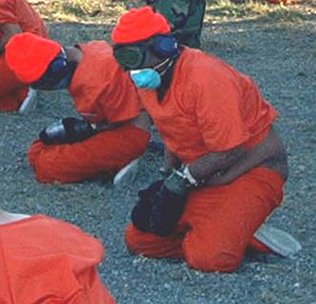
…And if you look at many of those photographs, what do they show? They show people with bags over their heads. If you look at the photographs of the Guantanamo detainees even today, they look exactly like those student volunteers in Dr. Hebb’s original cubicle.

Now, then the second major breakthrough that the C.I.A. had came here in New York City at Cornell University Medical Center, where two eminent neurologists under contract from the C.I.A. studied Soviet K.G.B. torture techniques; and they found that the most effective K.G.B. technique was self-inflicted pain. You simply make somebody stand for a day or two. And as they stand — okay, you’re not beating them, they have no resentment — you tell them, “You’re doing this to yourself. Cooperate with us, and you can sit down.” And so, as they stand, what happens is the fluids flow down to the legs, the legs swell, lesions form, they erupt, they separate, hallucinations start, the kidneys shut down.

…[S]everal of those photos you just showed, one of them with a man with a bag on his head, his arms are straight in front of him, people are standing with their arms extended, that’s self-inflicted pain. And the combination of those two techniques — sensory disorientation and self-inflicted pain — is the basis of the C.I.A.’s technique.

Aleksandr Solzhenitsyn wrote about the many forms of physical torture employed in the Soviet prison system; but the purpose of such cruelty usually had little to do with acquiring real information, since the victims were going to be convicted no matter what they said. Torture was employed to make the victims implicate others and sign confessions — or to amuse the interrogators.

Torture twists the perpetrator as well as the victim. Specialist Charles Graner is now in prison because of his actions at abu Ghraib. But before the torture scandal erupted, when he was confronted by a colleague, Graner explained, “The Christian in me says it’s wrong, but the corrections officer [in me] says, ‘I love to make a grown man piss on himself.’”

Torture techniques were refined at Guantanamo with the addition of psychologists who would participate in interrogations and identify the fears and phobias of individual prisoners. Something very like that was described by George Orwell in his great, dystopian novel 1984. The protagonist, Winston Smith, had a fear of rats. He was finally broken when his head was confined in a small cage and his tormentor was about to release a rat into the cage.

When most people imagine torture, they envision fingernails ripped out, electrodes attached to genitals, or good old-fashioned beatings. They don’t really know how fine the line is between sanity and madness; they can’t conceive of prisoners so bent and crushed that they will inflict more pain on themselves than their captors will. But that happened at abu Ghraib. A newly disclosed video shows a victim confined in a canvas bag chained to a wall. His head alone is free as he rocks back and forth, smashing his forehead against the wall.

McCOY: Look, at the start of the war on terror, the Bush administration ordered torture. President Bush said right on September 11, 2001, when he addressed the nation, “I don't care what the international lawyers say. We’re going to kick some ass.” Those were his words, and then it was up to his legal advisors in the White House and the Justice Department to translate his otherwise unlawful orders into legal directives…

They dithered with the definition of “severe” pain, deciding that severe meant “just short of death.” They insisted that torture was bound up with the intent of the perpetrator. If the torturer is seeking information, then he is not committing torture. They inserted a provision in the McCain anti-torture legislation permitting a long-discredited line of defense — if the torturer believes he is following a lawful order, he is not culpable. He’s just following orders.

Finally, in an amendment to the McCain bill, the administration declared that for the purposes of the act, Guantanamo is not part of the United States.

And that, dear reader, is how evil becomes law in a “democracy.” McCain’s bill to prohibit torture became a law to protect torturers. George Bush, Junior can declare anyone a suspect. The suspect can be held indefinitely without charges at a military facility outside the country. We can do anything we want to him. The suspect can be tried by a secret, military court and summarily executed.

You say that doesn’t sound right? Why do you hate America so much?

____________________

Labels: , , , , , , ,

Friday, January 27, 2006

Laws and Disorder

Aleksandr Solzhenitsyn, author of The Gulag Archipelago, described all too well the Soviet penchant for secrecy and its debilitating effects upon the fabric of society. Secrecy destroys the sense of community. Secret courts, secret prisons, and secret trials turn the law into a boot on the neck of the people. Freedom of speech and of the press is replaced by the right to petition the government from your cell. If a confession is all that is needed to put you away for a decade, or forever, the prosecutor doesn’t worry himself about evidence. And if even a confession is superfluous, questioning is merely an opportunity for the interrogator to have a little fun.

The Soviet system of state terror did not spring into existence overnight. It developed gradually and logically and always, of course, to defend the homeland.

By Executive Order in November of 2001, George Bush, Jr. granted himself the power to compel a military trial for any non-citizen he deems to be engaged in terrorism. The suspect would not have the protections ordinarily afforded prisoners. The trial could be secret; the evidence could be secret; and the suspect would have no right of appeal. If found guilty, he could be executed. (“End-Running the Bill of Rights,” Washington Post, 11/16/2001, p. A46)

The Bush administration, in violation of the Fourth Amendment, authorized warrantless searches of U.S. citizens — to defend the homeland, of course. Our new attorney general, until recently a counsel for George Bush, Jr., contends that torture is permissible. Alberto Gonzales argues that even without the Patriot Act, George Bush, Jr. has the authority to violate the law.

Four Muslims who were held without charges after 9/11 and then deported have returned to the U.S. to pursue a lawsuit against the government. They claim they were beaten, verbally abused, forbidden to contact their families or attorneys, and held captive even after they were cleared. When not in court, the men must remain in their hotel and may not speak about their case. So much for the First Amendment.

Last year, we learned that the Central Intelligence Agency had operated secret prisons in former Soviet client states — indeed, in former Soviet prison facilities. When the Agency’s activities were exposed, the nameless victims were moved to new dungeons, apparently in north Africa.

In a major address delivered on May 26, 2004, former Vice-President Al Gore discussed the circumstances which led to the abuses at abu Ghraib prison and elsewhere. (An audio clip from his speech follows.) Gore noted the possibility that 37 prisoners may have been murdered while in custody. More recent information, unfortunately, suggests that the number is closer to 100.

this is an audio post - click to play

Enlisted personnel were placed under the control of civilians who were not subject to the Uniform Code of Military Justice and who had been granted immunity from prosecution. A civilian contractor could commit murder or rape or bank robbery without fear of arrest. Last year, a video emerged from Iraq. Private security guards had filmed themselves as they drove around Baghdad shooting at randomly selected cars.

Iraqi General Abed Hamed Mowhoush turned himself in to U.S. forces on November 10, 2003. Sixteen days later, he was killed. Chief Warrant Officer Lewis Welshofer, Jr. put a sleeping bag over Mowhoush’s head, covered his mouth, and sat on his chest until he died. On January 23, 2006, Welshofer was convicted of negligent homicide. He was fined $6000 and sentenced to 60 days of house arrest — although he is allowed to work and attend church. Before Welshofer murdered Mowhoush, the Central Intelligence Agency brought in Iraqi assets to beat the general. A secret witness, hidden from view in court, testified at Welshofer’s trial. Defense attorney Frank Spinner asked his client about the C.I.A. and then apologized for the error. Mere mention of the C.I.A. was not permitted.

In this country not so long ago, whites enjoyed effective immunity for crimes committed against blacks. A distressingly large number of people accepted that situation as proper and even moral.

The Bush administration has launched a war against the United States of America, and they are winning. They claim immunity; they say the laws don’t apply to them. It is a measure of how far we have fallen that we can speak seriously of “authorizing” criminal acts. Our nation’s founders rebelled against such arrogance; but today, we as a people are much smaller and far more timid. Kill just a few of us, and the rest will rush to surrender their privacy, their rights, and the futures of their children.

____________________

Labels: , , , , , ,

Wednesday, January 11, 2006

The Mexican Mystery Tour

Recently, a few people have asked me about a new film, Rendezvous with Death, concerning the assassination of President John Kennedy. According to filmmaker Wilfried Huismann, Lee Harvey Oswald either volunteered or was recruited to help Cuban intelligence kill Kennedy. Seven weeks before the murder, Oswald went to Mexico City where he met a Cuban agent and was paid $6,500. The assassination investigation was short-circuited out of fear that the public would clamor for war when they learned Castro was behind the crime.

There is, of course, a big problem with that explanation: There is no evidence that Lee Oswald killed anybody.

The stories of Oswald in Mexico City are as baseless as every other aspect of the lone assassin fairytale. Supposedly, the Central Intelligence Agency photographed Oswald when he visited the Russian and Cuban embassies. But the photo of “Oswald” disclosed by the C.I.A. (left) looks nothing like Oswald. Supposedly, the C.I.A. intercepted and recorded Oswald’s telephone calls to the embassies. But after the assassination, when F.B.I. agents who had interrogated Oswald heard the Mexico City tapes, they unanimously agreed that the voice on the tapes was not Oswald’s.

The claim that Oswald was paid $6,500 came from a man identified only as “D” by the Warren Commission. “D” said that in September of 1963, he overheard a conversation in the Cuban embassy between two men, one “a tall, thin Negro with reddish hair, obviously dyed, who spoke rapidly in Spanish and English...” “D” identified the second man as Oswald. They were joined by a third man, a Cuban, who handed money to the Negro as Oswald listened to the Negro’s claim that he wanted “to kill the man”:

Oswald replied, “You’re not man enough, I can do it.” The Negro then said in Spanish, “I can’t go with you, I have a lot to do.” Oswald replied, “The people are waiting for me back there.” The Negro then gave Oswald $6,500 in large-denomination American bills, saying, “This isn’t much.” (Warren Report, pp. 307-308)

Mexican authorities, however, told the U.S. that “D” had admitted his story was a fabrication. Reportedly, “D” said that he had never seen Oswald anywhere and that his account was intended to facilitate his entry into the U.S. so he could participate in operations against Castro. He hoped his story would prompt the U.S. to “take action” against Castro.

“D” insisted that his retraction was coerced by the Mexicans. But the alleged date of his Oswald sighting, September 17 or 18, was ruled out by evidence that Oswald was in Louisiana on those dates. Besides, Oswald spoke English and Russian. How could he have had such a conversation in Spanish? And why would Castro’s agents meet Oswald at the consulate, which they would expect to be under surveillance? To further complicate matters, “D” turned out to be a Nicaraguan intelligence agent named Gilberto Alvarado Ugarte. In 1963, Nicaragua was under the thumb of Anastasio Somoza, who enjoyed the support of the U.S.

Although the Warren Commission rejected “D’s” account of Oswald and the Cubans, the Commission adopted a version of that same story involving Oswald and the Russians later in September. Credible eyewitness testimony indicated that Oswald was in Dallas at that time, not Mexico City; but the Warren Commission was undeterred. Oswald, it was said, may have met Valeriy Vladimirovich Kostikov, reportedly in charge of assassinations in the Western Hemisphere — which brings us to another absurdity from Huismann’s film. The investigation, it is claimed, was cut short because of concerns that if the public learned of Cuba’s role in the assassination, they would demand retaliation that could lead to war. Nevertheless, the Commission pondered the far more dangerous possibility of Russian involvement in the murder.

Some Cubans were certainly connected to the assassination, but they were anti-Castro Cubans, not pro-Castro Cubans. And there are still more problems with the Mexican Mystery Tour, but I won’t detail them here. I will simply close with a conversation between President Lyndon Baines Johnson and F.B.I. Director John Edgar Hoover on the very day of the assassination. Johnson asked if there was any new information about Oswald’s trip to Mexico, and Hoover replied:

No, that’s one angle that’s very confusing for this reason. We have up here the tape and the photograph of the man who was at the Soviet Embassy using Oswald’s name. That picture and the tape do not correspond to this man’s [Oswald’s] voice, nor to his appearance. In other words, it appears that there is a second person who was at the Soviet Embassy down there

Really? Someone was impersonating Oswald? Whatever for?

Labels: , , , , , ,