Tuesday, September 24, 2013

From Where We Were to Where We Are

1898     Remember the Maine.  Cuba was fighting for independence from Spain; the United States was looking for a pretext to intervene.  The U.S.S. Maine blew up and sank in Havana harbor.  The U.S. blamed Spain and thus began the Spanish-American War.  The U.S. acquired Puerto Rico and, for a time, the Philippines.

1941     The Japanese attack Pearl Harbor.  Hawaii commanders General Walter Short and Admiral Husband Kimmel are impugned for dereliction of duty but denied courts martial.  Between ‘41 and ‘45, nine investigations follow.  Congress will eventually release a 39-volume compilation of evidence and testimony.

1942     The office of Coordinator of Information becomes the Office of Strategic Services, forerunner of the Central Intelligence Agency.

Early 50s     The C.I.A. begins a heavily funded effort to gain influence in the arts and media.  The program will last nearly 20 years.  In the late 1950s, the Select Committee on Improper Activities in Labor and Management, the [John] McClellan Committee, investigates the influence of organized crime.  Senator John F. Kennedy sits on the Committee, and Robert F. Kennedy serves as counsel.  In R.F.K.’s subsequent book, The Enemy Within, he describes what he calls the Private Government.

1951     With the help of officer Everette Howard Hunt, Jr., the C.I.A. acquires film rights to George Orwell’s novels, Animal Farm and 1984.

1959     The U.S. begins anti-Cuba plots.  These will lead to Operation Zapata, the 1961 Bay of Pigs invasion, and to conspiracies to kill Fidel Castro.

1962     The Joint Chiefs of Staff present Defense Secretary Robert McNamara with a report on Operation Northwoods — proposals for creating pretexts for action against Cuba, including some “Remember the Maine” scenarios.

1964     The President’s Commission on the Assassination of President John F. Kennedy, the Warren Commission, issues a report and 26 volumes of evidence and testimony.  The U.S.S. Maddox is apparently attacked in the Gulf of Tonkin by the Vietnamese.  The ensuing Gulf of Tonkin Resolution effectively transfers war powers from Congress to the presidency.

1968     Reverend Doctor Martin Luther King, Jr. is killed in Memphis, allegedly by James Ray.  Senator and presidential hopeful Robert F. Kennedy is shot to death in Los Angeles, allegedly by Sirhan Sirhan.

1970     Everette Howard Hunt, Jr. “retires” from the Agency to take a job with the Robert R. Mullen Company.  James McCord also retires to strike out on his own.  Both men will soon figure prominently in the Watergate scandal.

1971     The Pentagon Papers reveal the secret history of the Vietnam war.  The U.S.S. Maddox had been part of Operation Plan 34A.  34A included bombings by Thai pilots flying U.S. planes, coastal raids, and kidnappings; the military denies that provocation was the goal.  The wording of the Gulf of Tonkin Resolution was prepared by unidentified figures in the administration four months before the “attacks” occurred.

1977     Carl Bernstein reports on intelligence assets in the news media.  The New York Times reports on the Agency’s role in the publication of over 1000 books.

1979     The House Select Committee on Assassinations issues a report and 24 volumes of evidence and testimony in the murders of President Kennedy and Dr. King.  The Committee concludes that conspiracies were behind the crimes but is curiously unable to pin down details.  The Department of Justice remains inert.  Critical documents on the assassinations are classified for 50 years.

The 1980s     American hostages in Iran are released on the day President Ronald Reagan takes office.  Exposure of the Iran-contra-cocaine operation will continue into the 1990s.

1985     Liberty Lobby, the publisher of Spotlight, prevails against a defamation suit brought by Everette Howard Hunt, Jr.  A Spotlight article concerned Hunt’s lack of an alibi for November 22, 1963, and a possible C.I.A. strategy of “limited hang-out” during the House Select Committee on Assassinations hearings.  If the Committee learned too much or broke free of control, Hunt could be sacrificed.

1988     The investigative files on the murder of Senator Robert F. Kennedy are opened only to find they have been eviscerated.

The 1990s become the Decade of Disclosure.  New details emerge in the J.F.K. murder, Pearl Harbor, the Gulf of Tonkin Incident, Operation Zapata, the killing of Malcolm X, and other events.

1991     Oliver Stone’s movie, JFK, ignites intense interest in the assassination of President Kennedy.  Congress responds in 1992 with powerful new disclosure legislation.  By the time the Assassinations Records Review Board expires in 1998, they have compiled an archive of over 4.5 million pages, covering a breath-taking range of details.

1993     Elderly and ailing Loyd Jowers confesses his part in the King assassination on A.B.C.’s Prime Time with Sam Donaldson.  Jowers names others involved, some of them Memphis policemen.

1995     Critical documents on Pearl Harbor are declassified, including a 1940 action proposal from the Office of Naval Intelligence which laid out an 8-step plan to provoke the attack.  In the next few years, Congress and the military will posthumously exonerate Short and Kimmel without admitting foreknowledge of the attack.

1996     300 surviving Vietnamese commandos, recruited decades ago by the C.I.A., are belatedly compensated for their work in Op Plan 34A, which included the “attacks” in the Gulf of Tonkin.  The legislatively arranged payments prevent a trial.  A second group of commandos is paid for Op Plan 35A.

1998     James Ray dies in prison.     1999 — Loyd Jowers is found guilty in a civil suit brought by the King family, who ask for $100 in damages.     2000 — Jowers dies without ever facing questioning from state or federal authorities.

2001     Vice-President Dick Cheney heads secret meetings on energy.  The committee maps oil fields and drilling sites in Iraq and develops a list of buyers.  Henry Kissinger is named in a suit by the survivors of Chilean General Rene Schneider.  The next day, some planes crash into some buildings.

2002     U.S. survivors of Japan’s attack on the Philippines seek compensation.  They were not evacuated in 1941 so the Japanese would not suspect the U.S. had broken the Japanese codes.  Canada, England, Norway, Singapore, and Australia have already made payments to their citizens captured by Japan.  Congressional investigative documents on the murder of Dr. King remain secret.  In California, where Sirhan Sirhan is imprisoned for the murder of Robert Kennedy, a writ of habeas corpus is inching its way through the courts.  The U.S. and England agree to “fix intelligence” around the coming attack on Iraq.

2004     The aging and ailing Everette Howard Hunt, Jr. makes a written and tape-recorded confession of his knowledge of the conspiracy to kill J.F.K.  Hunt names others involved — Frank Sturgis, David Atlee Philips, Cord Meyer, David Morales, and more — all connected to the C.I.A.  Hunt dies three years later; his son discloses the tape-recording; and Hunt’s confession doesn’t make the evening news. 

2008     Oil industry executive Richard Cheney considers plans to start a war with Iran by having U.S. forces, disguised as Iranians, fire on U.S. forces.  (The J.C.S. had a similar scheme in mind for Cuba in 1962.)  Halliburton moves to Dubai, beyond the reach of U.S. enforcement agencies.  The bank bailouts begin.

2013     45th anniversary of the murders of Dr. King and Senator Kennedy.  50th anniversary of the murder of President Kennedy.

Labels: , , , , , , , , , ,

Wednesday, November 21, 2007

Lies My TV Told Me

A week or so ago, while I was watching WTTW in Chicago, the station ran a “teaser” — a preview of an upcoming show. Commentator John Callaway had interviewed Tim Weiner about Weiner’s new book, Legacy of Ashes: The History of the CIA. But when I heard them talking about President John Kennedy, my heart sank. The anniversary of Kennedy’s murder was approaching. I realized that it was time once again for main-stream media to smear the Kennedys.

Weiner offered the ridiculous claim that we will probably never really know what happened to J.F.K. and denied that declassified files shed any new light on the assassination, thereby proving he hadn’t done any homework. Then he accused John and Robert Kennedy of using the C.I.A. to threaten or kill foreign leaders.

Callaway didn’t do any homework, either. He did not, for example, ask Weiner about C.I.A. officer Everette Howard Hunt, Jr.’s confession in the case. He did not ask about any of the Agency figures identified by Hunt, like Cord Meyer, Frank Sturgis, William Harvey, and David Atlee Phillips. Callaway did not ask about Phillips’s admission, nearly thirty years ago, that the so-called “Mexico City” trip made by the alleged assassin was a fabrication. Other officers or assets have confessed knowledge of or participation in the assassination, but Callaway didn’t ask about any of them.

The Central Intelligence Agency killed President John Kennedy and Senator Robert Kennedy. After extensive investigations, the Agency exonerated itself in each case and reporters have duly reiterated the C.I.A.’s findings for decades. So, if you missed Callaway’s interview, don’t worry. There will be more such exercises in news fiction next year, around Thanksgiving.


___________________

Labels: , , , ,

Friday, July 27, 2007

Non-Remembrance of Things Past

The attorney’s performance was amazing. Asked at the eleventh hour to aid the defense in a civil case, he quickly had the plaintiff’s witnesses, and the plaintiff himself, stumbling to correct their tales. But the judge wasn’t interested. It was a slander case brought by an itinerant preacher, Oliver Brindley “The Walking Bible” Owen (aka Jerry Owen), against KCOP-TV in Los Angeles. As far as Judge Jack A. Crickard was concerned, the circumstances surrounding the issue, especially the secrecy and malfeasance of the Los Angeles police, were off limits. Crickard found for the plaintiff. He ordered KCOP to pay $35,000 for reporting Owen’s possible involvement in the assassination of Senator Robert Kennedy. The defense attorneys, Michael Wayland and Vincent T. Bugliosi, lost. Yes, in 1975, Vincent Bugliosi, the man who had prosecuted the Charles Manson murder conspiracy, suspected a cover-up in R.F.K.’s death. He also faced a judge who didn’t want to hear it.

Owen’s connection to the assassination is too complex to relate here. But essentially, evidence indicated that Owen had a pre-existing relationship with Sirhan Bishara Sirhan, the man falsely convicted of killing Senator Kennedy. Owen had arranged to meet Sirhan outside the Ambassador Hotel on the night of the murder, ostensibly to sell him a horse. Bugliosi managed to bring out some information about Owen, but Crickard effectively prevented disclosure of key details. Bugliosi noted in his closing argument for KCOP that:

we are talking about a conspiracy to commit murder, a conspiracy to assassinate someone who was a major candidate for the presidency of the United States, a conspiracy the prodigious dimensions of which would make Watergate look like a one-roach marijuana case.

In fact, before the trial, when another judge had ordered a review of the ballistics evidence in R.F.K.’s death, Bugliosi told the press:

Gentlemen, the time for us to keep on looking for additional bullets in this case has passed. The time has come for us to start looking for the members of the firing squad that night.

Vincent Bugliosi had no trouble recognizing a cover-up in Senator Kennedy’s assassination. And he learned that searching for the truth brought ridicule, not praise. A few weeks after the Owen vs. KCOP trial, he announced his candidacy for district attorney, pledging to uncover the facts in Robert Kennedy’s murder. The Los Angeles Times opposed him, claiming that “Bugliosi believes he has an emotional issue that he can exploit” in his quest for office. Bugliosi lost the election.

Three decades later, Bugliosi has redeemed himself; and he is no longer a conspiracy buff. This year, he published Reclaiming History: the Assassination of John F. Kennedy. Weighing in at 1,612 pages, Reclaiming History is nearly twice as long as the Warren Report on President Kennedy’s murder. Drawing out the lie at greater length, however, doesn’t make it true. It remains an embarrassment of errors, omissions, and faulty reasoning.

Bugliosi appeared on the Colbert Report (6/21/2007) to promote his work, and he began by listing a number of “facts” which are simply not facts at all. And since Bugliosi is convinced that alleged assassin Lee Oswald acted alone, I couldn’t help wondering how he explains C.I.A. officer Everette Howard Hunt, Jr.’s confession in the J.F.K. murder. Alas, the topic never came up. Colbert cracked jokes; and Bugliosi responded in kind, calling Colbert a “clone of Oliver Stone.”

It was an odd remark considering Bugliosi’s work on the assassination of Robert Kennedy. Maybe, I thought, Stone is a clone of Bugliosi! — the young Bugliosi who recognized when a case was fixed.

__________
For an extensive account of Oliver Owen and Bugliosi’s role in the case, see The Assassination of Robert F. Kennedy: the Conspiracy and Coverup, by William Turner and Jonn Christian. It is full of information on the crime and praise for Bugliosi. Has Vincent forgotten the Walking Bible?

Sometimes, coincidences seem to stretch out forever, don’t they? For example, Oliver Owen had a friend named Gail Aiken. One of her brothers was William Bremer, Jr., who was convicted of a confidence swindle. His lawyer was Ellis Rubin. Rubin later represented Frank Sturgis, Bernard Barker, Eugenio Martinez, and Virgilio Gonzalez after they were caught in the Watergate Hotel.

Gail had another brother, Arthur, the man who shot presidential candidate George Wallace in 1972. Everette Howard Hunt, Jr., of J.F.K. assassination fame and another Watergate burglar, was sent to search Arthur’s home after the shooting to find evidence implicating the Democrats. But Arthur Bremer turned out to be merely another lone nut seeking fame. Like Lee Oswald and Sirhan Sirhan, Arthur Bremer supposedly really wanted to kill Richard Nixon, but settled for another victim instead. It’s amazing how many lone assassins in America wanted to kill Richard Nixon but ended up killing somebody else.

____________________

Labels: , , , ,

Wednesday, May 09, 2007

The Mighty Wurlitzer

C.I.A. officer David Atlee Phillips called it The Mighty Wurlitzer. Put in a quarter and it would play your favorite tunes over and over, across the nation, for years on end.

He was referring to the Agency’s influence on mass media, the ability to plant a story in a variety of outlets and then just keep repeating it as if it was true. In newspapers and magazines, on television and radio, through a shifting array of advocates, a thousand times a day, as though it was widely accepted, for decades if necessary. And if the Agency preferred silence, the Wurlitzer could do that, too. Deafening silence.

(Left: a 1971 Wurlitzer 3500 “Zodiac” jukebox.)

Silence is what we heard when Everette Howard Hunt, Jr. died. He named names in the assassination of President Kennedy, all of them connected to the C.I.A. He didn’t merely tell his son about the plot; he made a twenty-minute cassette recording about the murder to be released after his death. An excerpt is available now on the internet; reportedly, the entire tape will be out soon.

A.B.C., N.B.C., and C.B.S. have insisted for nearly 45 years that the official fairy tale of John Kennedy’s murder was true. The New York Times, putatively the nation’s paper of record, has pushed the story just as long. Other news outlets have done the same. Now that Hunt has joined the list of operatives who have confessed, the networks and the newspapers have nothing to say.

In 1978, David Atlee Phillips admitted that a key part of the C.I.A.’s cover story — the “lone-assassin’s” trip to Mexico City — was false; the evidence was fabricated. Phillips was in a position to know since he helped create that tale. Mainstream media still hasn’t reported it. C.I.A. contract agent Robert Morrow wrote a book about his role in the murder. It’s a pretty bad book, but that’s not the point. Morrow’s confession never turned up on the six-o’clock news.

After Oliver Stone’s movie, JFK, was released in 1991, Chauncey Holt came forward with his confession. Mainstream media responded by laughing him off and calling Stone paranoid. More than twenty years ago, C.I.A. asset Marita Lorentz testified in open court about her knowledge of Hunt’s part in the murder. Don’t tell me; let me guess. You’ve never heard of Marita Lorentz. For some reason, the Mighty Wurlitzer doesn’t mention her.

The list of confessors doesn’t stop there; but in all likelihood, you’ve never heard of them. For years, authorities have claimed that if a conspiracy had existed, someone would have talked by now. Well, several people have talked; but the Wurlitzer continues to play the old single, “No Confessions.”

Of course, there are more recent numbers on the Wurlitzer play list. A favorite these days is “We Didn’t Lie,” the soulful plaint of Agency innocence in the intelligence plot leading to the 2003 invasion of Iraq.

Former C.I.A. director George Tenet received the Medal of Freedom for his service to his country. On Sixty Minutes (4/29/2007), Tenet delivered a powerful rendition of “We Didn’t Lie”; but it lacked sincerity. A group of former intelligence officers sent a letter to Tenet about his complicity in the pre-war deception. You can read their letter on the internet, but it hasn’t gotten any play on the Wurlitzer. I have excerpted a paragraph below. After noting the C.I.A.’s collaboration with the British to “fix” the intelligence around the Iraq war policy, the writers added:

By your silence you helped build the case for war. You betrayed the CIA officers who collected the intelligence that made it clear that Saddam did not pose an imminent threat. You betrayed the analysts who tried to withstand the pressure applied by Cheney and Rumsfeld. Most importantly and tragically, you failed to meet your obligations to the people of the United States. Instead of resigning in protest, when it could have made a difference in the public debate, you remained silent and allowed the Bush Administration to cite your participation in these deliberations to justify their decision to go to war. Your silence contributed to the willingness of the public to support the disastrous war in Iraq, which has killed more than 3300 Americans and hundreds of thousands of Iraqis.

It’s hard to believe, isn’t it? Former intelligence officers think there was some sort of arrangement to deceive the American public? Whose side are they on?

____________________

Labels: , , ,

Wednesday, March 21, 2007

Why Are We In Iraq?

Why are We in Vietnam?, by Norman Mailer, was published in 1967. His protagonist is a Texas teenager on a hunting trip in Alaska before he is sent to fight on the other side of the world. The Dallas Times described it as “[a] shattering social commentary…The book is a tour de force, a treatise on human nature, society, and war in flip disguise.”

No such book has yet been written about Iraq, so the task has fallen to me. My protagonist, D, is the son of illegal aliens, brought to the United States in the early 1920s and educated in Indiana. A gifted student with an interest in medicine, he becomes a prominent psychologist just as the ideas of Sigmund Freud are taking hold in the United States. In the aftermath of World War II, D is recruited by the U.S. Army to assist in a massive study of returning veterans. D corresponds with Anna Freud and takes a job with Sigmund Freud’s nephew, Edward Bernays, the father of public relations. In 1951, when Bernays is hired by United Fruit to build public support for a coup in Guatemala, D advises C.I.A. officer Everette Howard Hunt, Jr. on propaganda operations in the target nation.

D becomes wealthy with his own public relations firm. He also works for the C.I.A. occasionally, assisting in domestic operations. Meanwhile, the idea of controlling society by countering destructive subconscious impulses is replaced by another concept: Docility produced by manufacturing and then sating consumer desires, giving the population a sense of choice and self-worth. D sees no contradiction in this paradigm shift; he has long since internalized the belief that the ruling elite, although comprised of individuals, is somehow free of the primitive emotions that motivate everyone else. When the paradigm changes again with the rise of the human potential movement, D unhesitatingly finds a way to turn that into an ad campaign. In the course of his career, D never encounters a theory of human behavior that he can’t use for the benefit of his clients.

At the age of 75, he is consulted on ways to sell the first invasion of Iraq to the American public. He comes up with the pitch that Iraqi soldiers in Kuwait had dumped premature babies out of incubators and sent those incubators to Iraq. It works like a charm. Seven months before the second invasion, he succumbs to pneumonia. He dies believing that democracy is dangerous because ordinary people cannot be trusted to make informed, responsible decisions. For their own good, people must be given the illusion of choice without the prospect of choice.

I have no intention of writing the book I’ve described. But I did grow up in America during the ascension of Freudian thought. My stepfather was a clinical psychologist and my mother was a psychiatric nurse. For a time, my family lived in an apartment building for hospital staff on the grounds of Longcliff State Hospital, the largest state hospital in Indiana. I also grew up in the late stages of the Red Scare propaganda campaign that led to the invasion of Vietnam.

And unfortunately, Edward Bernays and Everette Howard Hunt, Jr. are not figments of my imagination. Nor is Anna Freud. More distressing, people like D certainly exist. Throughout the ages, business and government have sought techniques to manage public perceptions.

True or false or a bit of both, all models of motivation accepted by a significant faction of any society wield influence, if only because they have a Pygmalion effect. Even so, some general principles have been understood for centuries. Fear and secrecy, for example, have long been known to influence behavior.

Baseball season approaches, so I will close with a baseball analogy. Wrigley Field in Chicago is the home of the Chicago Cubs. It’s an old stadium with regularly spaced columns to support the upper decks. If you end up sitting behind one of those columns, you have an obstructed view. You may have to lean left or right to follow a play; you may miss a key play completely.

Mass media consolidation is building a Media Wrigley Field with much wider columns so all but prime ticket holders will have an obstructed view of the field.

If you can’t wait for my non-existent book, you can still watch a remarkable four-part series by the B.B.C. titled “The Century of the Self,” about the advent and success of modern public relations — or perception management or whatever spin is called these days. The series is available through Google video at the following addresses.


Part 1 http://video.google.com/videoplay?docid=-2637635365191428174
Part 2 http://video.google.com/videoplay?docid=-678466363224520614
Part 3 http://video.google.com/videoplay?docid=-6111922724894802811
Part 4 http://video.google.com/videoplay?docid=1122532358497501036


Our founding fathers thought that a successful democracy required an informed public. Suppose they were right. How, then, are we to judge our democracy today?


____________________

Labels: , , ,

Tuesday, January 30, 2007

The Death of a Dangerous Man


One of the most influential criminals of our time has died of pneumonia at the age of 88.

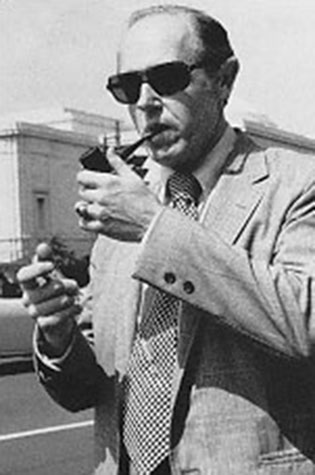
He had his fingers in several significant pieces of history that we know of, and probably others that we don’t. He was so successful that he is generally not even thought of as a criminal. He was C.I.A. officer Everette Howard Hunt, Jr. (Seen left in a photo from the 1960s.)

Hunt was in charge of the propaganda campaign accompanying the 1954 coup in Guatemala. The U.S. organized the coup, codenamed Operation Success, at the behest of the United Fruit Company to protect their holdings in Guatemala.

Hunt played a similar role in Operation Zapata, the invasion of Cuba in 1961. The C.I.A. initially assisted Fidel Castro’s insurgency against Fulgencio Batista, who had lost the support of the Cuban military. The scheme was to then replace Castro with another version of Batista. The flip-flop took on added urgency after Castro arranged to buy oil from Russia. President Eisenhower authorized the first black ops against Cuba in 1959. Zapata was supposed to take place before the 1960 elections so Vice-President Richard Nixon would be swept into the Oval Office on a wave of patriotic fervor. But preparations for the invasion bogged down, and Nixon lost the election. Zapata then became an operation against the incoming administration.

Hunt is best known for his role in the Watergate affair — the break-in at the Democratic Party headquarters in the Watergate Hotel. As I noted last month (“A Free Man,” The Chair-Herding Pictures, 12/28/2006), Hunt and senior C.I.A. officer James McCord were the key figures in the operation against Nixon.

But Watergate wasn’t Hunt’s only crime during Nixon’s presidency. During the Pentagon Papers controversy in the early 1970s, Hunt forged diplomatic cables to make it appear as though President John Kennedy was behind the assassination of Vietnamese President Ngo Dinh Diem, murdered less than three weeks before Kennedy was gunned down in Dallas.

Which brings us to Hunt’s most important and least publicized crime. On November 21, 1963, Hunt and Frank Sturgis (also of Watergate fame) arrived in Dallas to deliver the rifles used to kill Kennedy the next day.

Evidence of Hunt’s role emerged in the course of a libel suit he brought against Liberty Lobby. In 1978, Liberty Lobby published an article about a C.I.A. document concerning the need to arrange an alibi for Hunt for the day of Kennedy’s assassination. Hunt sued, and he prevailed at first. But by the time Liberty Lobby’s appeal came to trial in 1984, they had a lot more information to work with. Under informed cross-examination, Hunt’s C.I.A. witnesses crumbled. His only non-Agency witnesses were his three children, who were between the ages of 10 and 13 when Kennedy was killed. Hunt claimed he was at home with them on the day of the assassination, and together they watched the television coverage over the weekend. Yet by Hunt’s own account, his children didn’t remember that. In fact, when his children first learned of allegations of his involvement in the assassination, they confronted him and demanded to know if the accusations were true. His children were not called to testify on his behalf. The jury found for Liberty Lobby.

Shortly before Abraham Lincoln’s death, he wrote a letter in which he expressed his fear for the future of our country. As a result of the Civil War, “corporations have been enthroned and an era of corruption in high places will follow, and the money power of the country will endeavor to prolong its reign by working upon the prejudices of the people until all wealth is aggregated in a few hands and the Republic is destroyed. I feel at this moment more anxiety for the safety of my country than ever before, even in the midst of war. God grant that my suspicions may prove groundless.”

The huge increase in military spending brought about by World War II led President Eisenhower to warn us of “unwarranted power” wielded by the military/industrial complex. His successor was killed under conspicuously suspicious circumstances, and the war which followed was our longest war. Until recently, it was also our most expensive war. Today, we see increasing “corporatization” of the military and the government ostensibly for the sake of efficiency but actually to remove them from democratic control. In the face of massive debt, we see corporate figures with government titles spending obscene amounts of money for unarmored vehicles and voting machines that can’t count.

What we cannot see, though it certainly exists, is the small army of men like Everette Howard Hunt, Jr., ever ready to confuse power with patriotism.

____________________

Labels: , , , , , , , , , , ,

Thursday, December 28, 2006

A Free Man

President Gerald Ford died a free man at the age of 93, on the day after Christmas in 2006.

Ford attained his high position after President Richard Milhous Nixon’s first Vice-President, Spiro Agnew, resigned under a cloud of corruption investigations in his home state. Nixon selected then-Congressman Ford to be Vice-President. Nixon resigned under a cloud of suspicion in 1974, and Ford became President. He then granted Nixon a pardon.

Ford has been praised for his unpopular and supposedly courageous decision to pardon Nixon and “heal the nation.” But the nation wasn’t ill and didn’t need to be healed. The media huffed and puffed about a constitutional crisis, but no such crisis existed. Ford’s action served primarily to forestall public awareness of the Watergate affair and the involvement of the C.I.A. With one exception, all of the Watergate burglars were Agency officers or assets. The two men running the show, Everette Howard Hunt, Jr. and James McCord, were career intelligence officers with the highest clearance. The C.I.A. provided the burglars with money, disguises, electronic equipment, and lock-picking expertise. To this day, most people have no idea what Watergate was about.

Ford installed George Herbert Walker Bush as Director of Central Intelligence in the critical period preceding the House Select Committee on Assassinations inquiry into the murders of President John F. Kennedy and the Rev. Dr. Martin Luther King, Jr. Nixon’s chief-of-staff, H. R. Haldeman, noted that the C.I.A. obliterated a mountain of evidence connecting the Agency to Kennedy’s assassination. (Haldeman, H. R., with Joseph DiMona, The Ends of Power: Kissinger in the Nixon White House, New York, Time Books, 1978, pp. 39-40)

And Ford didn’t merely pardon Nixon for Watergate; Ford issued a blanket pardon for any crimes Nixon may have committed as President.

I can think of at least one crime Nixon may have committed as President: The U.S.-backed assassination of Chilean President Salvador Allende on 9/11/1973. Nixon’s economic efforts to “make the [Chilean] economy scream” brought hardship to Chile but failed to unseat Allende. The alternative approach, killing him, worked better.

Allende’s successor, Augusto Pinochet, recently died a free man while under investigation for “disappearing” thousands of “dissidents.” Some of the victims were foreigners from the U.S., Spain, or France. During a visit to France 28 years after Allende’s murder, Nixon’s Secretary of State, Henry Kissinger, was invited by the authorities to respond to certain inquiries. Kissinger promptly fled to Italy. Nixon died a free man in 1994. Henry Kissinger isn’t getting any younger; and he will most likely die a free man under a cloud of suspicion.


In 1963, 50-year-old Congressman Ford was appointed by President Lyndon Johnson to serve on the Warren Commission which oversaw the federal investigation of the assassination of President Kennedy. The Commissioners classified important evidence for 75 years. Commissioner Allen Dulles had served for nine years as director of the C.I.A.; he was fired by Kennedy after the Bay of Pigs fiasco. Newsweek magazine described Gerald Ford as “the C.I.A.’s best friend in Congress.”

The Warren Report became the most discredited document ever printed by the Government Printing Office, a record previously held by the Roberts Commission Report on the attack against Pearl Harbor.

When Indonesia was preparing to invade East Timor in 1975, their primary concern was U.S. opposition which might have led to the withholding of arms shipments to Indonesia. That December, Ford met Indonesian President Sukarno and gave him the green light. Ford then flew to Guam to deliver a speech on the anniversary of the surprise attack on Pearl Harbor — as Indonesia began the surprise carnage in East Timor. The death toll in East Timor, considered as a percentage of the total population, was worse than the slaughter visited upon Europe by Adolph Hitler.

Yes, Ford did grant amnesty to U.S. citizens who went to Canada to escape the draft during the invasion of Vietnam. But that lone positive gesture was more than offset by the damage he did.

Gerald Ford died a free man at the age of 93, on the day after Christmas in 2006.

____________________

Labels: , , , , , , , , , ,

Sunday, March 05, 2006

Civil War in Iraq? Mission Accomplished!

William F. Buckley, Jr., editor at large for the far-right National Review, has declared defeat. “One can’t doubt,” he wrote on 2/24/2006, “that the American objective in Iraq has failed.” According to Buckley, the Bush administration operated on the assumptions that Iraqis would transcend their differences, cooperate to end insurgent violence, and pursue a society with religious freedom. But that hasn’t happened. And Mr. Bush, as “military leaders” are sometimes compelled to do, must “acknowledge a tactical setback, but…insist on the survival of strategic policies…And the kernel here is the acknowledgment of defeat.”

Despite the troubles in Iraq, the administration:

can defend itself historically, standing by the inherent reasonableness of the postulates. After all, they govern our policies in Latin America, in Africa, and in much of Asia…

In Buckley’s estimation, it would be better for Americans to concede defeat in Iraq than to abandon the principles which impelled us. “The killer insurgents are not entitled to blow up the shrine of American idealism.”

These claims, coming from a former C.I.A. operative who worked to undermine the Mexican government in the early 1950s, have no credibility.

By Buckley’s own account, he spent a year working under Everette Howard Hunt, Jr., one of the worst of the worst. Hunt is most famous for his Watergate caper with fellow C.I.A. officer James McCord against Richard Nixon, but Hunt has a lot of other dubious achievements. He was propaganda officer for the 1954 coup in Guatemala and the 1961 invasion of Cuba. In the mid-1980s, he sued Spotlight magazine over an article about his alleged involvement in some unpleasantness in Dallas, Texas — and lost. I’m not trying to convict Buckley by association. I’m merely noting that whatever he learned from Everette Howard Hunt, Jr. couldn’t be good.

And that makes me question Buckley’s concern for his metaphorical shrine to American idealism. What ideals does he have in mind? Toppling legitimate foreign leaders to replace them with thugs? Rigging elections? Building a better plutocracy? Raising mercenary armies and paying them with drug money? In the name of freedom and democracy, the U.S. has worked tirelessly against freedom and democracy in Latin America and elsewhere. We always have high-sounding excuses for supporting tyrants and butchers.

Buckley thinks we must preserve the “strategic policies” behind our invasion of Iraq. He doesn’t say what those policies might be, perhaps because they are insufficiently uplifting. The terrible reality is that we have no exit strategy for Iraq because we don’t plan on leaving. (Why else are we building permanent bases there?) If the United States converted to renewable energy sources tomorrow, the neo-cons would still press for occupation of Iraq, with an eye on Iran. Modern armies run on oil, and the neo-cons anticipate a lot of wars in the future. They want their hands on the oil spigot to thwart future adversaries — like Europe and China.


When we were defeated in Vietnam, some commentators lamented that our noble cause had gone tragically awry. But it was never a noble cause; it was a war built on lies from the very beginning — just as the invasion of Iraq was the bastard child of government deceit. The idea that civil war in Iraq represents a failure of U.S. policy presumes that the U.S. wants stability. Is there any reason to believe that?

____________________

Labels: , , , , , , ,