Wednesday, October 25, 2006

An Open Letter to the Editor of The Progressive

Earlier this month, The Progressive ran an article by Matthew Rothschild dismissing conspiracy theories about the attacks of September 11, 2001. ("Enough Conspiracy Theories, Already," October 2006, p. 39) Rothschild lauded the work of Popular Mechanics's editors James Meigs and David Dunbar and the computer simulation of the Pentagon crash made at Purdue University.

On September 11, 2006, Democracy Now aired a debate pitting Meigs and Dunbar against Dylan Avery and Jason Bermas. Avery and Bermas created the film Loose Change, which examines many of the questions surrounding 9/11. Meigs's and Dunbar's performance was telling. They did not present a single photo, video, audio file, chart, or transcript in support of their position. They didn't even show any of the pictures from their website, no doubt because of the problematic nature of those pictures. The Purdue simulation was seriously flawed. It did not take into account any of the six exterior walls penetrated on 9/11. Worse, it depicted two physical impossibilities — treating the wings of American Airlines Flight 77 as essentially rigid bodies moving into the building at the same angle they presented when attached to the plane.

I sent a letter to the editor of The Progressive. Of course, I could not address all the mistakes in the article; but I could rebut a central premise. Thus far, The Progressive has not acknowledged receipt of my letter. I have reproduced it below.


Pooh-poohing 9/11 conspiracy theories, Matthew Rothschild (October 2006) quoted Napoleon to the effect that malice should not be construed where incompetence is likely, thereby declaring a host of federal agencies incompetent.

Enough coincidence theories already. The truth is that large conspiracies are usually not kept secret. They are merely kept safe from prosecution.

In 1995, the U.S. declassified critical documents on Pearl Harbor. They prove beyond peradventure of doubt that the U.S. cracked Japan’s codes a full year before the day that will live in infamy. The U.S. intercepted and decoded nearly all of Japan’s attack related messages — including the Imperial order sending the First Air Carrier Fleet to Hawaii. Indeed, in October of 1940, the U.S. began planning to provoke just such an attack. The U.S. knew to the day and to the hour when the bombs were going to fall. In the opinion of the high command, Pearl Harbor was a small price to pay for future U.S. interests in the Pacific.

George Bush, Jr., Henry Kissinger, and others declared 9/11 the new Pearl Harbor because it was the new Pearl Harbor.


____________________

Labels: , , , , ,

Friday, July 14, 2006

Remember the Maine

On Wednesday, 7/5/2006, Amy Goodman from Democracy Now! reported on U.S. government planning for intervention in Cuba upon the death of Fidel Castro.

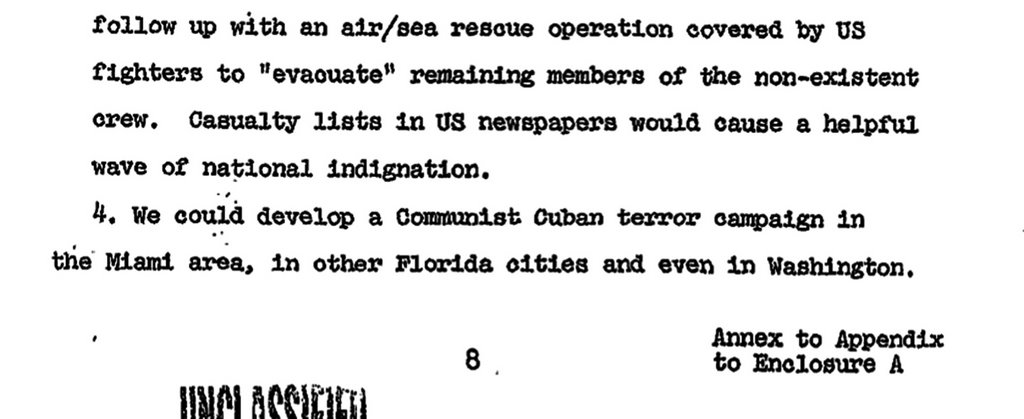
In 1962, the Joint Chiefs of Staff presented a summary of Operation Northwoods to Secretary of Defense Robert McNamara. An excerpt from that document appears above. The Chiefs outlined a number of plans to create a pretext for an attack against Cuba, including a “Remember the Maine” scheme. During Cuba’s war for independence from Spain, the U.S. sank one of its own ships, the Maine, in Havana harbor and blamed it on Spain. The public was outraged; the result was the Spanish-American War of 1898. That is how we acquired Puerto Rico and, for a while, the Philippines. In 1962, the U.S. military remembered the Maine and was considering some variations of the scam.

The Chiefs pondered a “Communist Cuban terror campaign” in the U.S. — shooting some people or staging bombings. With spectacular irony, they noted: “Exploding a few plastic bombs in carefully chosen spots, the arrest of Cuban agents and the release of prepared documents substantiating Cuban involvement also would be helpful in projecting the idea of an irresponsible government.”

Of course, the military was not the only federal entity developing plans to deceive the American public. The Central Intelligence Agency was thinking along similar lines, and some declassified material on their activities has surfaced. But for now, I want to focus on one item of Operation Northwoods — the downing of a commercial passenger plane and the loss of all aboard.

Witting passengers with fraudulent papers would board a plane. That plane would fly toward Cuban airspace, followed by a drone plane carrying a bomb. The passenger plane would descend below radar range and proceed to a military base in Florida. The drone would transmit a “May Day” message and then explode. Alternatively, a U.S. fighter could be “jumped” by MIGs from Cuba. In either scenario, the Navy could:

In 1959, a Marine radar operator defected to the Soviet Union. After he returned to the United States, he became the sole member of the Fair Play for Cuba Committee in New Orleans and then allegedly killed President John Kennedy. The Marine was killed by a Dallas nightclub owner named Jacob Rubenstein — aka Jack Ruby. In the investigation which followed, Ruby told the Warren Commission about a trip he took to Cuba in 1959, “during our good times:”

Was in harmony with our enemy of the present time. As a matter of fact, the U.S. Government was wanting persons to help them at that particular time when they threw out the dictator. [Fulgencio] Batista. (Warren Commission Volume 5, p. 202)

What? The U.S. government wanted people to help Castro overthrow Batista?

Fulgencio Batista lost the support of his own military and therefore the support of the U.S. intelligence community. The idea — in Washington — was to replace him with a transitional figure who would then be supplanted by another Batista.

Castro’s first offense was the purchase of oil from Russia. When U.S. companies in Cuba refused to refine the oil, Castro nationalized the refineries. This was followed by nationalization of other U.S. businesses, including establishments run by organized crime. President Eisenhower authorized covert operations against Cuba in 1959. Operation Zapata, the invasion at the Bay of Pigs, was supposed to be the “October Surprise” of 1960, vaulting Vice-President Richard Nixon into the White House. But the plans were not completed in time; the invasion was postponed; and Zapata was transformed into an operation to compel military action by the incoming administration. President Kennedy refused overt U.S. military aid to Operation Zapata in 1961. He refused to invade Cuba during the missile crisis of October, 1962; and he was planning withdrawal from Vietnam. Killing Kennedy in 1963 turned out to be far more cost effective than killing Castro.

On the day Kennedy was gunned down, a full-page, black-bordered advertisement appeared in the Dallas Morning News, listing a dozen loaded questions for the President. (Warren Commission Exhibit 1031, Warren Report, p. 294) The last question was this:

Why have you scrapped the Monroe Doctrine in favor of the “Spirit of Moscow”?

Promulgated in 1823, the Monroe Doctrine was a declaration of U.S. regional hegemony. Turning away from that creed, Kennedy opposed interests which had profited from Latin America and plagued Latin America for over a century. Meanwhile, similar circumstances — an illegitimate government, an agriculture-based economy, and drug traffic — existed in other locales of increasing U.S. involvement, Mexico and Vietnam.

Look at the broad picture. After a spate of assassinations in Mexico in 1994, former Mexican President Carlos Salinas (and strong supporter of the Free Trade Agreement) took an extended vacation abroad. His sister-in-law was arrested in Switzerland when she tried to withdraw $80 million from one of her husband’s various numbered accounts under false names. The Swiss had targetted the account for investigation of possible money laundering.

Salinas ended up in Ireland, where he granted an interview to a reporter from The New York Times (1/31/1997). He described a tremendous power struggle in Mexico, and added an amazing personal note. When his wife became pregnant, the couple went to Cuba so their daughter could be

“born in a country of dignified people who love their sovereignty.”

What on earth did he mean by that?! Isn’t Mexico a sovereign nation? Why didn’t he choose to have his daughter born in the United States?

Fidel Castro was born in 1926; he will certainly die one day. The contest for the sovereignty of Cuba has already begun in Havana and Washington, D.C.

Is there anything, anything at all, that we wouldn’t do gain control of Cuba?

____________________

Labels: , , , , , , ,

Saturday, February 18, 2006

A Short Course in Evil

Senator John McCain was a younger man once, and he fought in Vietnam. He was captured and tortured; he experienced pain. In the course of debate last year over his bill prohibiting torture, McCain said that if he was faced with being physically or psychologically tortured, he would rather be beaten.

Sleep deprivation can make a victim susceptible to confusion and manipulation. (Alleged assassin James Ray was coerced with sleep deprivation, and it didn’t produce a single mark on his body.) Physical torture may prompt a victim to speak, but it may also stimulate resistance and an urge for revenge. He might lie just to make you stop. Drugs may scramble the brain and render communication meaningless. If you really want to break a man to pieces, you must attack his mind and soul. Psychological torture leaves wounds that don’t heal.

What follows is a summary of the work of Professor Alfred McCoy, the author of A Question of Torture: C.I.A. Interrogation from the Cold War to the War on Terror. He was interviewed by Amy Goodman on Democracy Now, 2/17/2006.

ALFRED McCOY: Well, if you look at the most famous of photographs from Abu Ghraib, of the Iraqi standing on the box, arms extended with a hood over his head and the fake electrical wires from his arms, okay? In that photograph you can see the entire 50-year history of C.I.A. torture. It's very simple. He's hooded for sensory disorientation, and his arms are extended for self-inflicted pain. And those are the two very simple fundamental C.I.A. techniques, developed at enormous cost.

…Dr. Donald O. Hebb of McGill University, a brilliant psychologist, had a contract from the Canadian Defense Research Board, which was a partner with the C.I.A. in this research, and he found that he could induce a state of psychosis in an individual within 48 hours. It didn't take electroshock, truth serum, beating or pain. All he did was have student volunteers sit in a cubicle with goggles, gloves and headphones — earmuffs — so that they were cut off from their senses, and within 48 hours, denied sensory stimulation, they would suffer, first hallucinations, then ultimately breakdown.

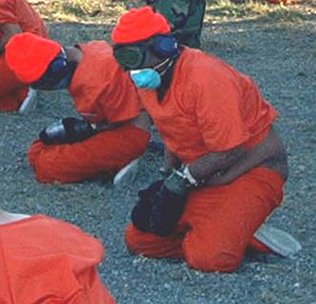
…And if you look at many of those photographs, what do they show? They show people with bags over their heads. If you look at the photographs of the Guantanamo detainees even today, they look exactly like those student volunteers in Dr. Hebb’s original cubicle.

Now, then the second major breakthrough that the C.I.A. had came here in New York City at Cornell University Medical Center, where two eminent neurologists under contract from the C.I.A. studied Soviet K.G.B. torture techniques; and they found that the most effective K.G.B. technique was self-inflicted pain. You simply make somebody stand for a day or two. And as they stand — okay, you’re not beating them, they have no resentment — you tell them, “You’re doing this to yourself. Cooperate with us, and you can sit down.” And so, as they stand, what happens is the fluids flow down to the legs, the legs swell, lesions form, they erupt, they separate, hallucinations start, the kidneys shut down.

…[S]everal of those photos you just showed, one of them with a man with a bag on his head, his arms are straight in front of him, people are standing with their arms extended, that’s self-inflicted pain. And the combination of those two techniques — sensory disorientation and self-inflicted pain — is the basis of the C.I.A.’s technique.

Aleksandr Solzhenitsyn wrote about the many forms of physical torture employed in the Soviet prison system; but the purpose of such cruelty usually had little to do with acquiring real information, since the victims were going to be convicted no matter what they said. Torture was employed to make the victims implicate others and sign confessions — or to amuse the interrogators.

Torture twists the perpetrator as well as the victim. Specialist Charles Graner is now in prison because of his actions at abu Ghraib. But before the torture scandal erupted, when he was confronted by a colleague, Graner explained, “The Christian in me says it’s wrong, but the corrections officer [in me] says, ‘I love to make a grown man piss on himself.’”

Torture techniques were refined at Guantanamo with the addition of psychologists who would participate in interrogations and identify the fears and phobias of individual prisoners. Something very like that was described by George Orwell in his great, dystopian novel 1984. The protagonist, Winston Smith, had a fear of rats. He was finally broken when his head was confined in a small cage and his tormentor was about to release a rat into the cage.

When most people imagine torture, they envision fingernails ripped out, electrodes attached to genitals, or good old-fashioned beatings. They don’t really know how fine the line is between sanity and madness; they can’t conceive of prisoners so bent and crushed that they will inflict more pain on themselves than their captors will. But that happened at abu Ghraib. A newly disclosed video shows a victim confined in a canvas bag chained to a wall. His head alone is free as he rocks back and forth, smashing his forehead against the wall.

McCOY: Look, at the start of the war on terror, the Bush administration ordered torture. President Bush said right on September 11, 2001, when he addressed the nation, “I don't care what the international lawyers say. We’re going to kick some ass.” Those were his words, and then it was up to his legal advisors in the White House and the Justice Department to translate his otherwise unlawful orders into legal directives…

They dithered with the definition of “severe” pain, deciding that severe meant “just short of death.” They insisted that torture was bound up with the intent of the perpetrator. If the torturer is seeking information, then he is not committing torture. They inserted a provision in the McCain anti-torture legislation permitting a long-discredited line of defense — if the torturer believes he is following a lawful order, he is not culpable. He’s just following orders.

Finally, in an amendment to the McCain bill, the administration declared that for the purposes of the act, Guantanamo is not part of the United States.

And that, dear reader, is how evil becomes law in a “democracy.” McCain’s bill to prohibit torture became a law to protect torturers. George Bush, Junior can declare anyone a suspect. The suspect can be held indefinitely without charges at a military facility outside the country. We can do anything we want to him. The suspect can be tried by a secret, military court and summarily executed.

You say that doesn’t sound right? Why do you hate America so much?

____________________

Labels: , , , , , , ,

Friday, January 20, 2006

A Few Good Men


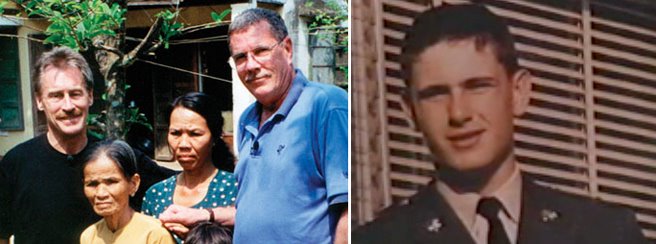
Lawrence Colburn and Hugh Thompson (photo left) and Glenn Andreotta

Hugh Thompson was a helicopter pilot in Vietnam, flying a reconnaissance mission for a ground operation. His task was to draw fire so the enemy’s position would be exposed. But nothing happened. He and his crew — Lawrence Colburn and Glenn Andreotta, flew without incident, watching women and children leaving a village, apparently heading to the market. It was a quiet day.

It was so quiet that when they left to refuel, they did not request any backup. On their return to the village, however, they saw bodies on the roads and in the ditches. Many of the people they had seen leaving the area were dead or dying. The crew couldn’t figure out what had happened. There had been no artillery fire since early that morning; there had been no gunship fire and no enemy fire. They passed a wounded woman and marked her position with a smoke grenade, expecting medical assistance to arrive. But it was May 16, 1969, at My Lai. As they watched from above, a captain reached the woman, kicked her, stepped back, and shot her.

Landing by a ditch where dozens of people lay dead or dying, Thompson spoke to a soldier, telling him that those people had to be helped, that they had no weapons, that there were no draft age males among them, that they were clearly civilians. The soldier agreed; and as the helicopter lifted off, the soldier opened fire.

So when Thompson, Colburn, and Andreotta saw U.S. troops approaching a bunker where Vietnamese were hiding, Thompson landed between the bunker and the troops. A lieutenant said he was going to use grenades against the position, but Thompson had a better idea. He would get the people out. And “[i]f you fire on these people when I’m getting them out…my people will fire on you.” He called in a gunship to evacuate the Vietnamese.

Later that same day, Andreotta spotted movement in a ditch filled with bodies. The crew landed and rescued an eight-year-old boy.

In 1998, Thompson, Colburn, and Andreotta were awarded the Soldier’s Medal for their actions that day. Andreotta was not present because he was killed less than a month after My Lai. Thompson and Andreotta eventually returned to Vietnam where they met two of the women they had saved — and the boy, now a man, they had plucked from death.

One soldier, Lieutenant William Calley, stood trial for the massacre at My Lai. He was sentenced to life in prison. He spent three days in the stockade. President Nixon commuted the sentence to house arrest and granted a pardon three years later.

Hugh Thompson was interviewed for a 1998 documentary, “The Sound of the Violin in My Lai.” He said:

I’m just real sorry that my crew could not have done more. I’m extremely sorry for my fellow Americans for what happened. It wasn’t right. It wasn’t war. And I pray to God something like this never happens again.

Thompson died of cancer on January 6, 2006.


Ernest Johnson, Jr. was at a North Carolina military base when word of My Lai broke out. The massacre, the unrest at home, and the stories he heard from returning Marines convinced him that he could not go to Vietnam. He spent 37 years on the run. Using the name McQueen, he was living with his girl friend in Fort Worth when he was discovered and arrested for desertion. Johnson said, “I just decided I didn’t want to be a part of killing anybody. That’s as plain as I can say it.” Johnson faces the possibility of three years in prison.

Lawrence Colburn learned about Johnson in the course of an interview for Democracy Now. Colburn expressed a desire to contact Johnson.


And the war in Vietnam continues. Every year, hundreds of Vietnamese are killed or wounded by U.S. ordnance. A farmer uncovers an artillery shell, and it kills him. A child finds a canister from a cluster bomb, and it kills him. It is estimated that 300,000 tons of unexploded ordnance remain in Vietnam.

We have irradiated Iraq. We have dropped cluster bombs in cities all over the country. If we leave Iraq tomorrow, we will still be killing Iraqis for years to come. Victory is ours.

____________________

Labels: , , , , , , ,