In
recent remarks to the National Broadcasting Company, Secretary of State John
Kerry expressed his dissatisfaction with the official stories of President
Kennedy’s assassination. On Sunday, November
10, 2013, N.B.C.’s David Gregory asked Kerry to elaborate on his statement
that, “To this day, I have serious
doubts that Lee Harvey Oswald acted alone.”
Understandably reluctant to be labelled a conspiracy theorist,
Kerry refused to be drawn out; but it was still a telling exchange:
Kerry: No. I
just have a point of view. And I’m not
going to get into that. It’s — you know,
it’s not something that I think needs to be commented on, and certainly not at
this time.
Gregory:
Do you think the conspiracy theories — his
involvement with Russia, motivation from the Soviet Union or Cuba — are valid
at some level?
Unfortunately,
but somewhat predictably, Gregory asked about foreign motivation for the murder.
Apparently, he is unaware that all of the crimes committed in support of
the lone assassin story were perpetrated by domestic
entities.
In
1963, murder of the President was not a federal offense; jurisdiction for the
assassination rested in Texas. Consequently,
the removal of Kennedy’s body from Dallas was a crime. The Russians didn’t do that; the Secret
Service did. The autopsy at Bethesda
Naval Hospital, where the prosectors were ordered to remain silent on pain of
court martial, was a crime; but the Navy did that, not the Cubans. Gangsters didn’t make up the story about alleged
assassin Lee Oswald going to Mexico City in September of 1963; the C.I.A. did
that. Those crimes, and many more, were committed
to protect Kennedy’s killers.
In
a nutshell, the official history of the crime goes like this. “We’re innocent; it was that guy over there
with the $3 rifle.”[1] Millions of people found that claim to be
ridiculous; so, a dozen years later, the perpetrators changed their alibi. “We’re innocent, but we think the mob might
have been involved.”
The
Warren Commission was an accessory after the fact to the murder of J.F.K. The House Select Committee on Assassinations
was an accessory after the fact to two murders — John Kennedy and Dr. Martin
Luther King.
The
Commission and Committee stories are fairy tales. Yet, some people who discounted the first
story nevertheless bought the second version!
Author and syndicated radio and tv host Thom Hartmann is one of those
people. On November 12, 2013, Hartmann
appeared with Amy Goodman on Democracy Now! and briefly discussed the assassination:
Hartmann: Yeah, yeah.
The — with virtual certainty, I can say that, you know, it was the mob
who killed Jack Kennedy. At that — in
that context, I mean, there was involvement of others within our government and
whatnot, but principally it was the mob…
“[O]thers within our government and whatnot”
were involved, but organized crime killed the President. Hartmann is virtually certain of that.
He can’t
explain the Magic Bullet Theory or the Magic Ammunition Clip Theory. He doesn’t know where the spent shells found
in the Texas School Book Depository went.
He can’t explain why x-rays of the President’s skull don’t show an
entrance wound in the back of Kennedy’s head. He can’t explain any details of the
crime. But he is virtually certain that gangsters
did it. His book, Legacy of Secrecy: The
Long Shadow of the JFK Assassination, is being
made into a movie starring Leonardo DiCaprio.
Goodman: And when is the movie coming out?
Hartmann: We’ll see. Hopefully next year.
[1] That’s not a
joke. The Mannlicher-Carcano rifle supposedly
used in the shooting sold for three bucks wholesale. “Oswald” bought it retail for twelve and
change.
The
approaching anniversary of President Kennedy’s assassination was certain to
bring with it new tales of how the U.S. intelligence apparatus did not kill
him.And sure enough, a new
we-didn’t-do-it account of the murder landed in bookstores this fall — A
Cruel and Shocking Act: The Secret
History of the Kennedy Assassination, by investigative reporter Philip
Shenon.
Dave Davies
interviewed Shenon for the N.P.R. program Fresh
Air, broadcast on October 28, 2013. Unfortunately,
like many other interviewers on this topic, Davies apparently knows nothing of
any importance about the case.So when
Shenon launched into the F.B.I.’s role in the investigation, Davies was unable
to ask a single insightful question.
Shenon: Very early on, I mean within 48 hours of the
assassination, FBI Director J. Edgar Hoover determines in his own mind that
Oswald acted alone, there was no conspiracy, there’s really not much to
investigate here…
In reality,
Hoover had no doubt that there was a conspiracy.
The C.I.A.
reported that Oswald went to Mexico City in September of 1963 and contacted the
Cuban and Russian embassies.The Agency
had photos of “Oswald” in Mexico City and recordings of “Oswald’s” phone calls.Within 48 hours of the assassination, President
Johnson asked Hoover about that trip.
Johnson:Have you established any more about the visit
to the Soviet Embassy in Mexico in September?
Hoover:No, that’s one angle that’s very confusing
for this reason.We have up here the
tape and the photograph of the man who was at the Soviet Embassy using Oswald’s name. That picture and the tape do not correspond to
this man’s voice, nor to his appearance.In other words, it appears that there is a second person who was at the Soviet Embassy down there…[1](Italics added.)
(Left: "Oswald" in Mexico City) Hoover had proof,
photographs and tape recordings, that someone impersonated Oswald in Mexico
City. In September of 1963, Oswald was a
nobody.Why would someone want to
impersonate him?
In the
interview, Shenon repeated one myth after another — that the missing autopsy
photos were held by Robert Kennedy; that Jacqueline Kennedy chose to have the
autopsy conducted at Bethesda Naval Hospital; that Jack Ruby insisted there was
no conspiracy; that Oswald was under surveillance in Mexico City; that he met
with a K.G.B. officer responsible for assassinations in the west; that the
F.B.I and the C.I.A. didn’t connect the dots;[2]
that the Zapruder film was a “clock of the assassination”; that Lyndon Johnson
thought Fidel Castro was behind the murder…
The only
genuinely instructive part of the interview concerned the influence of Oliver
Stone’s movie, JFK.Public response to the movie prompted the
President John F. Kennedy Assassination Records Collection Act of 1992 which
resulted in the release of millions of pages of documents.Shenon said that his own research benefitted
from that material, but I find his assertion very hard to believe.
Philip Shenon
told N.P.R. that the destruction of evidence in the case was a major theme of
his book.The F.B.I. and the C.I.A. lied
about the crime, but they only did so because they had failed to prevent the
assassination and wanted to cover their butts.There was no conspiracy.
I would
remind investigative reporter Philip Shenon that the removal of President
Kennedy’s body from Dallas was a crime.The autopsy was a crime.The
destruction of evidence was a crime.The
fabrication of evidence was a crime. The
federal government didn’t have jurisdiction in the case and the Warren
Commission didn’t have the legal authority to classify evidence, so that entire
process was a crime.Thank goodness
there was no conspiracy!I’d hate to
think all those crimes were committed to protect Kennedy’s killers.
[1]Deb Reichmann,
“Oswald no longer thought to be voice on tape,” Chicago Sun-Times, 11/22/1999, p. 20.Reichmann’s title was a bit odd; Oswald was never thought to be the voice on those
tapes.Intelligence analyst John Newman quoted
the same phone call between Johnson and Hoover in his 1995 book, Oswald and
the CIA.
[2]The C.I.A.
absolutely connected the dots in Mexico City because they invented those
dots.C.I.A. officer David Atlee
Phillips admitted in 1978 that there was no evidence Oswald was photographed in
Mexico City or that he visited the Soviet Embassy.In fact, there is no evidence that he went to
Mexico City at all.
This year
marks the 50th anniversary of the assassination of President
Kennedy, so we will be treated once again to stories about his death, about
enduring puzzles of the case, and so on.In 1963, the authorities decided that a 24-year-old communist did it
with a $12 rifle — a conclusion that was not widely accepted.Speculation turned to the involvement of
Fidel Castro or, more likely, gangsters, as the killing slowly gained an
underserved reputation for impenetrability.Now, a haunting irony supposedly looms over this signal event — that
after all the probes and investigations, we might never know who did it.
It is a
testament to the power of secrecy that such ridiculous notions arose and persist,
because the murder was not a particularly difficult crime to solve.All that was missing was a good-faith
investigation.For example:
Whatever
you might think about alleged assassin Lee Oswald, I’m sure you’ll agree that he
was younger once.He was a teenager
once.He had a few part-time jobs in
1955 and 1956 before he joined the Marines, and they are listed in the Warren Report.He was a stock boy at Dolly Shoe Company.He worked at Pfisterer Dental Lab and Gerard
F. Tujague, Inc., a shipping company.The
F.B.I. found his W2s among his possessions — and buried them. Why?
Decades
passed.Today, thanks to the
declassification process created by Congress in 1992, the reason for secrecy is
clear: the W2s bear tax identification numbers issued by the I.R.S. in January
of 1964. In fact, rather a lot of
“facts” about Oswald have turned out to be similarly crafted fictions.
The “organized crime” theory of the
shooting has an air of plausibility to it because we know how bad those people
can be.But, like the other “it wasn’t
us” stories; it can’t actually explain
anything.
Did
gangsters forge those W2s?Did hired
muscle arrange an illegal, secret, military autopsy to misrepresent, alter, and
destroy medical evidence? Did Carlos
Marcello convince the F.B.I. to run neutron activation tests of material in the
case and then conceal the findings?Did the
families lean on Lyndon Johnson to sign an executive order classifying evidence
for 75 years?Did powerful criminal
elements persuade the House Select Committee on Assassinations to scoop up further
traces and hide them for half a century?
By the way,
the H.S.C.A. also investigated the murder of Reverend Martin Luther King, Jr.;
and we only have to wait another 26 years to find out what they uncovered.
In 2009,
after the election of Barack Obama, Paul Ryan reiterated his great admiration
for Ayn Rand, the high priestess of greed.
According to Ryan, Rand’s work shows clearly the moral justification for
capitalism. (http://crooksandliars.com/leah-nelson/true-confessions-i-was-ayn-rand-fangir)
In The
Fountainhead and Atlas Shrugged, Rand depicts a world run by an
elite, the prime movers of society, to whom all lesser persons ought to be grateful.
It should
not be surprising, then, that Ayn Rand appeared before the House Un-American
Activities Committee in 1947 as a friendly witness against communist influences
in Hollywood. Nor should it be
surprising that she really didn’t know what she was talking about.
At the
request of HUAC, Rand watched a movie, Song
of Russia, produced by Louis B. Mayor in 1943. She then told the committee her
reactions. She described it as a work of
propaganda that inaccurately portrayed life in the Soviet Union.
The hero of
the movie, an American conductor played by Robert Taylor, goes to Russia —
first to Moscow and then to a farming village.
In Moscow, he finds large, clean, prosperous-looking buildings. He dines at a splendid restaurant. He sees no bread lines, no ragged
children. Rand told HUAC that in the
village:
You see the happy peasants. You see they are meeting the hero at the
station with bands, with beautiful blouses and shoes, such as they never wore
anywhere. You see children with operetta
costumes on them and with a brass band which they could never afford. You see the manicured starlets driving
tractors and the happy women who come from work singing. You see a peasant at home with a closeup of
food for which anyone there would have been murdered. If anybody had such food in Russia in that
time he couldn't remain alive, because he would have been torn apart by
neighbors trying to get food…
— www.noblesoul.com/orc/texts/huac.html
The movie
also shows peasants freely practicing their religious beliefs, scenes for which
Rand expressed justifiable distain.
In fact,
Rand’s account of the movie was accurate in all but the most important
respect.
Song of Russia was indeed propaganda — because
it was one of three movies commissioned by the United States government to counteract
prior propaganda and present our World War II ally in a favorable light. Hollywood did its patriotic duty and made:
Song of Russia, Mission to Moscow, and North
Star, written by Lillian Hellman.
Hellman’s script was extensively rewritten. The words “socialism” and “communism” were
deleted; the ending was changed; songs were added; the movie very nearly became
a musical Western! During the Red Scare
following World War II, North Star,
as tepid as it was, was cited as an example of communist influence in the film
industry. National Telefilm Associates
bought North Star and completely
sterilized it. Every use of the word
“comrade” was cut; footage of Soviet intervention into Hungary was spliced in;
a voice-over warned about the growing danger in the East. (Dan Georgakas, “The Revisionist Releases of
North Star,” Cineaste, April 1996,
Vol. 22, #1, p. 46) The transition was
complete. A claim about the chocolate
ration was changed.
— How the West was Lost, Jerrold Smith
The
investigations of Hollywood to expose imaginary communist subversion actually
served as cover for the very real infiltration of the movie industry by the
Central Intelligence Agency and the Federal Bureau of Investigation. However unwittingly, Ayn Rand served their
cause.
Catholic Republican
Vice-Presidential candidate Paul Ryan has recently found it expedient to
distance himself from atheist Ayn Rand.
Nevertheless, Paul Ryan is still out there, still hunting witches. He seeks higher office, the better to pursue
them.
I can remember exactly where I was when I heard the news. I was at work; I had just walked in the front door. Customers and employees were gathered around the tv; a friend of mine, almost in tears, told me what had happened. On the screen, medical personnel were running away from the site of the attack as the announcer explained the discovery of a second bomb inside the building, and later a third. It was April 19, 1995. The north façade of the Alfred P. Murrah Federal Building in Oklahoma City was a pile of rubble. I remember thinking that people still trapped in the wreckage might die if help could not arrive in time. I also remember thinking something even worse — that the other bombs were set specifically to kill rescue workers.
Suspicion immediately fell upon Muslim extremists. After all, hadn’t they bombed the World Trade Center in 1993?* The Oklahoma story, however, took an unexpected turn when a state trooper stopped a car without a license plate. The driver admitted that he had a gun and a knife and he surrendered them. Why? He was Timothy McVeigh, a veteran of Desert Storm and definitely not a Muslim. Earlier that morning, he had become the worst mass-murderer in U.S. history. Presumably, he was making his escape; but he wasn’t speeding. Why did he give up his gun? Why didn’t he just shoot the cop and drive on?
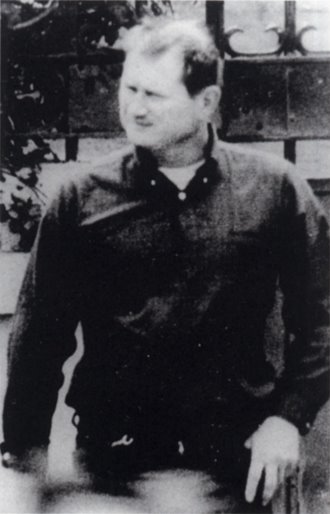
And then there was the question of John Doe #2. A sketch of him based on witness accounts (below left), received wide media coverage. Another sketch of him (below center) became evidence at McVeigh’s trial. John Doe #2 had a muscular build and a dragon tattoo on his left arm. But McVeigh’s accomplice, a farmer named Terry Nichols (below right), wasn’t muscular and didn’t have a dragon tattooed on his arm, raising an obvious question. Who was John Doe #2?
Evidently, he was nobody. The hunt for him ended when authorities determined that the JD2 story didn’t pan out. There was no John Doe #2.
McVeigh and Nichols were convicted in separate trials. In 2001, McVeigh was executed. Then, very quietly, the hunt was on again; and the F.B.I revealed that Nichols had agreed to help identify the previously non-existent John Doe #2.
Whoever John Doe #2 was, he wasn’t the man on the left, Kenney Trentadue. Trentadue was stopped at the Mexican border on June 10, 1995, for driving on a suspended license. He was also wanted for parole violations. On August 18, he was transferred to Oklahoma City. Three days later, he seemingly committed suicide in his cell.
Reporter James Ridgeway, writing for Mother Jones magazine, presents the story of Kenney’s brother, Jesse Trentadue, a lawyer in Utah. Kenney’s body was covered by bruises, with slashes on the throat. Jesse wanted to know why. Several Freedom of Information Act filings and a dozen years later, Jesse has pieced together enough details of his brother’s death to put it in context. The evidence is not encouraging.
It was murder by interrogation. Kenney fit the description of John Doe #2; the Bureau tried to get information out of him that he didn’t have. And he wasn’t the only JD2 match to die in custody. Worst of all, federal informants apparently had relayed information about the bombing before the attack.
The John Does who bombed the Murrah Building are at large, and the truth about the bombing remains hidden from the public. Jesse Trentadue has exposed part of the cover-up, but it is likely to be a long time before full disclosure is compelled.
__________
* An excellent question. See A Higher Reason, The Chair-Herding Pictures, June 30, 2006. The bomb used in the 1993 attack on the Trade Center was built by a F.B.I. informant named Emad Salem. Salem recorded his telephone conversations with the targets of the investigation and with his F.B.I. handlers. He couldn’t understand why the Bureau failed to prevent the attack. ____________________
Let me begin with an acknowledgment that I’m thirteen years behind on this story. I’ve learned a great deal, however, in the past two weeks.
Emad A. Salem is a former Egyptian Army officer. According to attorney William Kunstler, Salem claimed that he was a body guard for President Anwar Sadat when Sadat was assassinated in 1981 — a claim the Egyptian government denies.
Reportedly, Salem at one time received money from Kahane Chai, an organization created after the 1990 assassination of Rabbi Meir Kahane. Kahane essentially advocated a theocracy in Israel. He favored laws prohibiting missionary work in Israel, banning sexual relations between Jews and non-Jews, and evicting Muslims. He founded the Jewish Defense League and a political party, Kach. Kach and Kahane Chai were eventually outlawed by Israel and the U.S. as terrorist groups.
Apparently, Salem began working with the F.B.I. in 1991, while El Sayyid Nosair stood trial for Kahane’s murder. Nosair was acquitted. He was retried for conspiracy in the killing and was convicted. In 1993, Nosair stood trial in another important case which is the topic of this account.
Salem, acting as a F.B.I. informant, secretly recorded his meetings with the subjects under investigation. He also secretly recorded 40 conversations with his F.B.I. handlers. The existence of those recordings was disclosed at trial, and the government produced transcripts. Alas, by some oversight, the government was not entirely forthcoming. Salem made astonishing statements which were duly discounted by the F.B.I. An unidentified investigator in the case characterized Salem’s claims as figments of his imagination. Portions of the tapes which incriminated the defendants were leaked to A.B.C. Peter Jennings reported them; they were played on Nightline. Other parts of the tapes which suggested Bureau complicity in the crime were kept secret.
Now that you have glimpsed the background, take a good, hard look at the foreground. Emad Salem was the key figure in the February 26, 1993 bombing of the World Trade Center.
Do you remember the Blind Sheikh, Omar Abdel Rahman? Do you recall Mohammed Salameh, who signed his own name to rent the Ryder truck used in the attack? Before the bombing, he reported the truck stolen to the rental agency and the police. After the bombing, he tried to get a refund of his deposit and was arrested. Everyone wondered how he could be so stupid.
I wondered that myself. But in 1993, I was deeply immersed in a study of political assassinations in the United States. I didn’t follow the details of the Trade Center bombing; I didn’t read about the trial.
Today, as I wade into reports about the bombing, they sound terribly familiar. The Roberts Commission, which “investigated” Pearl Harbor, has come back from the dead to explain once again how we were taken by surprise. The Warren Commission, which “investigated” the assassination of President Kennedy, has been reassembled to explain the Magic Bomb in the basement.
Ralph Blumenthal, writing for The New York Times, presented damning descriptions of Salem’s tapes. (“Tapes in Bombing Plot Show Informer and F.B.I. at Odds,” 10/27/1993, p. A1. “Tapes Depict Proposal to Thwart Bomb Used in Trade Center Blast,” 10/28/1993, p. A1.)
A correction was added on 10/29/1993, indicating that the Bureau transcripts “do not make clear the extent to which the Federal authorities” knew in advance that the Trade Center was the target. That doesn’t ring true, unfortunately. Talking to an agent, Salem said:
Guys, now you saw this bomb went off and you both know that we could avoid that…
Do you deny your supervisor is the main reason of bombing the World Trade Center?
The explosion killed six people and wounded more that 1000 others. Salem expressed his incredulity and sorrow over the Bureau’s failure to prevent the attack:
You were informed. Everything is ready. The day and the time. Boom. Lock them up and that’s that. That’s why I feel so bad.
According to Blumenthal:
The transcript quotes Mr. Salem as saying that he wanted to complain to F.B.I. headquarters in Washington about the bureau’s failure to stop the bombing, but was dissuaded by an agent identified as John Anticev.
“He said, I don’t think that the New York people would like the things out of the New York office to go to Washington, D.C.,” Mr. Salem said Mr. Anticev had told him.
Another agent, identified as Nancy Floyd, does not dispute Mr. Salem’s account, but rather, appears to agree with it, saying of the New York people: “Well, of course not, because they don’t want to get their butts chewed.”
That kind of talk doesn’t inspire a lot of confidence.
One of Salem’s phone calls to F.B.I. Agent John Anticev is available online. Go to http://www.answers.com/topic/emad-salem Scroll down to the bibliography, click on the “longer clip” from WBAI Radio, and listened closely. Salem talks about being honest with “the lady” — Agent Nancy Floyd. He submitted receipts (!) only to discover later that his expenses were in question. Anticev implies that the problem is a only a bureaucratic issue because some of the expenses are “a little out of the ordinary”:
Salem: Okay. I don't think it was. If that what you think guys, fine, but I don’t think that because we was start already building the bomb which is went off in the World Trade Center. It was built by supervising supervision from the Bureau and the DA and we was all informed about it and we know what the bomb start to be built. By who? By your confidential informant! What a wonderful great case!
Anticev keeps his language general; he merely argues that the process naturally takes a little more time. He assures Salem that the money will come:
Forget about one supervisor or one ASAIC or whatever. We’re doing this for a higher reason. We know what we’re doing, and we know what it’s gonna mean in the future…We know what we’re doing, and at the end we’re gonna at least be able to look at each other and say “We tried the best we could.” You know, not for the government. The government is a very, you know, uh, uh, what do you call, unidentifiable thing, you know. It’s a, it’s not, sometimes it’s one person affecting you; sometimes it’s some bureaucratic things. But we’ll still know what we did. And we’re still gonna, we’re not gonna leave you out in the cold regarding funding and payments and, you know…
I don’t know what higher reason Agent Anticev had in mind. But a quick survey of the wider perspective is not encouraging.
• Apparently, a police officer in New York City advised Salem on how to negotiate with the government for more money.
• Three of the four defendants in the bombing were denied counsel of their choice. Rahman’s attorney, for example, was appointed by the court. Her name is Lynne Stewart. In 2002, U.S. Attorney General John Ascroft announced charges against her for violating “Special Administrative Measures” — SAMs — which are now used to control lawyer-client communications in national security matters. In 2003, she was indicted for aiding a terrorist organization. She was convicted in 2005. Former U.S. Attorney General Ramsey Clark said that Lynne Stewart, like the Constitution, is a victim of 9/11.
• After the bombers were convicted, they hired William Kunstler and his partner, Ronald Kuby, who were limited by the court in what they could say about the case and barred from their clients’s sentencing hearing. Their view of the tapes was profoundly troubling. Salem has vanished inside the witness protection program. Kunstler said that Salem was the conspiracy, that Salem set up everyone. According to Kuby, the tape recordings reveal that Salem assembled the bomb. In his conversation with Agent Anticev, Salem alluded to the new story about how, when, and where the bomb was constructed. Ralph Blumenthal wrote that “the transcripts reflect an effort to keep Mr. Salem as an intelligence asset who would not have to go public or testify.”
• The F.B.I. came under scrutiny for it’s handling of evidence in the Trade Center case and the 1995 attack on the Murrah Building in Oklahoma City and several other cases. A 1997 report by the Justice Department strongly criticized the bomb unit for scientifically inaccurate analyses slanted against defendants. A key witness in the Oklahoma case was a F.B.I informant, Carol Howe, who did not testify at the trial of Timothy McVeigh.
The Bureau determined that the
World Trade Center bomb was made with fertilizer and fuel oil, like the bomb in
Oklahoma City. But remember what Emad
Salem said to his handler before the trial of the WTC bombers:
“Okay, it’s
built with a different way in another place; and that’s it.”
• Some of the Trade Center defendants were trained by the C.I.A. during the Afghan conflict with Russia. Sheikh Rahman apparently was connected to Pakistani forces operating in Afghanistan. He was on a security watch-list when he came to the U.S., but he was given a green card. He visited a mosque in Jersey City, and Salem tried to recruit members of that mosque. Thus, the U.S. attorney in New Jersey was involved in the investigation. That attorney was Michael Chertoff, now head of Homeland Security.
• Ramzi Ahmed Yousef was convicted in the 1993 W.T.C. bombing. His uncle, incidentally, was trained in the United States as an engineer. Yousef’s uncle is Khalid Shaikh Mohammed, allegedly one of the men behind the 9/11 attacks.
What really happened on February 26, 1993? I don’t know. A couple of weeks ago, the name “Emad Salem” meant nothing to me. I’ve developed an interest in him since then; but I’m fifty-five years old, so there’s a good chance I will die of old age before all the significant details emerge. I have the sinking feeling, however, that I’ve seen this movie before; and I’m afraid I know how it ends.
They were Christians in the ordinary sense. They believed that Jesus is the son of god and he is in heaven. They believed in Biblical prophecies concerning end times and salvation. In particular, they studied Revelations, which tells of a great book at the hand of god, bound with seven seals. Only the Lamb of God can open the last seal.
They believed that seven messiahs would come before the end of the world, and the last would be the sinful messiah. That did not mean he would deliberately sin. It simply meant that, unlike Jesus, the seventh messiah would not be without sin. He would be an ordinary man, born into sin as we all are. He will father twenty-four children who will fall to the armies of Babylon. They will be killed by fire and will preside as angels in heaven.
I don’t hold any of those beliefs; I think they’re all nonsense. But the Branch Davidians had a right to their beliefs.
Like thousands of people in Texas, they bought and sold guns. There’s a lot of money to be made buying weapons which appreciate in value; and there are a lot of gun dealers in Texas. All gun dealers “stockpile” weapons; that stockpile is called an inventory. Many of the Davidian neighbors owned multiple weapons. Furthermore, when Jesus was arrested, he told his followers not to resist. But he also said that henceforth, he who was without a sword should take up a sword.
I think that story is ridiculous. But under the Constitution, Davidians had the right to believe it; and they had the right to keep and bear arms.
Congressional budget hearings were approaching. The Bureau of Alcohol, Tobacco, and Firearms was planning a dramatic raid to demonstrate how vital the Bureau was to the security of the nation. They were investigating a Christian commune in Texas that sold firearms. On February 28, 1993, the B.A.T.F. was not outgunned. They had three helicopters carrying armed men; they had nearly eighty men armed and armored. They had video cameras and fax machines. They had media contact phone numbers. They were ready.
Incredibly, however, they didn’t have contact information for ambulances or hospitals. When the B.A.T.F. took casualties, they had to ask a reporter to call for help. They simply never imagined they would meet resistance. After all, they were only serving a search warrant. There were no charges at that point, and the Bureau had already avoided an opportunity to inspect the suspect premises. They were going to search Mount Carmel, and they were going to get it on tape.
The Davidians had lived at Mount Carmel for decades; some had been born and raised there. Some had left home, as children do, and some had returned. Some were white; some were black. Wayne Martin, one of the first black graduates of Harvard law school, lived at Mount Carmel. A family of six had moved from England to Waco to learn about the seven seals. There were grandmothers and grandfathers at Mount Carmel. As a “branch” of Seventh Day Adventists (“advent” meaning the second coming of Christ), the Davidians didn’t feed their children junk food or sit around the tv. When lots of people live together, they need a big kitchen; they have to do laundry. The Davidians recycled material from old 1950s cottages on the site and built a large home. They added a small gymnasium which did additional duty as a church and a rehearsal space. On February 28, approximately 130 Davidians lived at Mount Carmel. When the B.A.T.F. attacked, Wayne Martin called 9-1-1.
Vernon Howell, also known as David Koresh, was the spiritual leader of the Davidians. The B.A.T.F. could have detained him on one of his trips into town, but they didn’t. For that matter, a Davidian neighbor who seemed to have an interest in Davidian beliefs was, in fact, an undercover B.A.T.F. agent named Robert Rodriguez. He was at Mount Carmel on February 28, and he left shortly before the raid in an effort to stop it.
Four agents and two Davidians were killed outright in the raid. Another died of his wounds; another was later killed in a field some distance from the home. The Davidians were charged with the murder of federal agents. The F.B.I. took over the investigation and the crime scene. Some Davidians surrendered to authorities, or surrendered their children to safe care. Others did not.
On April 19, 1993, fire consumed Mount Carmel. Nine Davidians escaped the flames. Seventy-six others, including a score of children, did not.
Eleven Davidians were subsequently tried and acquitted of murder and conspiracy to commit murder. If you don’t recall the blaring headlines — “Davidians not guilty!” — that could be because there were no such headlines. The acquittals seemingly didn’t merit much coverage.
Laura Berg (left) is a Veterans Administration nurse in Albuquerque, New Mexico. She’s been a V.A. nurse for fifteen years, specializing in mental health emergencies of veterans. More than a decade ago, she worked with veterans of the Persian Gulf invasion; and she deals today with soldiers returning from Iraq.
She found that veterans from other wars were also affected by the invasion of 2003. Even some World War II veterans experienced increased aggressiveness, nightmares, or anxiety. Six months ago, like millions of other Americans, she watched the massive failure of federal response unfold in the wake of Katrina. So she sat down at home to write a letter to a local paper, The Alibi, criticizing the Bush administration for its handling of Iraq and Katrina. She called on citizens to “act forcefully to remove a government administration playing games of smoke and mirrors and vicious deceit.”
The V.A. reported her letter to the F.B.I. Her computer at work was seized in case she had used it to write her letter, which would have been a misuse of government property. The computer was found innocent and was returned, but Berg learned that she was under investigation for sedition.
Sedition is a thought-crime, the advocacy of the violent overthrow of government. The Sedition Act of 1798 further outlawed “false, scandalous and malicious writing or writings against the government of the United States” along with writing that defamed the government or brought it into disrepute. Section 3 of the 1917 Espionage Act prohibited “any disloyal, profane, scurrilous, or abusive language about the form of government of the United States.”
The Sedition Act of 1798 expired in 1801; the 1917 provision was repealed in 1921. In retrospect, it seems incredible that such manifestly un-Constitutional laws were ever enacted; but it is frightening to realize that the notion of sedition is still alive. Laura Berg did not bring the Bush team into disrepute; they did that themselves. Was her letter disloyal? No, quite the opposite. Can anyone at the Justice Department distinguish between “forcefully” and “forcibly”? Let us hope. I would hate to think that she is under investigation simply to intimidate her — and others — into silence.
I collect or write far more pieces than I disseminate. Here are two items from the archives.
• Proponents of neo-con policy in the middle east often talk about schools in the region where children are taught jihad and hatred of foreigners. That was certainly the case in Afghanistan, where schoolchildren studied militant Islamic teachings in texts illustrated with pictures of tanks, guns, and bullets.
The United States knew about those books because the United States produced those books. To stir resistance to Soviet occupation of Afghanistan, the U.S. covertly supplied textbooks filled with violent images. The Washington Post published the details four years ago.
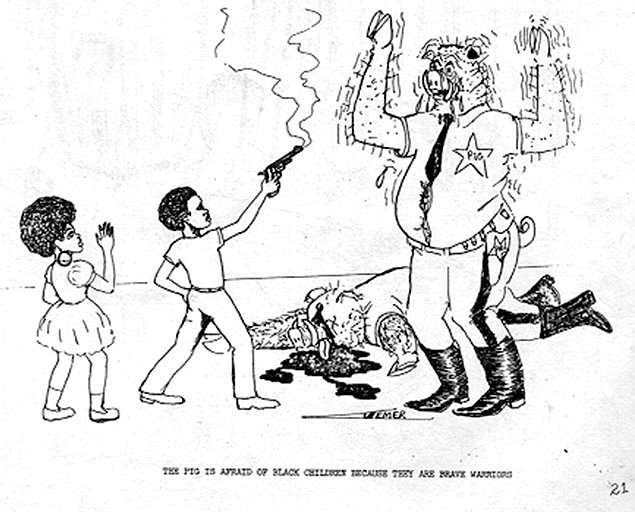
The Washington Post account reminded me of coloring books in the early 1970s. The F.B.I. was cracking down on the Black Panthers, and one complaint against the Panthers concerned coloring books which contained violent images of blacks killing policemen — evidence of the Panthers’s contempt for law and order.
In fact, the coloring book idea came from Panther Mark Teemer and was rejected by the Panther leadership. However, the F.B.I. acquired the book and was quite interested. The Bureau added drawings, changed some captions, and mailed copies of the “Black Panther Coloring Book” all around the country to discredit the Panthers.
• Obviously, the U.S. had a good reason to invade Iraq twice. Saddam Hussein was a beast who gassed his own people at Halabja in 1988. Who could doubt it?
Well, the Defense Intelligence Agency doubted it. Stephen C. Pelletiere was a C.I.A. political analyst on Iraq during the eight-year Iran-Iraq War. (“A War Crime or an Act of War?”, The New York Times, 1/31/2003) According to Pelletiere, the D.I.A. concluded that Iranians gassed the Kurds at Halabja in the course of a battle to capture the Darbandikhan dam. Pelletiere noted that:
Before the Persian Gulf war, Iraq had built an impressive system of dams and river control projects, the largest being the Darbandikhan dam in the Kurdish area. And it was this dam the Iranians were aiming to take control of when they seized Halabja. In the 1990’s there was much discussion over the construction of a so-called Peace Pipeline that would bring the waters of the Tigris and Euphrates south to the parched Gulf states and, by extension, Israel. No progress has been made on this, largely because of Iraqi intransigence. With Iraq in American hands, of course, all that could change.
Thus America could alter the destiny of the Middle East in a way that probably could not be challenged for decades — not solely by controlling Iraq's oil, but by controlling its water. Even if America didn't occupy the country, once Mr. Hussein’s Baath Party is driven from power, many lucrative opportunities would open up for American companies.
Professor Pelletiere spoke at Saint Bonaventure University on January 29, 2003. Video excerpts from that lecture are available at The Information Clearing House — Part One and Part Two. His discussion of Halabja is in part two.
You can also read Amy Goodman’s interview with John Stauber (co-author of Weapons of Mass Deception) and Stephen Pelletiere.
Stephen Pelletiere is obviously misguided. Why, only yesterday, I received a coloring book in the mail from Iran which clearly shows Iraqi forces gassing Kurds. I used purple for the gas to heighten the dramatic effect.
News accounts have paid tribute to Coretta King and her husband, the Reverend Doctor Martin Luther King, Jr. On matters of great importance, however, modern American media have an irritating way of saying very little at great length. You can digest the details in the newspapers and on tv; but the photos were cropped long ago and the most important passages were deleted.
The first U.S. military intelligence files on the King family were opened in 1917. Spy operations were initiated against black social organizations and especially against black churches, which were viewed as prime sources of information about the black community. Three generations of the King family produced ministers who served the Ebenezer Baptist Church in Atlanta, Georgia. It was inevitable that they would fall under scrutiny.
In 1917, the government was concerned that the Huns would turn our colored people against us in World War I — a notion that reeks of white guilt and the suppressed recognition that the black community harbored legitimate grievances. Domestic spying continued in World War II because the Japanese might have roused our negroes. And during the Vietnam War, of course, we faced the danger of communists stirring up our blacks. When you ponder the issue of warrantless domestic surveillance today, remember that there are black Muslims; and they are very high on the list of those who must be watched.
The military intelligence file on Martin Luther King, Jr. was opened in 1947, when he was eighteen. He was considered a curiousity rather than a threat until 1957, when he attended the Highlander Folk School in Monteagle, Tennessee. He was watched ever more closely after that. When Dr. King was in New York, he was monitored by 108th Military Intelligence Group, in Los Angeles by the 115th, in Washington by the 116th, in Europe by the 66th, and so on. When he visited Memphis in March and April of 1968, his hotel room was bugged by the 902nd M.I.G. Civil rights organizations in Memphis were infiltrated by the 111th M.I.G. In April of 1968, there were at least three military operations underway in and around Memphis, Tennessee.
On April 4th, 1968 — one year to the day after his first major speech against the war in Vietnam — a joint operation involving the Memphis police, the Federal Bureau of Investigation, and the United States Army killed Dr. King.
A “lone assassin” named James Ray was duly convicted and the cover-up went into high gear. In a memo dated March 11, 1969, F.B.I. Assistant Director Cartha DeLoach wrote:
… I would like to suggest that the Director allow us to choose a friendly, capable author, or the Reader’s Digest, and proceed with a book based on this case.
A carefully written factual book would do much to preserve the true history of this case. While it will not dispel or put down future rumors, it would certainly help to have a book of this nature on college and high school library shelves so that the future would be protected.*
The F.B.I. launched a smear campaign to defame Dr. King and marginalize critics of the investigation, starting with Coretta. DeLoach suggested a friendly media contact should be told that Coretta King and Ralph Abernathy were “plotting” to garner media attention and “keep the money coming in to Mrs. King” by claiming a conspiracy was behind the assassination.
For a quarter of a century, details of the killing steadily emerged, only to be downplayed or ignored. Then, in December of 1993, on Prime Time with Sam Donaldson, Loyd Jowers confessed his role in the murder of Dr. King.
Jowers was a former policeman turned restauranteur. He once owned Jim’s Grill, on South Main Street in Memphis. The back door of Jim’s Grill opened onto a vacant lot overlooking the Lorraine Motel where King was shot. Jowers said he was paid $100,000 for his help by Memphis businessman Frank Camille Liberto. Jowers alleged the involvment of James Barger, his former partner on the force, and officer Earl Clark, a long-time friend of Jowers. Jowers also alleged the participation of Marrell McCullough, from the 111th M.I.G., working as an undercover Memphis policeman. You’ve already seen a picture of McCullough and you didn’t even know it. He’s on Andrew Young’s left in the photo above.
Although Jowers had confessed to a capital offense for which there is no statute of limitations, he was not questioned by Memphis authorities or the F.B.I. Why generate a record? Jowers was old and ill. All they had to do was wait.
But there was still Coretta King.
The King family declared that James Ray was innocent, and Coretta King asked President Clinton for a new, open inquiry into the death of her husband — a Truth Commission, modeled on the reconciliation process adopted in South Africa to heal the wounds of apartheid. Instead, the Justice Department conducted a narrow inquiry that answered no questions and attacked critics. “Shut up,” the Department explained. In some quarters, Coretta King was characterized as a pathetic figure who had fallen under the spell of conspiracy theorists. On the 30th anniversary of the assassination, The New York Times claimed falsely that Ray had admitted firing the shot which killed King. The paper bemoaned the doubtful “fact” that:
A certain awkwardness attends this year’s commemoration. The King family, which remained in Atlanta for services there, has embraced Mr. Ray’s claim of innocence and his contention that he was, at most, an unwitting tool of a conspiracy that authorities have either failed to uncover or refused to unmask… (Steve Barnes, “Young and Old, of Varied Colors, Honor Dr. King,” The New York Times, 4/5/1998)
Who would find the King family’s position awkward?
The King family filed a civil suit against Jowers, seeking $100 in damages. On December 8, 1999, Jowers was found guilty. The New York Times reported the verdict on December 9, on page A23, next to the weather and the national classified ads. The story concluded with a broad slap at the King family, the judge, the attorneys, and the jury by quoting author Gerald Posner**:
It distresses me greatly that the legal system was used in such a callous and farcical manner in Memphis. If the King family wanted a rubber stamp of their own view of the facts, they got it.
On December 10, the Times ran a second article with more psycho-babble from Posner. People “want to embrace the sweeping conspiracy theory” because “it matches the stature of the man and somehow gives even more meaning and power to his death.”
James Ray died in prison on April 23, 1998. Loyd Jowers died on May 20, 2000.
Coretta King died on January 31, 2006. Sadly, it is a measure of her importance that in the years to come, she will be intermittently and respectfully ridiculed when the subject of her husband’s murder arises.
____________________ * The Bureau selected Gerold Frank, who wrote An American Death — the King assassination equivalent of the Warren Report on the murder of John Kennedy. ** Posner wrote Killing the Dream — the King assassination equivalent of the House Select Committee’s 1979 report on the murder of John Kennedy.
Recently, a few people have asked me about a new film, Rendezvous with Death, concerning the assassination of President John Kennedy. According to filmmaker Wilfried Huismann, Lee Harvey Oswald either volunteered or was recruited to help Cuban intelligence kill Kennedy. Seven weeks before the murder, Oswald went to Mexico City where he met a Cuban agent and was paid $6,500. The assassination investigation was short-circuited out of fear that the public would clamor for war when they learned Castro was behind the crime.
There is, of course, a big problem with that explanation: There is no evidence that Lee Oswald killed anybody.
The stories of Oswald in Mexico City are as baseless as every other aspect of the lone assassin fairytale. Supposedly, the Central Intelligence Agency photographed Oswald when he visited the Russian and Cuban embassies. But the photo of “Oswald” disclosed by the C.I.A. (left) looks nothing like Oswald. Supposedly, the C.I.A. intercepted and recorded Oswald’s telephone calls to the embassies. But after the assassination, when F.B.I. agents who had interrogated Oswald heard the Mexico City tapes, they unanimously agreed that the voice on the tapes was not Oswald’s.
The claim that Oswald was paid $6,500 came from a man identified only as “D” by the Warren Commission. “D” said that in September of 1963, he overheard a conversation in the Cuban embassy between two men, one “a tall, thin Negro with reddish hair, obviously dyed, who spoke rapidly in Spanish and English...” “D” identified the second man as Oswald. They were joined by a third man, a Cuban, who handed money to the Negro as Oswald listened to the Negro’s claim that he wanted “to kill the man”:
Oswald replied, “You’re not man enough, I can do it.” The Negro then said in Spanish, “I can’t go with you, I have a lot to do.” Oswald replied, “The people are waiting for me back there.” The Negro then gave Oswald $6,500 in large-denomination American bills, saying, “This isn’t much.” (Warren Report, pp. 307-308)
Mexican authorities, however, told the U.S. that “D” had admitted his story was a fabrication. Reportedly, “D” said that he had never seen Oswald anywhere and that his account was intended to facilitate his entry into the U.S. so he could participate in operations against Castro. He hoped his story would prompt the U.S. to “take action” against Castro.
“D” insisted that his retraction was coerced by the Mexicans. But the alleged date of his Oswald sighting, September 17 or 18, was ruled out by evidence that Oswald was in Louisiana on those dates. Besides, Oswald spoke English and Russian. How could he have had such a conversation in Spanish? And why would Castro’s agents meet Oswald at the consulate, which they would expect to be under surveillance? To further complicate matters, “D” turned out to be a Nicaraguan intelligence agent named Gilberto Alvarado Ugarte. In 1963, Nicaragua was under the thumb of Anastasio Somoza, who enjoyed the support of the U.S.
Although the Warren Commission rejected “D’s” account of Oswald and the Cubans, the Commission adopted a version of that same story involving Oswald and the Russians later in September. Credible eyewitness testimony indicated that Oswald was in Dallas at that time, not Mexico City; but the Warren Commission was undeterred. Oswald, it was said, may have met Valeriy Vladimirovich Kostikov, reportedly in charge of assassinations in the Western Hemisphere — which brings us to another absurdity from Huismann’s film. The investigation, it is claimed, was cut short because of concerns that if the public learned of Cuba’s role in the assassination, they would demand retaliation that could lead to war. Nevertheless, the Commission pondered the far more dangerous possibility of Russian involvement in the murder.
Some Cubans were certainly connected to the assassination, but they were anti-Castro Cubans, not pro-Castro Cubans. And there are still more problems with the Mexican Mystery Tour, but I won’t detail them here. I will simply close with a conversation between President Lyndon Baines Johnson and F.B.I. Director John Edgar Hoover on the very day of the assassination. Johnson asked if there was any new information about Oswald’s trip to Mexico, and Hoover replied:
No, that’s one angle that’s very confusing for this reason. We have up here the tape and the photograph of the man who was at the Soviet Embassy using Oswald’s name. That picture and the tape do not correspond to this man’s [Oswald’s] voice, nor to his appearance. In other words, it appears that there is a second person who was at the Soviet Embassy down there…
Really? Someone was impersonating Oswald? Whatever for?
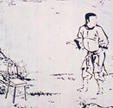
In Buddhist art, the Ox-Herding Pictures tell the story of enlightenment: A man searches for his missing ox, finds it, and returns home. If your ox disappears, you might think it wandered off on its own; but if your chair disappears, that thought doesn’t spring to mind. So, I have painted the Chair-Herding Pictures — a detail from the first picture, Losing the Chair, graces this page. The Chair-Herding Pictures are about following the tracks of consciousness.
My name is Jerrold Smith. I’m a free lance human being, living in Chicago.


%5B1%5D.jpg)