Stale Air
The
approaching anniversary of President Kennedy’s assassination was certain to
bring with it new tales of how the U.S. intelligence apparatus did not kill
him. And sure enough, a new
we-didn’t-do-it account of the murder landed in bookstores this fall — A
Cruel and Shocking Act: The Secret
History of the Kennedy Assassination, by investigative reporter Philip
Shenon.
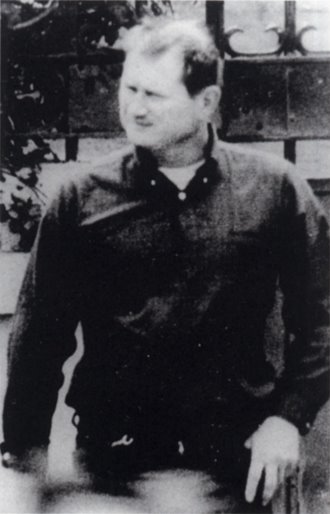
%5B1%5D.jpg) (Left: "Oswald" in Mexico City)
(Left: "Oswald" in Mexico City)
Hoover had proof, photographs and tape recordings, that someone impersonated Oswald in Mexico City. In September of 1963, Oswald was a nobody. Why would someone want to impersonate him?
Dave Davies
interviewed Shenon for the N.P.R. program Fresh
Air, broadcast on October 28, 2013. Unfortunately,
like many other interviewers on this topic, Davies apparently knows nothing of
any importance about the case. So when
Shenon launched into the F.B.I.’s role in the investigation, Davies was unable
to ask a single insightful question.
Shenon: Very early on, I mean within 48 hours of the
assassination, FBI Director J. Edgar Hoover determines in his own mind that
Oswald acted alone, there was no conspiracy, there’s really not much to
investigate here…
In reality,
Hoover had no doubt that there was a conspiracy.
The C.I.A.
reported that Oswald went to Mexico City in September of 1963 and contacted the
Cuban and Russian embassies. The Agency
had photos of “Oswald” in Mexico City and recordings of “Oswald’s” phone calls. Within 48 hours of the assassination, President
Johnson asked Hoover about that trip.
Johnson: Have you established any more about the visit
to the Soviet Embassy in Mexico in September?
Hoover: No, that’s one angle that’s very confusing
for this reason. We have up here the
tape and the photograph of the man who was at the Soviet Embassy using Oswald’s name. That picture and the tape do not correspond to
this man’s voice, nor to his appearance.
In other words, it appears that there is a second person who was at the Soviet Embassy down there…[1] (Italics added.)
%5B1%5D.jpg)
Hoover had proof, photographs and tape recordings, that someone impersonated Oswald in Mexico City. In September of 1963, Oswald was a nobody. Why would someone want to impersonate him?
In the
interview, Shenon repeated one myth after another — that the missing autopsy
photos were held by Robert Kennedy; that Jacqueline Kennedy chose to have the
autopsy conducted at Bethesda Naval Hospital; that Jack Ruby insisted there was
no conspiracy; that Oswald was under surveillance in Mexico City; that he met
with a K.G.B. officer responsible for assassinations in the west; that the
F.B.I and the C.I.A. didn’t connect the dots;[2]
that the Zapruder film was a “clock of the assassination”; that Lyndon Johnson
thought Fidel Castro was behind the murder…
The only
genuinely instructive part of the interview concerned the influence of Oliver
Stone’s movie, JFK. Public response to the movie prompted the
President John F. Kennedy Assassination Records Collection Act of 1992 which
resulted in the release of millions of pages of documents. Shenon said that his own research benefitted
from that material, but I find his assertion very hard to believe.
Philip Shenon
told N.P.R. that the destruction of evidence in the case was a major theme of
his book. The F.B.I. and the C.I.A. lied
about the crime, but they only did so because they had failed to prevent the
assassination and wanted to cover their butts.
There was no conspiracy.
I would
remind investigative reporter Philip Shenon that the removal of President
Kennedy’s body from Dallas was a crime.
The autopsy was a crime. The
destruction of evidence was a crime. The
fabrication of evidence was a crime. The
federal government didn’t have jurisdiction in the case and the Warren
Commission didn’t have the legal authority to classify evidence, so that entire
process was a crime. Thank goodness
there was no conspiracy! I’d hate to
think all those crimes were committed to protect Kennedy’s killers.
[1] Deb Reichmann,
“Oswald no longer thought to be voice on tape,” Chicago Sun-Times, 11/22/1999, p. 20. Reichmann’s title was a bit odd; Oswald was never thought to be the voice on those
tapes. Intelligence analyst John Newman quoted
the same phone call between Johnson and Hoover in his 1995 book, Oswald and
the CIA.
[2] The C.I.A.
absolutely connected the dots in Mexico City because they invented those
dots. C.I.A. officer David Atlee
Phillips admitted in 1978 that there was no evidence Oswald was photographed in
Mexico City or that he visited the Soviet Embassy. In fact, there is no evidence that he went to
Mexico City at all.
Labels: Central Intelligence Agency, Federal Bureau of Investigation, John Edgar Hoover, John Kennedy, Lee Harvey Oswald, Mexico City, Warren Commission
posted by Jerrold Smith at 10:32 AM
0 comments