Tuesday, January 30, 2007

The Death of a Dangerous Man

One of the most influential criminals of our time has died of pneumonia at the age of 88.

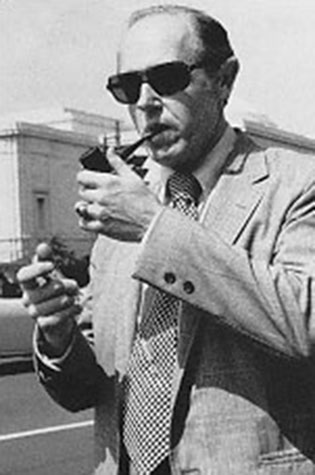
He had his fingers in several significant pieces of history that we know of, and probably others that we don’t. He was so successful that he is generally not even thought of as a criminal. He was C.I.A. officer Everette Howard Hunt, Jr. (Seen left in a photo from the 1960s.)

Hunt was in charge of the propaganda campaign accompanying the 1954 coup in Guatemala. The U.S. organized the coup, codenamed Operation Success, at the behest of the United Fruit Company to protect their holdings in Guatemala.

Hunt played a similar role in Operation Zapata, the invasion of Cuba in 1961. The C.I.A. initially assisted Fidel Castro’s insurgency against Fulgencio Batista, who had lost the support of the Cuban military. The scheme was to then replace Castro with another version of Batista. The flip-flop took on added urgency after Castro arranged to buy oil from Russia. President Eisenhower authorized the first black ops against Cuba in 1959. Zapata was supposed to take place before the 1960 elections so Vice-President Richard Nixon would be swept into the Oval Office on a wave of patriotic fervor. But preparations for the invasion bogged down, and Nixon lost the election. Zapata then became an operation against the incoming administration.

Hunt is best known for his role in the Watergate affair — the break-in at the Democratic Party headquarters in the Watergate Hotel. As I noted last month (“A Free Man,” The Chair-Herding Pictures, 12/28/2006), Hunt and senior C.I.A. officer James McCord were the key figures in the operation against Nixon.

But Watergate wasn’t Hunt’s only crime during Nixon’s presidency. During the Pentagon Papers controversy in the early 1970s, Hunt forged diplomatic cables to make it appear as though President John Kennedy was behind the assassination of Vietnamese President Ngo Dinh Diem, murdered less than three weeks before Kennedy was gunned down in Dallas.

Which brings us to Hunt’s most important and least publicized crime. On November 21, 1963, Hunt and Frank Sturgis (also of Watergate fame) arrived in Dallas to deliver the rifles used to kill Kennedy the next day.

Evidence of Hunt’s role emerged in the course of a libel suit he brought against Liberty Lobby. In 1978, Liberty Lobby published an article about a C.I.A. document concerning the need to arrange an alibi for Hunt for the day of Kennedy’s assassination. Hunt sued, and he prevailed at first. But by the time Liberty Lobby’s appeal came to trial in 1984, they had a lot more information to work with. Under informed cross-examination, Hunt’s C.I.A. witnesses crumbled. His only non-Agency witnesses were his three children, who were between the ages of 10 and 13 when Kennedy was killed. Hunt claimed he was at home with them on the day of the assassination, and together they watched the television coverage over the weekend. Yet by Hunt’s own account, his children didn’t remember that. In fact, when his children first learned of allegations of his involvement in the assassination, they confronted him and demanded to know if the accusations were true. His children were not called to testify on his behalf. The jury found for Liberty Lobby.

Shortly before Abraham Lincoln’s death, he wrote a letter in which he expressed his fear for the future of our country. As a result of the Civil War, “corporations have been enthroned and an era of corruption in high places will follow, and the money power of the country will endeavor to prolong its reign by working upon the prejudices of the people until all wealth is aggregated in a few hands and the Republic is destroyed. I feel at this moment more anxiety for the safety of my country than ever before, even in the midst of war. God grant that my suspicions may prove groundless.”

The huge increase in military spending brought about by World War II led President Eisenhower to warn us of “unwarranted power” wielded by the military/industrial complex. His successor was killed under conspicuously suspicious circumstances, and the war which followed was our longest war. Until recently, it was also our most expensive war. Today, we see increasing “corporatization” of the military and the government ostensibly for the sake of efficiency but actually to remove them from democratic control. In the face of massive debt, we see corporate figures with government titles spending obscene amounts of money for unarmored vehicles and voting machines that can’t count.

What we cannot see, though it certainly exists, is the small army of men like Everette Howard Hunt, Jr., ever ready to confuse power with patriotism.

____________________

Labels: , , , , , , , , , , ,

Friday, July 14, 2006

Remember the Maine

On Wednesday, 7/5/2006, Amy Goodman from Democracy Now! reported on U.S. government planning for intervention in Cuba upon the death of Fidel Castro.

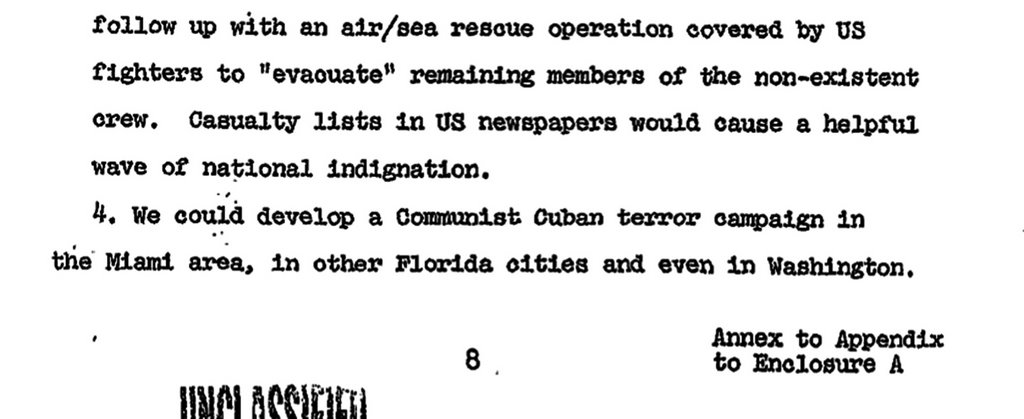
In 1962, the Joint Chiefs of Staff presented a summary of Operation Northwoods to Secretary of Defense Robert McNamara. An excerpt from that document appears above. The Chiefs outlined a number of plans to create a pretext for an attack against Cuba, including a “Remember the Maine” scheme. During Cuba’s war for independence from Spain, the U.S. sank one of its own ships, the Maine, in Havana harbor and blamed it on Spain. The public was outraged; the result was the Spanish-American War of 1898. That is how we acquired Puerto Rico and, for a while, the Philippines. In 1962, the U.S. military remembered the Maine and was considering some variations of the scam.

The Chiefs pondered a “Communist Cuban terror campaign” in the U.S. — shooting some people or staging bombings. With spectacular irony, they noted: “Exploding a few plastic bombs in carefully chosen spots, the arrest of Cuban agents and the release of prepared documents substantiating Cuban involvement also would be helpful in projecting the idea of an irresponsible government.”

Of course, the military was not the only federal entity developing plans to deceive the American public. The Central Intelligence Agency was thinking along similar lines, and some declassified material on their activities has surfaced. But for now, I want to focus on one item of Operation Northwoods — the downing of a commercial passenger plane and the loss of all aboard.

Witting passengers with fraudulent papers would board a plane. That plane would fly toward Cuban airspace, followed by a drone plane carrying a bomb. The passenger plane would descend below radar range and proceed to a military base in Florida. The drone would transmit a “May Day” message and then explode. Alternatively, a U.S. fighter could be “jumped” by MIGs from Cuba. In either scenario, the Navy could:

In 1959, a Marine radar operator defected to the Soviet Union. After he returned to the United States, he became the sole member of the Fair Play for Cuba Committee in New Orleans and then allegedly killed President John Kennedy. The Marine was killed by a Dallas nightclub owner named Jacob Rubenstein — aka Jack Ruby. In the investigation which followed, Ruby told the Warren Commission about a trip he took to Cuba in 1959, “during our good times:”

Was in harmony with our enemy of the present time. As a matter of fact, the U.S. Government was wanting persons to help them at that particular time when they threw out the dictator. [Fulgencio] Batista. (Warren Commission Volume 5, p. 202)

What? The U.S. government wanted people to help Castro overthrow Batista?

Fulgencio Batista lost the support of his own military and therefore the support of the U.S. intelligence community. The idea — in Washington — was to replace him with a transitional figure who would then be supplanted by another Batista.

Castro’s first offense was the purchase of oil from Russia. When U.S. companies in Cuba refused to refine the oil, Castro nationalized the refineries. This was followed by nationalization of other U.S. businesses, including establishments run by organized crime. President Eisenhower authorized covert operations against Cuba in 1959. Operation Zapata, the invasion at the Bay of Pigs, was supposed to be the “October Surprise” of 1960, vaulting Vice-President Richard Nixon into the White House. But the plans were not completed in time; the invasion was postponed; and Zapata was transformed into an operation to compel military action by the incoming administration. President Kennedy refused overt U.S. military aid to Operation Zapata in 1961. He refused to invade Cuba during the missile crisis of October, 1962; and he was planning withdrawal from Vietnam. Killing Kennedy in 1963 turned out to be far more cost effective than killing Castro.

On the day Kennedy was gunned down, a full-page, black-bordered advertisement appeared in the Dallas Morning News, listing a dozen loaded questions for the President. (Warren Commission Exhibit 1031, Warren Report, p. 294) The last question was this:

Why have you scrapped the Monroe Doctrine in favor of the “Spirit of Moscow”?

Promulgated in 1823, the Monroe Doctrine was a declaration of U.S. regional hegemony. Turning away from that creed, Kennedy opposed interests which had profited from Latin America and plagued Latin America for over a century. Meanwhile, similar circumstances — an illegitimate government, an agriculture-based economy, and drug traffic — existed in other locales of increasing U.S. involvement, Mexico and Vietnam.

Look at the broad picture. After a spate of assassinations in Mexico in 1994, former Mexican President Carlos Salinas (and strong supporter of the Free Trade Agreement) took an extended vacation abroad. His sister-in-law was arrested in Switzerland when she tried to withdraw $80 million from one of her husband’s various numbered accounts under false names. The Swiss had targetted the account for investigation of possible money laundering.

Salinas ended up in Ireland, where he granted an interview to a reporter from The New York Times (1/31/1997). He described a tremendous power struggle in Mexico, and added an amazing personal note. When his wife became pregnant, the couple went to Cuba so their daughter could be

“born in a country of dignified people who love their sovereignty.”

What on earth did he mean by that?! Isn’t Mexico a sovereign nation? Why didn’t he choose to have his daughter born in the United States?

Fidel Castro was born in 1926; he will certainly die one day. The contest for the sovereignty of Cuba has already begun in Havana and Washington, D.C.

Is there anything, anything at all, that we wouldn’t do gain control of Cuba?

____________________

Labels: , , , , , , ,

Why Kill Hugo Chavez?

The reason is simple. Tar sand.

If one counts the known reserves of light and heavy crude oil, Saudi Arabia has the most oil, followed by Russia, Iraq, Iran, and so on. But, if one counts the known reserves of extra-heavy crude — sometimes called tar sand, oil sand, bituminous sand, or non-conventional oil — Venezuela has the most oil.

Tar sand is a mixture of bitumen, clay or sand, and water. Bitumen and extra-heavy oil are types of petroleum which have been degraded by bacteria and other contaminants. Collecting extra-heavy oil is more like strip-mining than drilling, but squeezing the oil out of tar sand is very expensive. So recovering oil from tar sands is only economically feasible when the price of oil is high. And rumor has it the price of oil has been high lately.

Northern Canada also has huge reserves of oil sands; but they’re frozen, making them even more expensive to process. (Although as a friend of mine pointed out, they may not be frozen much longer.) The oil sands of Venezuela are much warmer and friendlier all the way around.

Hugo Chavez has been promoting a stable oil price of $50 a barrel — higher than the old $40 price but lower than the current price of $70. With oil at $50 a barrel, sustained processing of oil sands is possible. Even if you don’t believe that today’s leading oil producers have passed peak production, they’re going to sooner or later. Sooner or later, if we remain hooked on oil, we’ll be sucking it out of the sand in Venezuela.

Marion Gordon (Pat) Robertson claims that Venezuela has nuclear weapons and is planning to attack the United States. Venezuela has somehow managed to steal our tar sand and is on the verge of becoming the most important oil-producing nation on earth for decades to come. The evidence is clear. Chavez must be a Marxist terrorist.

There is another reason to kill Chavez; he has been cooperating with Fidel Castro. That alone is enough to convince many people of Chavez’s treachery, but the damning details still warrant close attention. For example, Cuba and Venezuela have been generating international pressure to bring 78-year-old Luis Posada Carriles to trial sometime before he dies. Long ago, Carriles received military training at Fort Benning in Georgia. As a U.S. intelligence asset, Carriles was the man behind the 1976 terrorist attack which brought down a Cuban airliner, killing everyone on board. Carriles is in the United States; the U.S. has refused to extradite him; and he is seeking political asylum here. Obviously, we cannot permit any foreign country, especially Cuba, to put one of our assets on trial for mass murder. Therefore, Chavez is a terrorist; and we must defend ourselves.

The most insidious Cuban-Venezuelan conspiracy, however, is so dark and malevolent that even Chavez’s worst critics are loathe to mention it. Through Operation Miracle, Venezuela has been flying poor people with cataracts from Latin American countries to Cuba for surgery to improve or restore their sight. Venezuela pays for the surgery and the transportation. Worse, Chavez wants to expand the operation into the United States and Africa, so that poor people who suffer from cataracts can have free surgery.

Chavez is obviously a madman who must be stopped. It may become necessary for us to discover that Osama bin Laden is hiding in Venezuela, if that’s what it takes to create public support for the occupation of Caracas.


____________________

Labels: , , , , , ,