On March
23, 1980, archbishop Oscar Romero called upon the El Salvadoran military to
refuse orders to attack and kill their fellow citizens. The next day, while celebrating Mass, Romero
was assassinated by a shot to the heart.
Central
America has long been a favorite target of the United States, and the region
was particularly hellish during the presidency of Ronald Reagan. The U.S. supported terrorists in Guatemala,
Nicaragua, El Salvador, and elsewhere.
In 1981, Robert White, the U.S. ambassador to El Salvador, named two
brothers from a ruling family in El Salvador as part of a group in Miami
funding the death squads. For that
action, White lost his job.
Why revisit
the past? Because in 1983, when Willard
Mitford Romney joined Bain & Company to head the new Bain Capitol private
equity firm, he turned to Central America for investors. The oligarchs provided 40% of Bain’s initial
funding. According to the Huffington Post:
The connection between the families
involved with Bain’s founding and those who financed death squads was made by
the Boston Globe in 1994 and the Salt Lake Tribune in 1999. This election cycle, Salon first raised the issue in January, and the Los Angeles Times filled out more of the
record earlier this month.[1]
Reportedly,
Romney was concerned about unsavory aspects of the ruling families. He had his new investors checked out and was
told that they had no connections to drug trafficking or death squads. Reportedly, he believed that story — which is
a bit like buying whiskey in Chicago during Prohibition after being assured
that no gangsters were behind the operation.
The last
thirty seconds of the audio file below come from a recording made by a Sister
in the chapel when Romero was murdered.
I can remember exactly where I was when I heard the news. I was at work; I had just walked in the front door. Customers and employees were gathered around the tv; a friend of mine, almost in tears, told me what had happened. On the screen, medical personnel were running away from the site of the attack as the announcer explained the discovery of a second bomb inside the building, and later a third. It was April 19, 1995. The north façade of the Alfred P. Murrah Federal Building in Oklahoma City was a pile of rubble. I remember thinking that people still trapped in the wreckage might die if help could not arrive in time. I also remember thinking something even worse — that the other bombs were set specifically to kill rescue workers.
Suspicion immediately fell upon Muslim extremists. After all, hadn’t they bombed the World Trade Center in 1993?* The Oklahoma story, however, took an unexpected turn when a state trooper stopped a car without a license plate. The driver admitted that he had a gun and a knife and he surrendered them. Why? He was Timothy McVeigh, a veteran of Desert Storm and definitely not a Muslim. Earlier that morning, he had become the worst mass-murderer in U.S. history. Presumably, he was making his escape; but he wasn’t speeding. Why did he give up his gun? Why didn’t he just shoot the cop and drive on?
And then there was the question of John Doe #2. A sketch of him based on witness accounts (below left), received wide media coverage. Another sketch of him (below center) became evidence at McVeigh’s trial. John Doe #2 had a muscular build and a dragon tattoo on his left arm. But McVeigh’s accomplice, a farmer named Terry Nichols (below right), wasn’t muscular and didn’t have a dragon tattooed on his arm, raising an obvious question. Who was John Doe #2?
Evidently, he was nobody. The hunt for him ended when authorities determined that the JD2 story didn’t pan out. There was no John Doe #2.
McVeigh and Nichols were convicted in separate trials. In 2001, McVeigh was executed. Then, very quietly, the hunt was on again; and the F.B.I revealed that Nichols had agreed to help identify the previously non-existent John Doe #2.
Whoever John Doe #2 was, he wasn’t the man on the left, Kenney Trentadue. Trentadue was stopped at the Mexican border on June 10, 1995, for driving on a suspended license. He was also wanted for parole violations. On August 18, he was transferred to Oklahoma City. Three days later, he seemingly committed suicide in his cell.
Reporter James Ridgeway, writing for Mother Jones magazine, presents the story of Kenney’s brother, Jesse Trentadue, a lawyer in Utah. Kenney’s body was covered by bruises, with slashes on the throat. Jesse wanted to know why. Several Freedom of Information Act filings and a dozen years later, Jesse has pieced together enough details of his brother’s death to put it in context. The evidence is not encouraging.
It was murder by interrogation. Kenney fit the description of John Doe #2; the Bureau tried to get information out of him that he didn’t have. And he wasn’t the only JD2 match to die in custody. Worst of all, federal informants apparently had relayed information about the bombing before the attack.
The John Does who bombed the Murrah Building are at large, and the truth about the bombing remains hidden from the public. Jesse Trentadue has exposed part of the cover-up, but it is likely to be a long time before full disclosure is compelled.
__________
* An excellent question. See A Higher Reason, The Chair-Herding Pictures, June 30, 2006. The bomb used in the 1993 attack on the Trade Center was built by a F.B.I. informant named Emad Salem. Salem recorded his telephone conversations with the targets of the investigation and with his F.B.I. handlers. He couldn’t understand why the Bureau failed to prevent the attack. ____________________
Suppose I punch you and steal five bucks because I’m trying to pay off a gambling debt. Now, suppose you punch me and steal five bucks because you hate people like me. Which crime deserves the harsher sentence?
That is the issue behind laws which create special classes of perpetrators and victims for otherwise comparable transgressions. I slugged you and I got two weeks because I only wanted money. You slugged me and you got a year because of what you thought. Is that equal protection under the law?
Which brings me to the Animal Enterprise Terrorism Act. The privileged victims are not of any particular race or religion. Instead, the victims are “animal enterprises,” such as the Huntington Life Sciences company in the United Kingdom which conducts experiments on animals for the manufacturers of cosmetics, cleaning solutions, or other products.
A group called Stop Huntington Animal Cruelty (SHAC) was very successful in its efforts against Huntington Life Sciences. SHAC used letter-writing campaigns, email campaigns, and so forth to propagate its views. Through its website, SHAC publicized demonstrations against Huntington, its customers, and its employees. SHAC also reproduced letters from anonymous contributors who claimed to have engaged in illegal activities. Several suppliers stopped doing business with Huntington, which went into debt. Because Huntington has a lab in New Jersey, federal charges in the U.S. were brought against SHAC.
The SHAC Six were the first people to be prosecuted under the Animal Enterprise Protection Act of 1992, and they were convicted in March of this year. But they were not found guilty of pouring blood on mink coats or releasing captive research animals. They were convicted of conspiring to inspire others to commit crimes. They were not convicted for what they did; they were convicted for what others have done or might do.
[t]he court neither found that SHAC or its leaders engaged in the illegal activities or that SHAC “directs” the actions of the activists who undertook illegal acts “within the scope of their actual or apparent authority” from SHAC. Had the court been able to find as such, the court could have rightly entered an injunction. However, the judge did not enter an injunction based on that analysis. Rather, he found that SHAC incited “imminent lawlessness.” For the factual basis, he relied on the fact that SHAC “endorsed” illegal activities and posted information about the illegal activity, which the court said thereby encouraged more illegal activity. The ACLU-NJ argues that allowing an injunction to issue based on individuals’ “endorsement” of other people’s illegal activities, is improper and a violation of free speech and freedom of the press.
The National Lawyers Guild opposed the Animal Enterprise Terrorism Act, ostensibly written to strengthen the Protection Act, because existing laws already protect businesses from offenses like trespass or vandalism. Furthermore, the language of the Act is unconstitutionally broad and vague. It could be interpreted to outlaw legal, expressive speech, silence whistleblowers, or criminalize boycotts. The Act violates the Fourteenth Amendment because it treats individual offenses on arbitrary grounds.
Animal rights activists are not widely understood or defended. Consequently, they present a good target for bad laws. The Animal Enterprise Protection Act “protects” an industry from legal activities by encroaching on the Constitution, which is why the right-wing favors it. If you can protect the profits of one industry, why not every industry?
Where is all this heading? On November 27, Newt Gingrich addressed a banquet in Manchester, New Hampshire. Here are some excerpts:
This is a serious, long term war. And it will inevitably lead us to want to know what is said in every suspect place in the country.
…we will adopt rules of engagement that use every technology we can find to break up their capacity to use the internet, to break up their capacity to use free speech…
It will lead us to learn how to close down every website that is dangerous…
I want to suggest to you that we right now should be impaneling people to look seriously at a level of supervision that we would never dream of if it weren’t for the scale of the threat.
Gingrich said he is not a candidate for the presidency. However, he is
seeking to create a movement to win the future by offering a series of solutions so compelling that if the American people say I have to be President, it will happen.
It’s always fear with the Republicans these days, isn’t it? The sales pitch is never hope or progress. If we don’t privatize Social Security, benefits will be cut. If we don’t attack, we’ll be attacked. If we don’t torture prisoners or suspend habeas corpus, Americans will die. To preserve free speech, we may have to end it.
Remember, terrorists can be anybody — eco-terrorists, narco-terrorists, al Qaeda, religious organizations, ordinary citizens opposed to the U.S. regime, right-wing bombers, “dangerous” bloggers, or anyone designated a terrorist by the Oval Office. It is anybody’s guess how the far right might construe “suspect” places. But Gingrich truly is talking about a level of supervision beyond your worst nightmares. So he has to convince you that there is an imminent threat.
The greatest threat we face, however, doesn’t spring from “terrorists.” The threat comes from Newt Gingrich and others who are chipping away at the First Amendment while promising to defend it, along with the Fourth, Fifth, Sixth, and Eighth Amendments. The tag line is always the same: Hurry, hurry; be afraid. Give up your rights before terrorists steal them.
Fear and prejudice can be effective motivational tools, but they are not amenable to reason. The way to preserve liberty is with more liberty, not less. The best defense against bad ideas is better ideas in the marketplace of ideas. When a government seeks to limit speech, it’s always a bad sign. It is an admission that the government has no faith in its professed ideals or confidence in the support of its people. And that really is something to fear.
Huey Long once said, “Fascism will come to America in the name of anti-fascism.” I’m afraid, based on my own experience, that fascism will come to America in the name of national security. —Orleans Parish District Attorney Earling Carothers [Jim] Garrison, Playboy, October 1967, vol. 14, no. 10
The elections were barely over when the media wondered aloud if the new Democratic majority in Congress would work in a bipartisan fashion and refrain from vindictiveness or retaliation. The questions implied that all the political shenanigans of the past few years were directed against the Democrats who might now seek retribution. In reality, the Republicans have conspired against the entire nation. It is justice, not revenge, which demands a reckoning.
The administration lied to Congress, to the American people, and to the entire world to justify a pre-planned invasion of Iraq. They used the war to line the pockets of their friends and to rationalize attacks on the Constitution. Republicans excluded Democrats from the legislative process. They wrote laws in the dead of night, published them in the wee hours of the morning, and voted on them before lunch — all in an effort to eliminate bipartisanship. When they could not stop inquiries into abu Ghraib, they limited their investigation to twelve hours of discussion. By comparison, they spent over one hundred hours investigating President Clinton’s Christmas card mailing list.
Now that they have lost control of Congress, they say the Democrats must play fair, the Democrats must work with the Republicans. Hooey. The Republicans didn’t mind stirring up animosity when they spent seventy million dollars and two years investigating Clinton’s sexual indiscretions. But oh, the Democrats must not investigate the deceptions which led to the mess in Iraq or the massive fraud which followed because that would be wrong, that would be divisive.
The lame-duck Congress wants to end oversight of the money spent in Iraq. Proposed legislation would close the Office of the Special Inspector General for Iraq Reconstruction by October 1, 2007. Why? Because he was doing his job. Democrats are already preparing a bill to restore the Office, but that merely proves they are unwilling to work with the Republicans. And should they get that bill through Congress, Bush will not sign it.
Some time back, a group of models were featured in an ad campaign against the fur industry, but we won’t get to see that anymore. Consider the Animal Enterprise Terrorism Act, to Strengthen the Animal Enterprise Protection Act. The A.E.T.A. expands criminalization of animal-related activism, permitting prosecution of anyone involved in legal, non-violent actions that cause the “loss of profits” for “animal enterprises.” Bush is expected to sign the Act, and all those models will become terrorists.
Even if you think those animal rights people are loonies, is it really a good idea to start “protecting” businesses from actions which are not crimes? How long will it be before citizens who protest major polluters or boycott genetically engineered foods are also defined as “terrorists”? It is dangerous and irresponsible to throw that word around; and Republicans these days simply cannot be trusted anywhere near the word “profit.”
So how did this happen? Late on Friday night, November 10, the Act was added to the House calendar for the following Monday — so it could be passed on a voice vote alone with limited discussion. There’s bipartisanship for you! The Animal Enterprise Terrorism Act is a direct assault on the First Amendment to the Constitution; but for the neo-cons’s brave, new plutocracy, the only amendment that really matters is the Fifth.
After the elections, the C.I.A. admitted the existence of a directive signed by Bush ordering the Agency to establish prison facilities outside the United States. The purpose obviously was to circumvent U.S. law. If Democrats say that, however, pundits on the idiot box will question why the Dems hate America so much.
Our “diplomat” in the United Nations, John Bolton, was a recess appointment; but Bush is trying once again to push Bolton’s nomination through the Senate before the new Congress convenes. Ninety-five percent of Bush’s judicial appointments were confirmed; only the most extreme were denied seats on the federal bench. Bush has renominated them while Republicans still control Congress.
Disgraced majority leader Tom Delay, on his way out the door, expressed the true feelings of his fellow Republicans when he said, “It is not the principled partisan, however obnoxious he may seem to his opponents, who degrades our public debate, but the preening, self-styled statesman who elevates compromise to a first principle.”
A slicker defense of hostility to the public good can scarcely be imagined.
The elections are barely over, and I’m already tired of the media mouths who insist the Democrats must behave. Does anyone seriously believe Bush will change course simply because he’s wrong? The Senators and Representatives defeated on November 7 will do everything they can to prosecute the war against the United States before their terms expire. They have nothing to lose, a lot to gain, and no principles to stand in the way.
On Wednesday, 7/5/2006, Amy Goodman from Democracy Now! reported on U.S. government planning for intervention in Cuba upon the death of Fidel Castro.
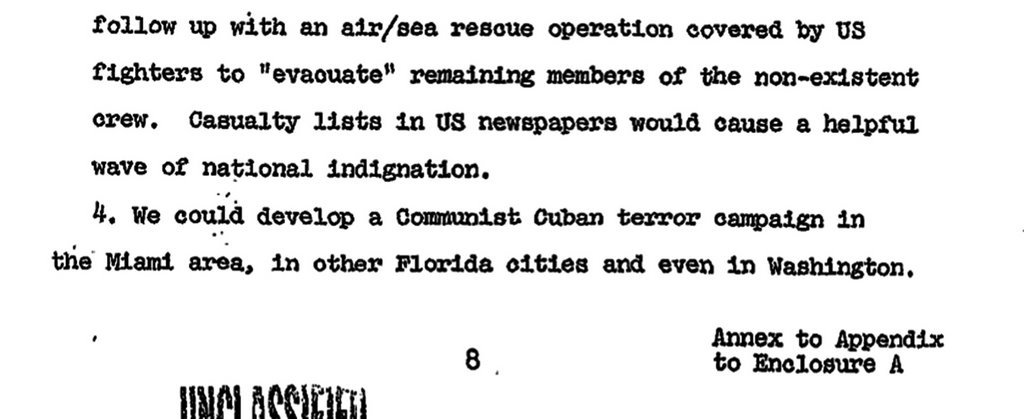
In 1962, the Joint Chiefs of Staff presented a summary of Operation Northwoods to Secretary of Defense Robert McNamara. An excerpt from that document appears above. The Chiefs outlined a number of plans to create a pretext for an attack against Cuba, including a “Remember the Maine” scheme. During Cuba’s war for independence from Spain, the U.S. sank one of its own ships, the Maine, in Havana harbor and blamed it on Spain. The public was outraged; the result was the Spanish-American War of 1898. That is how we acquired Puerto Rico and, for a while, the Philippines. In 1962, the U.S. military remembered the Maine and was considering some variations of the scam.
The Chiefs pondered a “Communist Cuban terror campaign” in the U.S. — shooting some people or staging bombings. With spectacular irony, they noted: “Exploding a few plastic bombs in carefully chosen spots, the arrest of Cuban agents and the release of prepared documents substantiating Cuban involvement also would be helpful in projecting the idea of an irresponsible government.”
Of course, the military was not the only federal entity developing plans to deceive the American public. The Central Intelligence Agency was thinking along similar lines, and some declassified material on their activities has surfaced. But for now, I want to focus on one item of Operation Northwoods — the downing of a commercial passenger plane and the loss of all aboard.
Witting passengers with fraudulent papers would board a plane. That plane would fly toward Cuban airspace, followed by a drone plane carrying a bomb. The passenger plane would descend below radar range and proceed to a military base in Florida. The drone would transmit a “May Day” message and then explode. Alternatively, a U.S. fighter could be “jumped” by MIGs from Cuba. In either scenario, the Navy could:
In 1959, a Marine radar operator defected to the Soviet Union. After he returned to the United States, he became the sole member of the Fair Play for Cuba Committee in New Orleans and then allegedly killed President John Kennedy. The Marine was killed by a Dallas nightclub owner named Jacob Rubenstein — aka Jack Ruby. In the investigation which followed, Ruby told the Warren Commission about a trip he took to Cuba in 1959, “during our good times:”
Was in harmony with our enemy of the present time. As a matter of fact, the U.S. Government was wanting persons to help them at that particular time when they threw out the dictator. [Fulgencio] Batista. (Warren Commission Volume 5, p. 202)
What? The U.S. government wanted people to help Castro overthrow Batista?
Fulgencio Batista lost the support of his own military and therefore the support of the U.S. intelligence community. The idea — in Washington — was to replace him with a transitional figure who would then be supplanted by another Batista.
Castro’s first offense was the purchase of oil from Russia. When U.S. companies in Cuba refused to refine the oil, Castro nationalized the refineries. This was followed by nationalization of other U.S. businesses, including establishments run by organized crime. President Eisenhower authorized covert operations against Cuba in 1959. Operation Zapata, the invasion at the Bay of Pigs, was supposed to be the “October Surprise” of 1960, vaulting Vice-President Richard Nixon into the White House. But the plans were not completed in time; the invasion was postponed; and Zapata was transformed into an operation to compel military action by the incoming administration. President Kennedy refused overt U.S. military aid to Operation Zapata in 1961. He refused to invade Cuba during the missile crisis of October, 1962; and he was planning withdrawal from Vietnam. Killing Kennedy in 1963 turned out to be far more cost effective than killing Castro.
On the day Kennedy was gunned down, a full-page, black-bordered advertisement appeared in the Dallas Morning News, listing a dozen loaded questions for the President. (Warren Commission Exhibit 1031, Warren Report, p. 294) The last question was this:
Why have you scrapped the Monroe Doctrine in favor of the “Spirit of Moscow”?
Promulgated in 1823, the Monroe Doctrine was a declaration of U.S. regional hegemony. Turning away from that creed, Kennedy opposed interests which had profited from Latin America and plagued Latin America for over a century. Meanwhile, similar circumstances — an illegitimate government, an agriculture-based economy, and drug traffic — existed in other locales of increasing U.S. involvement, Mexico and Vietnam.
Look at the broad picture. After a spate of assassinations in Mexico in 1994, former Mexican President Carlos Salinas (and strong supporter of the Free Trade Agreement) took an extended vacation abroad. His sister-in-law was arrested in Switzerland when she tried to withdraw $80 million from one of her husband’s various numbered accounts under false names. The Swiss had targetted the account for investigation of possible money laundering.
Salinas ended up in Ireland, where he granted an interview to a reporter from The New York Times (1/31/1997). He described a tremendous power struggle in Mexico, and added an amazing personal note. When his wife became pregnant, the couple went to Cuba so their daughter could be
“born in a country of dignified people who love their sovereignty.”
What on earth did he mean by that?! Isn’t Mexico a sovereign nation? Why didn’t he choose to have his daughter born in the United States?
Fidel Castro was born in 1926; he will certainly die one day. The contest for the sovereignty of Cuba has already begun in Havana and Washington, D.C.
Is there anything, anything at all, that we wouldn’t do gain control of Cuba?
If one counts the known reserves of light and heavy crude oil, Saudi Arabia has the most oil, followed by Russia, Iraq, Iran, and so on. But, if one counts the known reserves of extra-heavy crude — sometimes called tar sand, oil sand, bituminous sand, or non-conventional oil — Venezuela has the most oil.
Tar sand is a mixture of bitumen, clay or sand, and water. Bitumen and extra-heavy oil are types of petroleum which have been degraded by bacteria and other contaminants. Collecting extra-heavy oil is more like strip-mining than drilling, but squeezing the oil out of tar sand is very expensive. So recovering oil from tar sands is only economically feasible when the price of oil is high. And rumor has it the price of oil has been high lately.
Northern Canada also has huge reserves of oil sands; but they’re frozen, making them even more expensive to process. (Although as a friend of mine pointed out, they may not be frozen much longer.) The oil sands of Venezuela are much warmer and friendlier all the way around.
Hugo Chavez has been promoting a stable oil price of $50 a barrel — higher than the old $40 price but lower than the current price of $70. With oil at $50 a barrel, sustained processing of oil sands is possible. Even if you don’t believe that today’s leading oil producers have passed peak production, they’re going to sooner or later. Sooner or later, if we remain hooked on oil, we’ll be sucking it out of the sand in Venezuela.
Marion Gordon (Pat) Robertson claims that Venezuela has nuclear weapons and is planning to attack the United States. Venezuela has somehow managed to steal our tar sand and is on the verge of becoming the most important oil-producing nation on earth for decades to come. The evidence is clear. Chavez must be a Marxist terrorist.
There is another reason to kill Chavez; he has been cooperating with Fidel Castro. That alone is enough to convince many people of Chavez’s treachery, but the damning details still warrant close attention. For example, Cuba and Venezuela have been generating international pressure to bring 78-year-old Luis Posada Carriles to trial sometime before he dies. Long ago, Carriles received military training at Fort Benning in Georgia. As a U.S. intelligence asset, Carriles was the man behind the 1976 terrorist attack which brought down a Cuban airliner, killing everyone on board. Carriles is in the United States; the U.S. has refused to extradite him; and he is seeking political asylum here. Obviously, we cannot permit any foreign country, especially Cuba, to put one of our assets on trial for mass murder. Therefore, Chavez is a terrorist; and we must defend ourselves.
The most insidious Cuban-Venezuelan conspiracy, however, is so dark and malevolent that even Chavez’s worst critics are loathe to mention it. Through Operation Miracle, Venezuela has been flying poor people with cataracts from Latin American countries to Cuba for surgery to improve or restore their sight. Venezuela pays for the surgery and the transportation. Worse, Chavez wants to expand the operation into the United States and Africa, so that poor people who suffer from cataracts can have free surgery.
Chavez is obviously a madman who must be stopped. It may become necessary for us to discover that Osama bin Laden is hiding in Venezuela, if that’s what it takes to create public support for the occupation of Caracas.
Let me begin with an acknowledgment that I’m thirteen years behind on this story. I’ve learned a great deal, however, in the past two weeks.
Emad A. Salem is a former Egyptian Army officer. According to attorney William Kunstler, Salem claimed that he was a body guard for President Anwar Sadat when Sadat was assassinated in 1981 — a claim the Egyptian government denies.
Reportedly, Salem at one time received money from Kahane Chai, an organization created after the 1990 assassination of Rabbi Meir Kahane. Kahane essentially advocated a theocracy in Israel. He favored laws prohibiting missionary work in Israel, banning sexual relations between Jews and non-Jews, and evicting Muslims. He founded the Jewish Defense League and a political party, Kach. Kach and Kahane Chai were eventually outlawed by Israel and the U.S. as terrorist groups.
Apparently, Salem began working with the F.B.I. in 1991, while El Sayyid Nosair stood trial for Kahane’s murder. Nosair was acquitted. He was retried for conspiracy in the killing and was convicted. In 1993, Nosair stood trial in another important case which is the topic of this account.
Salem, acting as a F.B.I. informant, secretly recorded his meetings with the subjects under investigation. He also secretly recorded 40 conversations with his F.B.I. handlers. The existence of those recordings was disclosed at trial, and the government produced transcripts. Alas, by some oversight, the government was not entirely forthcoming. Salem made astonishing statements which were duly discounted by the F.B.I. An unidentified investigator in the case characterized Salem’s claims as figments of his imagination. Portions of the tapes which incriminated the defendants were leaked to A.B.C. Peter Jennings reported them; they were played on Nightline. Other parts of the tapes which suggested Bureau complicity in the crime were kept secret.
Now that you have glimpsed the background, take a good, hard look at the foreground. Emad Salem was the key figure in the February 26, 1993 bombing of the World Trade Center.
Do you remember the Blind Sheikh, Omar Abdel Rahman? Do you recall Mohammed Salameh, who signed his own name to rent the Ryder truck used in the attack? Before the bombing, he reported the truck stolen to the rental agency and the police. After the bombing, he tried to get a refund of his deposit and was arrested. Everyone wondered how he could be so stupid.
I wondered that myself. But in 1993, I was deeply immersed in a study of political assassinations in the United States. I didn’t follow the details of the Trade Center bombing; I didn’t read about the trial.
Today, as I wade into reports about the bombing, they sound terribly familiar. The Roberts Commission, which “investigated” Pearl Harbor, has come back from the dead to explain once again how we were taken by surprise. The Warren Commission, which “investigated” the assassination of President Kennedy, has been reassembled to explain the Magic Bomb in the basement.
Ralph Blumenthal, writing for The New York Times, presented damning descriptions of Salem’s tapes. (“Tapes in Bombing Plot Show Informer and F.B.I. at Odds,” 10/27/1993, p. A1. “Tapes Depict Proposal to Thwart Bomb Used in Trade Center Blast,” 10/28/1993, p. A1.)
A correction was added on 10/29/1993, indicating that the Bureau transcripts “do not make clear the extent to which the Federal authorities” knew in advance that the Trade Center was the target. That doesn’t ring true, unfortunately. Talking to an agent, Salem said:
Guys, now you saw this bomb went off and you both know that we could avoid that…
Do you deny your supervisor is the main reason of bombing the World Trade Center?
The explosion killed six people and wounded more that 1000 others. Salem expressed his incredulity and sorrow over the Bureau’s failure to prevent the attack:
You were informed. Everything is ready. The day and the time. Boom. Lock them up and that’s that. That’s why I feel so bad.
According to Blumenthal:
The transcript quotes Mr. Salem as saying that he wanted to complain to F.B.I. headquarters in Washington about the bureau’s failure to stop the bombing, but was dissuaded by an agent identified as John Anticev.
“He said, I don’t think that the New York people would like the things out of the New York office to go to Washington, D.C.,” Mr. Salem said Mr. Anticev had told him.
Another agent, identified as Nancy Floyd, does not dispute Mr. Salem’s account, but rather, appears to agree with it, saying of the New York people: “Well, of course not, because they don’t want to get their butts chewed.”
That kind of talk doesn’t inspire a lot of confidence.
One of Salem’s phone calls to F.B.I. Agent John Anticev is available online. Go to http://www.answers.com/topic/emad-salem Scroll down to the bibliography, click on the “longer clip” from WBAI Radio, and listened closely. Salem talks about being honest with “the lady” — Agent Nancy Floyd. He submitted receipts (!) only to discover later that his expenses were in question. Anticev implies that the problem is a only a bureaucratic issue because some of the expenses are “a little out of the ordinary”:
Salem: Okay. I don't think it was. If that what you think guys, fine, but I don’t think that because we was start already building the bomb which is went off in the World Trade Center. It was built by supervising supervision from the Bureau and the DA and we was all informed about it and we know what the bomb start to be built. By who? By your confidential informant! What a wonderful great case!
Anticev keeps his language general; he merely argues that the process naturally takes a little more time. He assures Salem that the money will come:
Forget about one supervisor or one ASAIC or whatever. We’re doing this for a higher reason. We know what we’re doing, and we know what it’s gonna mean in the future…We know what we’re doing, and at the end we’re gonna at least be able to look at each other and say “We tried the best we could.” You know, not for the government. The government is a very, you know, uh, uh, what do you call, unidentifiable thing, you know. It’s a, it’s not, sometimes it’s one person affecting you; sometimes it’s some bureaucratic things. But we’ll still know what we did. And we’re still gonna, we’re not gonna leave you out in the cold regarding funding and payments and, you know…
I don’t know what higher reason Agent Anticev had in mind. But a quick survey of the wider perspective is not encouraging.
• Apparently, a police officer in New York City advised Salem on how to negotiate with the government for more money.
• Three of the four defendants in the bombing were denied counsel of their choice. Rahman’s attorney, for example, was appointed by the court. Her name is Lynne Stewart. In 2002, U.S. Attorney General John Ascroft announced charges against her for violating “Special Administrative Measures” — SAMs — which are now used to control lawyer-client communications in national security matters. In 2003, she was indicted for aiding a terrorist organization. She was convicted in 2005. Former U.S. Attorney General Ramsey Clark said that Lynne Stewart, like the Constitution, is a victim of 9/11.
• After the bombers were convicted, they hired William Kunstler and his partner, Ronald Kuby, who were limited by the court in what they could say about the case and barred from their clients’s sentencing hearing. Their view of the tapes was profoundly troubling. Salem has vanished inside the witness protection program. Kunstler said that Salem was the conspiracy, that Salem set up everyone. According to Kuby, the tape recordings reveal that Salem assembled the bomb. In his conversation with Agent Anticev, Salem alluded to the new story about how, when, and where the bomb was constructed. Ralph Blumenthal wrote that “the transcripts reflect an effort to keep Mr. Salem as an intelligence asset who would not have to go public or testify.”
• The F.B.I. came under scrutiny for it’s handling of evidence in the Trade Center case and the 1995 attack on the Murrah Building in Oklahoma City and several other cases. A 1997 report by the Justice Department strongly criticized the bomb unit for scientifically inaccurate analyses slanted against defendants. A key witness in the Oklahoma case was a F.B.I informant, Carol Howe, who did not testify at the trial of Timothy McVeigh.
The Bureau determined that the
World Trade Center bomb was made with fertilizer and fuel oil, like the bomb in
Oklahoma City. But remember what Emad
Salem said to his handler before the trial of the WTC bombers:
“Okay, it’s
built with a different way in another place; and that’s it.”
• Some of the Trade Center defendants were trained by the C.I.A. during the Afghan conflict with Russia. Sheikh Rahman apparently was connected to Pakistani forces operating in Afghanistan. He was on a security watch-list when he came to the U.S., but he was given a green card. He visited a mosque in Jersey City, and Salem tried to recruit members of that mosque. Thus, the U.S. attorney in New Jersey was involved in the investigation. That attorney was Michael Chertoff, now head of Homeland Security.
• Ramzi Ahmed Yousef was convicted in the 1993 W.T.C. bombing. His uncle, incidentally, was trained in the United States as an engineer. Yousef’s uncle is Khalid Shaikh Mohammed, allegedly one of the men behind the 9/11 attacks.
What really happened on February 26, 1993? I don’t know. A couple of weeks ago, the name “Emad Salem” meant nothing to me. I’ve developed an interest in him since then; but I’m fifty-five years old, so there’s a good chance I will die of old age before all the significant details emerge. I have the sinking feeling, however, that I’ve seen this movie before; and I’m afraid I know how it ends.
The country was torn by political divisions; a dramatic attack on the capitol itself just six days before the elections raised tensions and fears. The President received emergency powers to protect the nation, including the power to suspend civil liberties and habeas corpus; but the government required additional tools for the fight. A new law granted temporary legislative powers to the executive branch. Able to rule by decree, Chancellor Adolf Hitler finally had the authority necessary to save the homeland.
On February 27, 1933, the Reichstag building, the seat of German government, was destroyed by arson. The fire was portrayed as the beginning of a communist revolution. With the fate of the nation at stake, the Enabling Act “to remedy the distress of the people” came to a vote. The Act was a model of concision, less that 250 words long (in English) and complete with a “sunset” provision. Hitler spoke in favor of the measure, promising to use the powers of his position only for vital issues and emphasizing the Christian nature of the German culture. The Act passed by a vote of 441 to 84. Only the Social Democrats voted against it, and they wouldn’t be around much longer anyway.
Of course, no one could have foreseen that the ongoing threats facing Germany would compel two formal extensions of the Act. By then, Hitler’s opponents had been eliminated; and the legislature was a vestigial organ of government. Thus, it was with uncanny prescience that Joseph Goebbels wrote after passage of the Enabling Act:
“The authority of the Führer has now been wholly established. Votes are no longer taken. The Führer decides. All this is going much faster than we had dared to hope.”
In a 1934 speech, Rudolph Hess explained his support for Hitler by declaring that the Führer was “the instrument of the will of a higher power.”
While it is comforting to know that Hitler took power legally and expeditiously, that’s not what I wanted to write about. I had in mind an entirely unrelated topic, a 2001 memo on presidential powers written by then-Deputy Assistant Attorney General John Yoo.
After analyzing the text of the Constitution and the history of relevant cases, Yoo concluded that:
the President has the plenary constitutional power to take such military actions as he deems necessary and appropriate to respond to the terrorist attacks upon the United States on September 11, 2001…
Military actions need not be limited to those individuals, groups, or states that participated in the attacks on the World Trade Center and the Pentagon…
Furthermore, neither the War Powers Resolution nor the Joint Resolution:
can place any limits on the President’s determinations as to any terrorist threat, the amount of military force to be used in response, or the method, timing, and nature of the response. These decisions, under our Constitution, are for the President alone to make. (Emphasis added.)
In a footnote, Yoo observed that in exercising his military powers:
the President’s decisions are for him alone and are unreviewable.
There it is in a nutshell. This argument, in one form or another, underpins the neo-conservative view of the unitary executive. With no limits on the President’s determinations of the threat or methods of response, and no review possible by Congress or the courts, what can he not do? Jail people indefinitely? Have them tortured? Order searches without warrants? Can he force people into slavery?
And if the war drags on as promised, what will the next Presidents do? On February 2, Donald Rumsfeld delivered a speech before the National Press Club titled “The Long War” in which he explained that the so-called war on terror could last decades. If there are no limits on presidential powers in time of war, and the war goes on indefinitely, isn’t the President effectively a dictator?
Alas, it seems I have digressed again. I actually intended to write about a psychology paper by Florette Cohen and Daniel M. Ogilvie of Rutgers University; Sheldon Solomon of Skidmore College; Jeff Greenberg of the University of Arizona; and Tom Pyszczynski of the University of Colorado at Colorado Springs.
The paper is titled “American Roulette: The Effect of Reminders of Death on Support for George W. Bush in the 2004 Presidential Election.” Commenting on the impact of the bin Laden video which appeared shortly before the 2004 elections, the authors noted that:
From a terror management perspective, the United States’ electorate was exposed to a wide-ranging multidimensional mortality salience induction.
In other words, the voters were reminded that they could be killed. Dick Cheney reiterated the message, implying that his re-election was a critical factor in preventing future terrorist attacks. The authors wrote that:
Allegiance to charismatic leaders may be one particularly effective mode of terror management. In Escape from Freedom, Eric Fromm (1941) proposed that loyalty to charismatic leaders results from a defensive need to feel a part of a larger whole, and surrendering one’s freedom to a larger-than-life leader can serve as a source of self-worth and meaning in life. Ernest Becker (The Denial of Death, 1973) posited that when mainstream worldviews are not serving people’s need for psychological security, concerns about mortality impel people to devote their psychological resources to following charismatic leaders who bolster their self-worth by making them feel that they are valued participants in a great mission to heroically triumph over evil.
Well, that’s exactly what left-wing academics would say, isn’t it? And in any case, another video from Osama bin Laden has been released, promising more attacks. Elections are coming. That should be uppermost in my mind; but for some reason, I’ve been thinking about the Constitution Restoration Act. It would forbid federal court review of certain cases decided by an element of government’s acknowledgment of God as the sovereign source of law.
The idea of criminalizing judicial review is brilliant; and I have no doubt Bush, Jr. would sign the Act if it passed. But it still requires legislators willing to vote for it — courageous men who will dismantle the antiquated system of checks and balances created by our paranoid founders. And we need judges prepared to uphold the Act, at least initially, or submit to it as the case may be — judges with a strong view of broad executive authority. That’s why I sat down to write about neo-con notions of a permanent Republican majority. It’s probably possible with electronic voting machines, but why would they wish such a thing?
In Buddhist art, the Ox-Herding Pictures tell the story of enlightenment: A man searches for his missing ox, finds it, and returns home. If your ox disappears, you might think it wandered off on its own; but if your chair disappears, that thought doesn’t spring to mind. So, I have painted the Chair-Herding Pictures — a detail from the first picture, Losing the Chair, graces this page. The Chair-Herding Pictures are about following the tracks of consciousness.
My name is Jerrold Smith. I’m a free lance human being, living in Chicago.