Monday, October 15, 2007

Rapture Ready

I didn’t do much writing over the summer, but I still tried to keep up with events. Here are four more items to ponder.

No End in Sight
And no end in the planning stages either. You can watch the trailer at:

http://www.noendinsightmovie.com/

I won’t try to summarize the entire film here, but I can give you something of its flavor. When U.S. occupying forces took no action to protect Iraqi museums, many irreplaceable treasures of antiquity were stolen. Secretary of Defense Donald Rumsfeld rather infamously explained it all away by saying that “stuff happens.” His indifference to the looting of a culture speaks volumes — in English or Arabic.

That indifference extends all the way down to security contractors muscling their way through Iraq. The film includes a video taken by “security contractors” through the back window of their car as they drove around Baghdad randomly shooting at cars behind them. Hey, it was fun! The shooters even added a rock music sound track.

Trashed
This is the story of garbage — the garbage we dump, the garbage we breathe, the garbage we eat, the garbage we pay for, the garbage we generate to process garbage, etc. Watch the trailer at:

http://www.youtube.com/watch?v=KgtLjHEKlnE

As the saying goes: Out of sight, out of mind. That’s definitely true of trash. To see what you’re missing, go to

http://www.chrisjordan.com/current_set2.php?id=7

and see the work of Chris Jordan. His images make the magnitude of our consumption crisis all too clear.

(Below: detail from Chris Jordan’s picture of 2,000,000 plastic bottles, the number used in the United States every five minutes.)


But of course, after the Second Coming, we won’t have to worry about trash, either in the form of plastic bottles or non-believers.

Rapture Ready
What god wants and who he wants to do it to are critical to the protection of Israel so it can be destroyed in Armageddon when Jesus returns — or something like that. Visit

http://www.huffingtonpost.com/max-blumenthal/rapture-ready-the-unauth_b_57826.html

and watch Max Blumenthal’s film about the conference of Christians United for Israel. Senator Rick Santorum was there, along with former Representative Tom Delay. Asked about the Second Coming, Delay replied, “I live for it. I hope it comes tomorrow.” Senator Joseph Lieberman called C.U.F.I. founder John Hagee a modern-day Moses. Apparently, the Christians United for Israel believe the modern day Pharaoh is in Iran. To them, the conclusion is obvious. To me, the conclusion is terrifying.

____________________

Labels: , , ,

Wednesday, May 09, 2007

The Mighty Wurlitzer

C.I.A. officer David Atlee Phillips called it The Mighty Wurlitzer. Put in a quarter and it would play your favorite tunes over and over, across the nation, for years on end.

He was referring to the Agency’s influence on mass media, the ability to plant a story in a variety of outlets and then just keep repeating it as if it was true. In newspapers and magazines, on television and radio, through a shifting array of advocates, a thousand times a day, as though it was widely accepted, for decades if necessary. And if the Agency preferred silence, the Wurlitzer could do that, too. Deafening silence.

(Left: a 1971 Wurlitzer 3500 “Zodiac” jukebox.)

Silence is what we heard when Everette Howard Hunt, Jr. died. He named names in the assassination of President Kennedy, all of them connected to the C.I.A. He didn’t merely tell his son about the plot; he made a twenty-minute cassette recording about the murder to be released after his death. An excerpt is available now on the internet; reportedly, the entire tape will be out soon.

A.B.C., N.B.C., and C.B.S. have insisted for nearly 45 years that the official fairy tale of John Kennedy’s murder was true. The New York Times, putatively the nation’s paper of record, has pushed the story just as long. Other news outlets have done the same. Now that Hunt has joined the list of operatives who have confessed, the networks and the newspapers have nothing to say.

In 1978, David Atlee Phillips admitted that a key part of the C.I.A.’s cover story — the “lone-assassin’s” trip to Mexico City — was false; the evidence was fabricated. Phillips was in a position to know since he helped create that tale. Mainstream media still hasn’t reported it. C.I.A. contract agent Robert Morrow wrote a book about his role in the murder. It’s a pretty bad book, but that’s not the point. Morrow’s confession never turned up on the six-o’clock news.

After Oliver Stone’s movie, JFK, was released in 1991, Chauncey Holt came forward with his confession. Mainstream media responded by laughing him off and calling Stone paranoid. More than twenty years ago, C.I.A. asset Marita Lorentz testified in open court about her knowledge of Hunt’s part in the murder. Don’t tell me; let me guess. You’ve never heard of Marita Lorentz. For some reason, the Mighty Wurlitzer doesn’t mention her.

The list of confessors doesn’t stop there; but in all likelihood, you’ve never heard of them. For years, authorities have claimed that if a conspiracy had existed, someone would have talked by now. Well, several people have talked; but the Wurlitzer continues to play the old single, “No Confessions.”

Of course, there are more recent numbers on the Wurlitzer play list. A favorite these days is “We Didn’t Lie,” the soulful plaint of Agency innocence in the intelligence plot leading to the 2003 invasion of Iraq.

Former C.I.A. director George Tenet received the Medal of Freedom for his service to his country. On Sixty Minutes (4/29/2007), Tenet delivered a powerful rendition of “We Didn’t Lie”; but it lacked sincerity. A group of former intelligence officers sent a letter to Tenet about his complicity in the pre-war deception. You can read their letter on the internet, but it hasn’t gotten any play on the Wurlitzer. I have excerpted a paragraph below. After noting the C.I.A.’s collaboration with the British to “fix” the intelligence around the Iraq war policy, the writers added:

By your silence you helped build the case for war. You betrayed the CIA officers who collected the intelligence that made it clear that Saddam did not pose an imminent threat. You betrayed the analysts who tried to withstand the pressure applied by Cheney and Rumsfeld. Most importantly and tragically, you failed to meet your obligations to the people of the United States. Instead of resigning in protest, when it could have made a difference in the public debate, you remained silent and allowed the Bush Administration to cite your participation in these deliberations to justify their decision to go to war. Your silence contributed to the willingness of the public to support the disastrous war in Iraq, which has killed more than 3300 Americans and hundreds of thousands of Iraqis.

It’s hard to believe, isn’t it? Former intelligence officers think there was some sort of arrangement to deceive the American public? Whose side are they on?

____________________

Labels: , , ,

Wednesday, March 21, 2007

Why Are We In Iraq?

Why are We in Vietnam?, by Norman Mailer, was published in 1967. His protagonist is a Texas teenager on a hunting trip in Alaska before he is sent to fight on the other side of the world. The Dallas Times described it as “[a] shattering social commentary…The book is a tour de force, a treatise on human nature, society, and war in flip disguise.”

No such book has yet been written about Iraq, so the task has fallen to me. My protagonist, D, is the son of illegal aliens, brought to the United States in the early 1920s and educated in Indiana. A gifted student with an interest in medicine, he becomes a prominent psychologist just as the ideas of Sigmund Freud are taking hold in the United States. In the aftermath of World War II, D is recruited by the U.S. Army to assist in a massive study of returning veterans. D corresponds with Anna Freud and takes a job with Sigmund Freud’s nephew, Edward Bernays, the father of public relations. In 1951, when Bernays is hired by United Fruit to build public support for a coup in Guatemala, D advises C.I.A. officer Everette Howard Hunt, Jr. on propaganda operations in the target nation.

D becomes wealthy with his own public relations firm. He also works for the C.I.A. occasionally, assisting in domestic operations. Meanwhile, the idea of controlling society by countering destructive subconscious impulses is replaced by another concept: Docility produced by manufacturing and then sating consumer desires, giving the population a sense of choice and self-worth. D sees no contradiction in this paradigm shift; he has long since internalized the belief that the ruling elite, although comprised of individuals, is somehow free of the primitive emotions that motivate everyone else. When the paradigm changes again with the rise of the human potential movement, D unhesitatingly finds a way to turn that into an ad campaign. In the course of his career, D never encounters a theory of human behavior that he can’t use for the benefit of his clients.

At the age of 75, he is consulted on ways to sell the first invasion of Iraq to the American public. He comes up with the pitch that Iraqi soldiers in Kuwait had dumped premature babies out of incubators and sent those incubators to Iraq. It works like a charm. Seven months before the second invasion, he succumbs to pneumonia. He dies believing that democracy is dangerous because ordinary people cannot be trusted to make informed, responsible decisions. For their own good, people must be given the illusion of choice without the prospect of choice.

I have no intention of writing the book I’ve described. But I did grow up in America during the ascension of Freudian thought. My stepfather was a clinical psychologist and my mother was a psychiatric nurse. For a time, my family lived in an apartment building for hospital staff on the grounds of Longcliff State Hospital, the largest state hospital in Indiana. I also grew up in the late stages of the Red Scare propaganda campaign that led to the invasion of Vietnam.

And unfortunately, Edward Bernays and Everette Howard Hunt, Jr. are not figments of my imagination. Nor is Anna Freud. More distressing, people like D certainly exist. Throughout the ages, business and government have sought techniques to manage public perceptions.

True or false or a bit of both, all models of motivation accepted by a significant faction of any society wield influence, if only because they have a Pygmalion effect. Even so, some general principles have been understood for centuries. Fear and secrecy, for example, have long been known to influence behavior.

Baseball season approaches, so I will close with a baseball analogy. Wrigley Field in Chicago is the home of the Chicago Cubs. It’s an old stadium with regularly spaced columns to support the upper decks. If you end up sitting behind one of those columns, you have an obstructed view. You may have to lean left or right to follow a play; you may miss a key play completely.

Mass media consolidation is building a Media Wrigley Field with much wider columns so all but prime ticket holders will have an obstructed view of the field.

If you can’t wait for my non-existent book, you can still watch a remarkable four-part series by the B.B.C. titled “The Century of the Self,” about the advent and success of modern public relations — or perception management or whatever spin is called these days. The series is available through Google video at the following addresses.


Part 1 http://video.google.com/videoplay?docid=-2637635365191428174
Part 2 http://video.google.com/videoplay?docid=-678466363224520614
Part 3 http://video.google.com/videoplay?docid=-6111922724894802811
Part 4 http://video.google.com/videoplay?docid=1122532358497501036


Our founding fathers thought that a successful democracy required an informed public. Suppose they were right. How, then, are we to judge our democracy today?


____________________

Labels: , , ,

Tuesday, March 20, 2007

Madam Secretary, Why Don't They Love Us?

On Fox News Sunday (2/25/2007), Secretary of State Condoleezza Rice explained why Congress should not reconsider the 2002 authorization of discretionary force granted to George Bush. Jr.:

“It would be like saying that after Adolf Hitler was overthrown, we needed to change then, the resolution that allowed the United States to do that, so that we could deal with creating a stable environment in Europe after he was overthrown.”

The implied camparison between Adolf Hitler and Saddam Hussein is absurd. Hitler conquered Europe, invaded Russia, and killed millions. Hussein was steam-rolled twice and captured in a hole in the ground. The Roosevelt administration did not have to invent stories about German and Japanese aggression to sell a war. And there was no resolution that “allowed” us to prevail or which gave President Roosevelt extraordinary war powers.

Japan attacked Pearl Harbor on December 7, 1941. The next day, Congress declared war against Japan. Three days later, Germany delivered a declaration of war to the State Department’s European Division under Secretary of State Cordell Hull (left), one of Rice’s predecessors. Congress declared war against Japan and Germany in the quaint, pre-9/11, Constitutional way.

U.S. Presidents did not determine post-war plans for Europe. Over Republican opposition, Congress approved the Marshall Plan and President Truman signed it in 1948. It was named after General George Marshall (right), former head of the Joint Chiefs of Staff who became Secretary of State in 1947.

The U.S. occupied Germany and Japan through the early 1950s, but the Germans and Japanese did not shoot U.S. troops or plant roadside bombs. Now, flash forward. Through war and economic sanctions, the U.S. has killed more Iraqis than former U.S. client, Saddam Hussein, who was overthrown and hanged in a soap episode you can download on the internet. Inexplicably, some Iraqis are still targeting their liberators and anyone connected to those liberators. I don’t understand, Madam Secretary. Why don’t they love us?

Labels: , , , ,

Sunday, October 15, 2006

Building a Better Bang

U.S. ordnance of all sorts is still killing people in Vietnam, and it will be killing Iraqis for years to come. On September 20, 2006, the United Nations reported that more than 250,000 unexploded cluster bombs — made in the U.S.A. — now litter Lebanon. According to David Shearer, the U.N. humanitarian coordinator in Lebanon, three people per day die from the ordnance.
(http://www.democracynow.org/article.pl?sid=06/09/20/1412233)

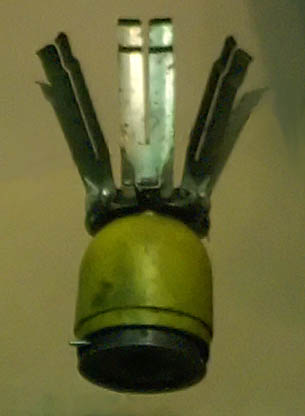
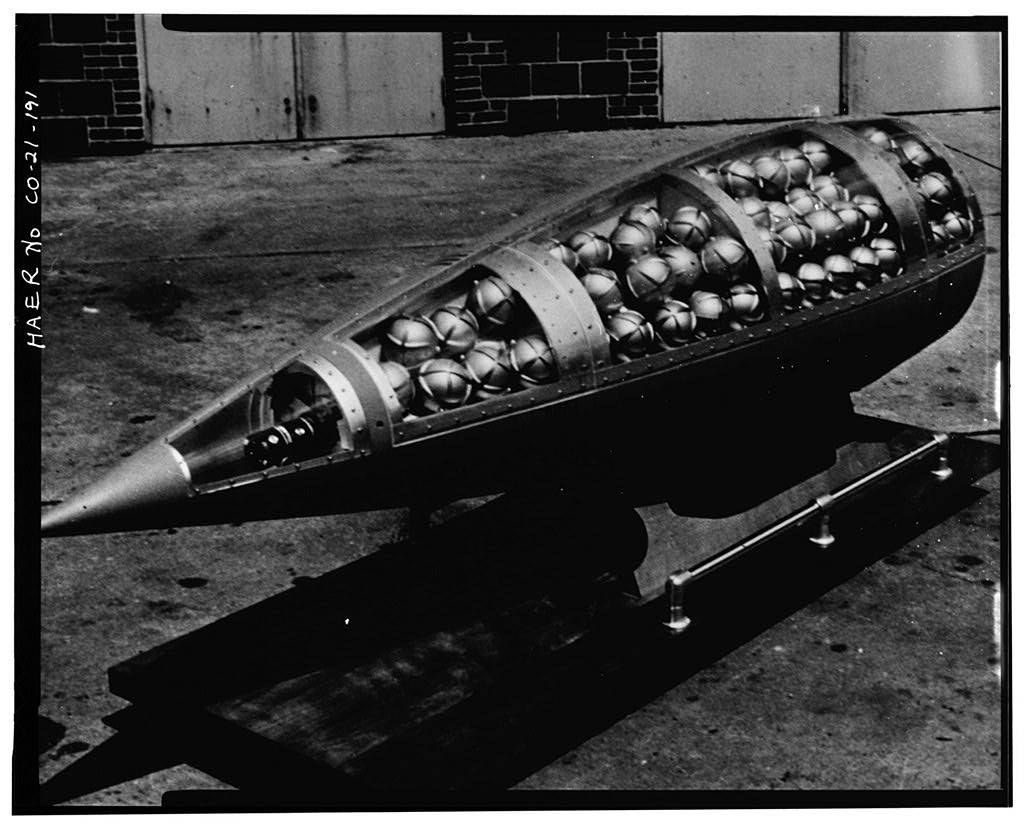
Small cluster bombs, such as the BLU-3, project fragments which can maim or kill. But cluster bombs can also be used to deliver chemical weapons.

Left: BLU-3 cluster bomblet, also called a “Pineapple” bomb, used in Vietnam.
Right: Cut-a-way view of Honest John warhead holding Sarin bomblets, circa 1960.

Last fall, jouralists from the Italian television station R.A.I. reported U.S. use of white phosphorus during the attack on Falujah in 2004. Now, R.A.I. is reporting accusations that the Israeli military used an experimental weapon against Palestinians in Gaza. The device produces major shrapnel wounds which can maim or kill — and it can cause severe burns.
(http://www.democracynow.org/article.pl?sid=06/10/12/145208)

Apparently, the weapon is similar to a U.S. Dense Inert Metal Explosive, or DIME. The DIME is advertized as a “low collateral damage” weapon because its impact field is relatively small. It is, so to speak, a “precision” cluster bomb. The small impact field, however, is much more intense than that of a typical cluster device. In short, detonated in a crowd, a DIME will wound fewer people than a BLU-3, but the wounds will be much worse. It’s a better bang for the buck. Science marches on.

____________________

Labels: , , ,

Friday, September 15, 2006

The Kettle Pot Calling Black

George Bush, Jr. has achieved a certain fame for his occasionally peculiar language. After 9/11, for example, he talked about a new crusade, apparently forgetting how the old Crusades turned out. Campaigning in 2004, he lamented that rising insurance costs mean some gynecologists cannot practice their love for women. And last month, during the anniversary of the ongoing Katrina disaster, he granted an interview to Brian Williams of M.S.N.B.C. Williams mentioned Junior’s trips to Kennebunkport to visit his father, President George Bush, Sr. Some members of Bush, Sr.’s administration (including, reportedly, Bush, Sr. himself) are against Junior’s middle-east policies. So Williams asked if there was any tension between father and son.

Bush: My relationship is adoring son.
Williams: Do you talk shop?
Bush: Sometimes, yeah, of course we do. But, uh, uh, but — that’s a really interesting question. I mean, it’s kind of conspiracy theory at its most rampant.


It’s impossible to say whether Bush was leaping to a conclusion or slipping, so to speak, to a Freudian. Either way, it sounded odd.

Recently, Bush and figures in his administration have adopted another term from the anti-American right: “Islamofascism.” It’s perfect. It’s evocative and it doesn’t quite mean what it says — two common features of propaganda.

To understand how propaganda works, consider a related example. Before the U.S. attack on Iraq, Saddam Hussein was compared to a famous Catholic, Adolph Hitler. Hitler was a battered child who hated his father and, as an adult, pursued two investigations (ultimately inconclusive) into the possibility that his paternal grandfather was a Jew. Jews, of course, have been persecuted by Catholics for centuries. The Church did not excommunicate Hitler and remained notoriously silent on the excesses of his regime. Yet, when Hussein was called the new Hitler, the public did not conclude that Hussein was Catholic.

“Islamofascism” welds two emotionally charged words into one counter-articulate brand. The result is an all-purpose synonym for anti-Semitism, insurgency, resistance to U.S. intervention, terrorism, or anything else the administration might care to insinuate. Anything, that is, except genuine fascism.

Former Nixon counsel John Dean appeared on M.S.N.B.C. to discuss recent statements from Donald Rumsfeld. Dean mentioned that conflating terrorism with fascism runs against earlier administration claims that terrorism is not state-based because fascism is state-based. The core switcheroo of the Islamofascism smear, however, was not addressed. It’s not about religion, and it’s not about a clash of cultures or opposition to the U.S.

Fascism, as Benito Mussolini once explained, should be called corporatism because it combines the powers of state and business.

The U.S. military has been buying up supplies of the vaccine Tamiflu at $100 per dose to protect U.S. soldiers if a bird flu pandemic develops. No one actually knows if Tamiflu is effective against bird flu, but one thing is clear. Secretary of Defense Donald Rumsfeld was chairman of Gilead Sciences, which developed Tamiflu. He’s a major stockholder of Gilead. He stands to make a lot of money from the decision to buy Tamiflu for the Department he heads. And “Rumsfeld isn’t the only political heavyweight to benefit from the demand for Tamiflu.”* There’s a word for that.

Four “contractors” were killed in Faluja, and the U.S. took revenge on the entire city. The men were “security personnel” from a company called Blackwater USA. F.E.M.A. hired Blackwater for security in post-Katrina New Orleans. Not surprisingly, information on Blackwater operations in Iraq is hard to find; but apparently, the Blackwater deal came through a series of companies which track back to Halliburton. Dick Cheney was the C.E.O. of Halliburton before he became Vice-President. He promptly held secret meetings with oil company executives to divvy up the oil fields in Iraq — seven months before 9/11 and two years before the invasion of Iraq.**

Our nation’s energy policy was written by politicians and businessmen who were conspiring to seize Iraq’s oil. There’s a word for that.

The Bush team doesn’t mind being fascists, but they’re not stupid. They know “fascist” is a title best bestowed on others. And let’s face it, “Christianofascism” sends all the wrong signals. Besides, it doesn’t roll well off the tongue.


* http://money.cnn.com/2005/10/31/news/newsmakers/fortune_rumsfeld/
** A lawsuit won the release of maps and a list detailing the progress of negotiations with interested companies. See: http://www.judicialwatch.org/iraqi-oil-maps.shtml

____________________

Labels: , , , , , , , , , , , ,

Monday, April 24, 2006

Outsourcing Justice

After four private security contractors were killed in Fallujah in March 2004, the U.S. retaliated against the entire city. U.S. forces even used white phosphorous, to horrific effect.

Now, the families of the slain guards are suing the guards’s employer, Blackwater USA, for contractual violations which allegedly endangered the men. For instance, the escort mission they were on was supposed to have three men in each car. But only two men were in each car, meaning that each vehicle lacked a rear gunner.

It costs money to hire guns. But how much — and who pays?

Scott Helvenston, one of the Blackwater men killed in Fallujah, was paid $600 per day. Blackwater billed a company in Kuwait $800 per day for Helvenston’s services. In turn, the company in Kuwait billed a Cypriot company, E.S.S., which reportedly got the contract from Kellogg, Brown, and Root, a subsidiary of Halliburton. And Halliburton got the job from us.

Suppose each link in the chain made $200 per day for its part in outsourcing Helvenston’s job. That’s $600 for Helvenston; $1000 for the middle-men.

It’s easy to see why business favors a volunteer army and privatization of the military. After all, isn’t business always more efficient than government?

To glimpse the true nature of the enterprise, however, forget about the money and watch the legal shenanigans. Purely for the sake of argument, assume that some actionable fault led to the death of Helvenston and the others. So what?

When Iraq was under the control of the Coalition Provisional Authority, U.S. contractors were exempted by decree from Iraqi laws. And Iraq is clearly in no position to enforce its laws over anybody today. Blackwater USA is not subject to the Uniform Code of Military Justice; and apparently, U.S. law does not apply because the assumed offense occurred outside the United States.

Imagine for the moment that Helvenston and the others were never sent on that fateful mission. Imagine instead that a Blackwater supervisor simply walked up to them and gunned them down. So what? Who could arrest him? What jury, if any, would hear the case? What law did he break?

George Bush, Junior oversaw the creation of the Coalition Provisional Authority, which authorized viceroy Paul Bremer to issue such decrees. On April 17, 2006, Bush spoke at John Hopkins University and took questions from the audience. A student briefly summarized the controversy surrounding the legal status of private military contractors. “I would submit to you,” the student said, “that this is one case [where] privatization is not a solution:”

…Mr. President, how do you propose to bring private military contractors under a system of law?

And Bush replied:

Yeah, I appreciate that very much. I wasn’t kidding. I was going to — I pick up the phone and say, Mr. Secretary, I’ve got an interesting question. This is what delegation — I don't mean to be dodging the question, although it’s kind of convenient in this case, but never — I really will. I’m going to call the secretary and say you brought up a very valid question, and what are we doing about it? It’s — that’s how I work.


We are outsourcing justice. In the United States of America, we are outsourcing justice itself. So when we run out of it here at home, we’ll only have ourselves to blame.

____________________

Labels: , , , , , ,

Monday, April 17, 2006

Hide-and-Seek History

Secretary of State Colin Powell went before the United Nations in February 2003 to make the case for an invasion of Iraq. He advanced a number of claims, including statements about Iraq’s nuclear threat, which turned out to be untrue. In September 2005, he expressed regret over the episode, saying that it had damaged his reputation. Though he accepted responsibility for his presentation, he blamed his mistakes on lower-level intelligence personnel.

Now, Powell reportedly contends that he and State Department experts never believed Iraq was a nuclear threat.

On the day of Powell’s U.N. address, a British Defense Intelligence Staff document undermining his account of Iraq and al Qaeda was leaked to the press, reportedly as retaliation from a group within British intelligence who were angered by the selective use of information to support pre-determined decisions. Later, the “Downing Street Memos” emerged, confirming an agreement between England and the U.S. to “fix” intelligence around the decision to attack Iraq.

Why was contradictory information coming out of England? I thought Britain was, if not America’s ally, certainly Bush’s ally. Is there a faction of British intelligence opposed to Prime Minister Tony Blair’s policies? What’s going on?

In this short essay, and in subsequent installments, I hope to convey a sense of what’s going on — the myriad ways in which modern intelligence agencies may function. My focus will be on the C.I.A. because a great deal is known about past Agency operations. But the C.I.A. isn’t the only U.S. agency with covert capabilities. Furthermore, there are other countries in the world — England, for instance — with clandestine agencies.


A surprisingly relevant example comes from Ronald Reagan’s presidency, when the C.I.A. provided him with inflated estimates of Soviet military spending to justify Reagan’s military budgets.

When the estimates finally came into question, the Agency reviewed the process by which such estimates are generated. A string of former Directors, including George Herbert Walker Bush, Sr., provided information and somewhat disturbing conclusions. The C.I.A., they said, is so secretive and compartmented that it is not possible for a Director to know everything the Agency is doing.

Obviously, that assessment could be viewed as self-serving because it smacks of plausible deniability: All of them could claim that they never wittingly passed false information to the President.

On the other hand, the assessment is plainly true, which leads to an unpleasant thought. It is an admission that, to an uncertain degree, intelligence is out of control. Or to put it another way, control doesn’t reside where one might think.

It is commonly assumed that the C.I.A. works for the President. The interaction, however, is vastly more complicated than that. At the risk of over-generalizing, it is more accurate to say that the intelligence community works for shifting alliances within the ruling elite. If a President enjoys the support of a significant faction of the elite, then the C.I.A. will generally work for him. If a President is opposed by the powers that be, the C.I.A. will oppose him, too.

Within those parameters, there is a broad range of possibilities. Consider a recent controversy, George Bush, Jr.’s apparent declassification of portions of a national intelligence estimate (N.I.E.) to rebut critics of the invasion of Iraq. Supposedly, Bush did not authorize the information to be leaked to reporters, though it is difficult to see how he expected to influence public opinion if the public could not learn about the estimate. In any case, the debate over his power to selectively declassify material overshadowed a much larger issue. The leaked information was inaccurate, and intentionally so, to justify the planned invasion. Several key administration claims — the Niger uranium story, the aluminum tubes story, the mobile laboratories story and more — were known to be suspect before Powell’s U.N. address and before Bush’s 2003 State of the Union Address. And of course, the related exposure of C.I.A. operative Valerie Plame is still under investigation.


The federal intelligence apparatus is not a monolithic entity. A number of agencies generate intelligence, and loyalties can be split in many ways. The entire “weapons of mass destruction” story looks very much like an example of agencies in conflict, and the bad guys won. The administration demanded falsified evidence. C.I.A. Director George Tenet assured Bush that the case against Iraq was a slam-dunk while Agency analysts were reaching the opposite conclusion. Once it became clear to the public that there were no weapons of mass destruction in Iraq, what happened? The administration blamed the C.I.A. for faulty intelligence; and Bush gave Tenet a medal!

The U.S. intelligence apparatus went through similar gyrations over the Tonkin Gulf incidents in 1964, when Vietnamese P.T. boats supposedly attacked a U.S. ship on the high seas. The cover-up of that hoax continues to this day, as evidenced by last year’s disclosure of a National Security Agency report on the Gulf of Tonkin intelligence.*

And in the mid-1990s, the U.S. declassified material on Pearl Harbor that proved beyond doubt the “surprise attack” was no surprise.**


In the examples related above, prevailing intelligence coalitions supported executive agendas; but that hasn’t always been the case. Sometimes, in service to narrow interests, elements of the intelligence community have attacked sitting Presidents. And sometimes, Presidents have used intelligence coalitions to manipulate the people.

Our government is composed of three branches regulated by various checks and balances because our founders understood that every one of us lives every day with an internal system of checks and balances which cannot be relied upon to produce right behavior.

Since our revolution, and particularly since World War II, intelligence entities have grown so numerous and capable that they constitute a fourth branch of government. We live in a grey world of half-heroes and half-villains, a world of deniable decisions based on debatable information from anonymous sources. Time after time after time, hidden forces dramatically affect events in ways the public never learns — or learns only when it was much too late. We can’t “vote the bastards out” thirty years after the fact. And most of them aren’t elected officials anyway.

President Dwight D. Eisenhower wrote about the growing centralization of government functions and the risk of drastic change in the political processes of the country. It was not an idle concern. The need for an informed citizenry, able to balance trust and skepticism, has never been greater — because today, as ordinary citizens, we simply cannot know who the intelligence community is serving at any given moment.

Overestimating the power of secrecy is an error, but underestimating it is a danger. Secrecy may be required from time to time, but it always presents a threat to democracy. It defeats citizen participation by turning us into spectators at a shadow play.


* “Operation Plan 34-A,” The Chair-Herding Pictures, 12/8/2005
** “A Small Price to Pay,” The Chair-Herding Pictures, 8/29/2005
____________________

Labels: , , , , , , , , , , ,

Sunday, April 09, 2006

At Our Mercy

Marine General Anthony Zinni served the U.S. for thirty-five years. After retiring, he co-authored a book with Tom Clancy titled Battle Ready (2004) about the invasion of Iraq. Commenting on preparations for the attack and the invasion’s subsequent conduct, he wrote that:

I saw at a minimum true dereliction, negligence, and irresponsibility — at worst, lying, incompetence and corruption.

It was said we couldn’t wait for a smoking gun in the form of a mushroom cloud. The administration ignored a decade of planning and dismissed troop level estimates out of hand. Reconstruction was a get-rich-quick scheme for contractors; most of the money just disappeared. The Iraqi army was disbanded, creating a power void at the federal level even as we claimed to be supporting a new Iraqi government.

On Meet the Press last week, Zinni described an administration mired in efforts to re-write history:

We just heard the Secretary of State [Condoleezza Rice] say these were tactical mistakes. These were not tactical mistakes; these were strategic mistakes, mistakes of policy made back here. Don’t blame the troops. They’re the ones that perform the tactics on the ground. They’ve been magnificent. If anything saves us, it will be them.

Pre-invasion claims about Iraq were ridiculous. Iraq had no weapons of mass destruction and no military capabilities. Hussein’s army:

…had caved in. It was nothing like the Gulf War; it was a shell of its former self. We knew we could go through it quickly. We had stripped away his air defenses. He was at our mercy.


All of the Iraqi people were at our mercy. They still are.
____________________

Labels: , ,

Sunday, March 12, 2006

Sedition!

Laura Berg (left) is a Veterans Administration nurse in Albuquerque, New Mexico. She’s been a V.A. nurse for fifteen years, specializing in mental health emergencies of veterans. More than a decade ago, she worked with veterans of the Persian Gulf invasion; and she deals today with soldiers returning from Iraq.

She found that veterans from other wars were also affected by the invasion of 2003. Even some World War II veterans experienced increased aggressiveness, nightmares, or anxiety. Six months ago, like millions of other Americans, she watched the massive failure of federal response unfold in the wake of Katrina. So she sat down at home to write a letter to a local paper, The Alibi, criticizing the Bush administration for its handling of Iraq and Katrina. She called on citizens to “act forcefully to remove a government administration playing games of smoke and mirrors and vicious deceit.”

The V.A. reported her letter to the F.B.I. Her computer at work was seized in case she had used it to write her letter, which would have been a misuse of government property. The computer was found innocent and was returned, but Berg learned that she was under investigation for sedition.

Sedition is a thought-crime, the advocacy of the violent overthrow of government. The Sedition Act of 1798 further outlawed “false, scandalous and malicious writing or writings against the government of the United States” along with writing that defamed the government or brought it into disrepute. Section 3 of the 1917 Espionage Act prohibited “any disloyal, profane, scurrilous, or abusive language about the form of government of the United States.”

The Sedition Act of 1798 expired in 1801; the 1917 provision was repealed in 1921. In retrospect, it seems incredible that such manifestly un-Constitutional laws were ever enacted; but it is frightening to realize that the notion of sedition is still alive. Laura Berg did not bring the Bush team into disrepute; they did that themselves. Was her letter disloyal? No, quite the opposite. Can anyone at the Justice Department distinguish between “forcefully” and “forcibly”? Let us hope. I would hate to think that she is under investigation simply to intimidate her — and others — into silence.

____________________

Labels: , , , , ,

Sunday, March 05, 2006

Civil War in Iraq? Mission Accomplished!

William F. Buckley, Jr., editor at large for the far-right National Review, has declared defeat. “One can’t doubt,” he wrote on 2/24/2006, “that the American objective in Iraq has failed.” According to Buckley, the Bush administration operated on the assumptions that Iraqis would transcend their differences, cooperate to end insurgent violence, and pursue a society with religious freedom. But that hasn’t happened. And Mr. Bush, as “military leaders” are sometimes compelled to do, must “acknowledge a tactical setback, but…insist on the survival of strategic policies…And the kernel here is the acknowledgment of defeat.”

Despite the troubles in Iraq, the administration:

can defend itself historically, standing by the inherent reasonableness of the postulates. After all, they govern our policies in Latin America, in Africa, and in much of Asia…

In Buckley’s estimation, it would be better for Americans to concede defeat in Iraq than to abandon the principles which impelled us. “The killer insurgents are not entitled to blow up the shrine of American idealism.”

These claims, coming from a former C.I.A. operative who worked to undermine the Mexican government in the early 1950s, have no credibility.

By Buckley’s own account, he spent a year working under Everette Howard Hunt, Jr., one of the worst of the worst. Hunt is most famous for his Watergate caper with fellow C.I.A. officer James McCord against Richard Nixon, but Hunt has a lot of other dubious achievements. He was propaganda officer for the 1954 coup in Guatemala and the 1961 invasion of Cuba. In the mid-1980s, he sued Spotlight magazine over an article about his alleged involvement in some unpleasantness in Dallas, Texas — and lost. I’m not trying to convict Buckley by association. I’m merely noting that whatever he learned from Everette Howard Hunt, Jr. couldn’t be good.

And that makes me question Buckley’s concern for his metaphorical shrine to American idealism. What ideals does he have in mind? Toppling legitimate foreign leaders to replace them with thugs? Rigging elections? Building a better plutocracy? Raising mercenary armies and paying them with drug money? In the name of freedom and democracy, the U.S. has worked tirelessly against freedom and democracy in Latin America and elsewhere. We always have high-sounding excuses for supporting tyrants and butchers.

Buckley thinks we must preserve the “strategic policies” behind our invasion of Iraq. He doesn’t say what those policies might be, perhaps because they are insufficiently uplifting. The terrible reality is that we have no exit strategy for Iraq because we don’t plan on leaving. (Why else are we building permanent bases there?) If the United States converted to renewable energy sources tomorrow, the neo-cons would still press for occupation of Iraq, with an eye on Iran. Modern armies run on oil, and the neo-cons anticipate a lot of wars in the future. They want their hands on the oil spigot to thwart future adversaries — like Europe and China.


When we were defeated in Vietnam, some commentators lamented that our noble cause had gone tragically awry. But it was never a noble cause; it was a war built on lies from the very beginning — just as the invasion of Iraq was the bastard child of government deceit. The idea that civil war in Iraq represents a failure of U.S. policy presumes that the U.S. wants stability. Is there any reason to believe that?

____________________

Labels: , , , , , , ,

Friday, February 17, 2006

Spreading Democracy

Kenneth Starr is accused of sending fake letters on behalf of a client, Michael Morales, to governor Arnold Schwarzenegger. Morales is scheduled to be executed for the rape and murder of a teen-age girl 25 years ago. The letters, ostensibly from five jurors in the case, requested clemency for Morales. According to a spokesman for the California Attorney General, the jurors all denied writing the letters or talking to the defense investigator who supposedly secured their signatures. Kenneth Starr, the prosecutor in the Monica Lewinsky scandal, is the dean of the Pepperdine School of Law.


Tony Blair has promised an investigation of British soldiers who were caught on video beating four Iraqi youths. (Three are shown in the sequence above. The fourth was brought in moments later, and several more soldiers joined in the fun.) It is impossible to determine with any precision the ages of the victims; but they are clearly much shorter than their captors, suggesting that they are fairly young. One soldier wearing a helmet butted heads with a victim; another soldier apparently kneed the boy in the face. Four or five soldiers set upon him in earnest. All the boys were beaten with clubs. One of them was kicked in the groin while he was held face down on the ground by two men who were punching him.

The video apparently was made by a corporal who was cheering the soldiers on. “Oh, yes! Oh, yes! You’re gonna get it! Yes, naughty little boys! (Laughter)” The boys can be heard crying, “No, no, please.” The cameraman mocks them, saying “Oh, please, don’t hurt me.”

The video is available at crooksandliars.com for February 12, 2006. It is not a beautiful thing to see.

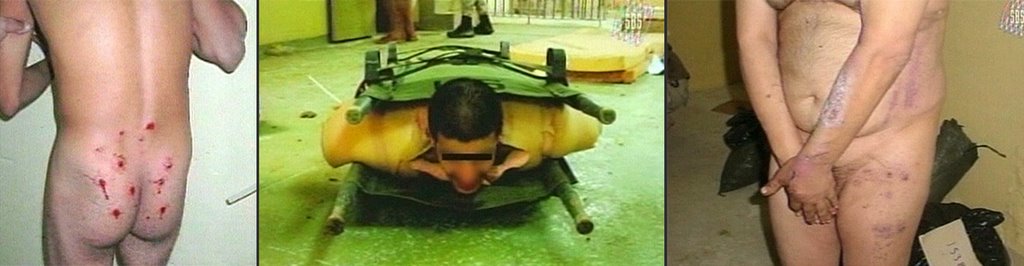
In a related story, 60 new photos have been released documenting the abuse of prisoners at abu Ghraib. Although similar to pictures already available, the new photos reveal graphic images of sexual humiliation and torture along with new incidents of murder. The pictures are available through World News Australia, but they have not yet been shown by American media outlets. Link Link


The final lesson in democracy comes from Palm Beach, Florida. In recent county elections, right-wing media mouth Ann Coulter voted in the wrong precinct — and not by accident. In fact, she gave a false address when she registered to vote in 2005 and signed the registration form certifying that the information she provided was true.

It is a felony to vote knowingly in the wrong precinct. Falsifying a voter registration form can result in a fine of up to $5000 and a maximum jail sentence of five years.

It’s going to be hard for her to blame this on President Clinton, but I’m confident she’ll find a way.

____________________

Labels: , , , ,

Saturday, February 11, 2006

Who Teaches Hate?

I collect or write far more pieces than I disseminate. Here are two items from the archives.

• Proponents of neo-con policy in the middle east often talk about schools in the region where children are taught jihad and hatred of foreigners. That was certainly the case in Afghanistan, where schoolchildren studied militant Islamic teachings in texts illustrated with pictures of tanks, guns, and bullets.

The United States knew about those books because the United States produced those books. To stir resistance to Soviet occupation of Afghanistan, the U.S. covertly supplied textbooks filled with violent images. The Washington Post published the details four years ago.

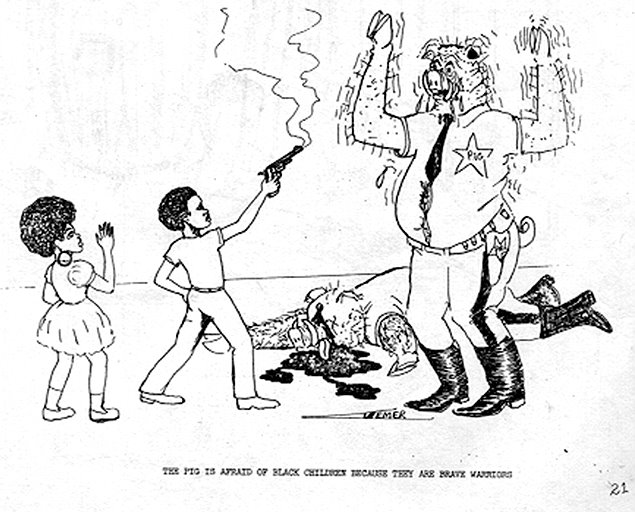
The Washington Post account reminded me of coloring books in the early 1970s. The F.B.I. was cracking down on the Black Panthers, and one complaint against the Panthers concerned coloring books which contained violent images of blacks killing policemen — evidence of the Panthers’s contempt for law and order.

In fact, the coloring book idea came from Panther Mark Teemer and was rejected by the Panther leadership. However, the F.B.I. acquired the book and was quite interested. The Bureau added drawings, changed some captions, and mailed copies of the “Black Panther Coloring Book” all around the country to discredit the Panthers.


• Obviously, the U.S. had a good reason to invade Iraq twice. Saddam Hussein was a beast who gassed his own people at Halabja in 1988. Who could doubt it?

Well, the Defense Intelligence Agency doubted it. Stephen C. Pelletiere was a C.I.A. political analyst on Iraq during the eight-year Iran-Iraq War. (“A War Crime or an Act of War?”, The New York Times, 1/31/2003) According to Pelletiere, the D.I.A. concluded that Iranians gassed the Kurds at Halabja in the course of a battle to capture the Darbandikhan dam. Pelletiere noted that:

Before the Persian Gulf war, Iraq had built an impressive system of dams and river control projects, the largest being the Darbandikhan dam in the Kurdish area. And it was this dam the Iranians were aiming to take control of when they seized Halabja. In the 1990’s there was much discussion over the construction of a so-called Peace Pipeline that would bring the waters of the Tigris and Euphrates south to the parched Gulf states and, by extension, Israel. No progress has been made on this, largely because of Iraqi intransigence. With Iraq in American hands, of course, all that could change.

Thus America could alter the destiny of the Middle East in a way that probably could not be challenged for decades — not solely by controlling Iraq's oil, but by controlling its water. Even if America didn't occupy the country, once Mr. Hussein’s Baath Party is driven from power, many lucrative opportunities would open up for American companies.


Professor Pelletiere spoke at Saint Bonaventure University on January 29, 2003. Video excerpts from that lecture are available at The Information Clearing House — Part One and Part Two. His discussion of Halabja is in part two.

You can also read Amy Goodman’s interview with John Stauber (co-author of Weapons of Mass Deception) and Stephen Pelletiere.

Stephen Pelletiere is obviously misguided. Why, only yesterday, I received a coloring book in the mail from Iran which clearly shows Iraqi forces gassing Kurds. I used purple for the gas to heighten the dramatic effect.

____________________

Labels: , , , , ,

Friday, January 20, 2006

A Few Good Men


Lawrence Colburn and Hugh Thompson (photo left) and Glenn Andreotta

Hugh Thompson was a helicopter pilot in Vietnam, flying a reconnaissance mission for a ground operation. His task was to draw fire so the enemy’s position would be exposed. But nothing happened. He and his crew — Lawrence Colburn and Glenn Andreotta, flew without incident, watching women and children leaving a village, apparently heading to the market. It was a quiet day.

It was so quiet that when they left to refuel, they did not request any backup. On their return to the village, however, they saw bodies on the roads and in the ditches. Many of the people they had seen leaving the area were dead or dying. The crew couldn’t figure out what had happened. There had been no artillery fire since early that morning; there had been no gunship fire and no enemy fire. They passed a wounded woman and marked her position with a smoke grenade, expecting medical assistance to arrive. But it was May 16, 1969, at My Lai. As they watched from above, a captain reached the woman, kicked her, stepped back, and shot her.

Landing by a ditch where dozens of people lay dead or dying, Thompson spoke to a soldier, telling him that those people had to be helped, that they had no weapons, that there were no draft age males among them, that they were clearly civilians. The soldier agreed; and as the helicopter lifted off, the soldier opened fire.

So when Thompson, Colburn, and Andreotta saw U.S. troops approaching a bunker where Vietnamese were hiding, Thompson landed between the bunker and the troops. A lieutenant said he was going to use grenades against the position, but Thompson had a better idea. He would get the people out. And “[i]f you fire on these people when I’m getting them out…my people will fire on you.” He called in a gunship to evacuate the Vietnamese.

Later that same day, Andreotta spotted movement in a ditch filled with bodies. The crew landed and rescued an eight-year-old boy.

In 1998, Thompson, Colburn, and Andreotta were awarded the Soldier’s Medal for their actions that day. Andreotta was not present because he was killed less than a month after My Lai. Thompson and Andreotta eventually returned to Vietnam where they met two of the women they had saved — and the boy, now a man, they had plucked from death.

One soldier, Lieutenant William Calley, stood trial for the massacre at My Lai. He was sentenced to life in prison. He spent three days in the stockade. President Nixon commuted the sentence to house arrest and granted a pardon three years later.

Hugh Thompson was interviewed for a 1998 documentary, “The Sound of the Violin in My Lai.” He said:

I’m just real sorry that my crew could not have done more. I’m extremely sorry for my fellow Americans for what happened. It wasn’t right. It wasn’t war. And I pray to God something like this never happens again.

Thompson died of cancer on January 6, 2006.


Ernest Johnson, Jr. was at a North Carolina military base when word of My Lai broke out. The massacre, the unrest at home, and the stories he heard from returning Marines convinced him that he could not go to Vietnam. He spent 37 years on the run. Using the name McQueen, he was living with his girl friend in Fort Worth when he was discovered and arrested for desertion. Johnson said, “I just decided I didn’t want to be a part of killing anybody. That’s as plain as I can say it.” Johnson faces the possibility of three years in prison.

Lawrence Colburn learned about Johnson in the course of an interview for Democracy Now. Colburn expressed a desire to contact Johnson.


And the war in Vietnam continues. Every year, hundreds of Vietnamese are killed or wounded by U.S. ordnance. A farmer uncovers an artillery shell, and it kills him. A child finds a canister from a cluster bomb, and it kills him. It is estimated that 300,000 tons of unexploded ordnance remain in Vietnam.

We have irradiated Iraq. We have dropped cluster bombs in cities all over the country. If we leave Iraq tomorrow, we will still be killing Iraqis for years to come. Victory is ours.

____________________

Labels: , , , , , , ,