Tuesday, September 24, 2013

From Where We Were to Where We Are

1898     Remember the Maine.  Cuba was fighting for independence from Spain; the United States was looking for a pretext to intervene.  The U.S.S. Maine blew up and sank in Havana harbor.  The U.S. blamed Spain and thus began the Spanish-American War.  The U.S. acquired Puerto Rico and, for a time, the Philippines.

1941     The Japanese attack Pearl Harbor.  Hawaii commanders General Walter Short and Admiral Husband Kimmel are impugned for dereliction of duty but denied courts martial.  Between ‘41 and ‘45, nine investigations follow.  Congress will eventually release a 39-volume compilation of evidence and testimony.

1942     The office of Coordinator of Information becomes the Office of Strategic Services, forerunner of the Central Intelligence Agency.

Early 50s     The C.I.A. begins a heavily funded effort to gain influence in the arts and media.  The program will last nearly 20 years.  In the late 1950s, the Select Committee on Improper Activities in Labor and Management, the [John] McClellan Committee, investigates the influence of organized crime.  Senator John F. Kennedy sits on the Committee, and Robert F. Kennedy serves as counsel.  In R.F.K.’s subsequent book, The Enemy Within, he describes what he calls the Private Government.

1951     With the help of officer Everette Howard Hunt, Jr., the C.I.A. acquires film rights to George Orwell’s novels, Animal Farm and 1984.

1959     The U.S. begins anti-Cuba plots.  These will lead to Operation Zapata, the 1961 Bay of Pigs invasion, and to conspiracies to kill Fidel Castro.

1962     The Joint Chiefs of Staff present Defense Secretary Robert McNamara with a report on Operation Northwoods — proposals for creating pretexts for action against Cuba, including some “Remember the Maine” scenarios.

1964     The President’s Commission on the Assassination of President John F. Kennedy, the Warren Commission, issues a report and 26 volumes of evidence and testimony.  The U.S.S. Maddox is apparently attacked in the Gulf of Tonkin by the Vietnamese.  The ensuing Gulf of Tonkin Resolution effectively transfers war powers from Congress to the presidency.

1968     Reverend Doctor Martin Luther King, Jr. is killed in Memphis, allegedly by James Ray.  Senator and presidential hopeful Robert F. Kennedy is shot to death in Los Angeles, allegedly by Sirhan Sirhan.

1970     Everette Howard Hunt, Jr. “retires” from the Agency to take a job with the Robert R. Mullen Company.  James McCord also retires to strike out on his own.  Both men will soon figure prominently in the Watergate scandal.

1971     The Pentagon Papers reveal the secret history of the Vietnam war.  The U.S.S. Maddox had been part of Operation Plan 34A.  34A included bombings by Thai pilots flying U.S. planes, coastal raids, and kidnappings; the military denies that provocation was the goal.  The wording of the Gulf of Tonkin Resolution was prepared by unidentified figures in the administration four months before the “attacks” occurred.

1977     Carl Bernstein reports on intelligence assets in the news media.  The New York Times reports on the Agency’s role in the publication of over 1000 books.

1979     The House Select Committee on Assassinations issues a report and 24 volumes of evidence and testimony in the murders of President Kennedy and Dr. King.  The Committee concludes that conspiracies were behind the crimes but is curiously unable to pin down details.  The Department of Justice remains inert.  Critical documents on the assassinations are classified for 50 years.

The 1980s     American hostages in Iran are released on the day President Ronald Reagan takes office.  Exposure of the Iran-contra-cocaine operation will continue into the 1990s.

1985     Liberty Lobby, the publisher of Spotlight, prevails against a defamation suit brought by Everette Howard Hunt, Jr.  A Spotlight article concerned Hunt’s lack of an alibi for November 22, 1963, and a possible C.I.A. strategy of “limited hang-out” during the House Select Committee on Assassinations hearings.  If the Committee learned too much or broke free of control, Hunt could be sacrificed.

1988     The investigative files on the murder of Senator Robert F. Kennedy are opened only to find they have been eviscerated.

The 1990s become the Decade of Disclosure.  New details emerge in the J.F.K. murder, Pearl Harbor, the Gulf of Tonkin Incident, Operation Zapata, the killing of Malcolm X, and other events.

1991     Oliver Stone’s movie, JFK, ignites intense interest in the assassination of President Kennedy.  Congress responds in 1992 with powerful new disclosure legislation.  By the time the Assassinations Records Review Board expires in 1998, they have compiled an archive of over 4.5 million pages, covering a breath-taking range of details.

1993     Elderly and ailing Loyd Jowers confesses his part in the King assassination on A.B.C.’s Prime Time with Sam Donaldson.  Jowers names others involved, some of them Memphis policemen.

1995     Critical documents on Pearl Harbor are declassified, including a 1940 action proposal from the Office of Naval Intelligence which laid out an 8-step plan to provoke the attack.  In the next few years, Congress and the military will posthumously exonerate Short and Kimmel without admitting foreknowledge of the attack.

1996     300 surviving Vietnamese commandos, recruited decades ago by the C.I.A., are belatedly compensated for their work in Op Plan 34A, which included the “attacks” in the Gulf of Tonkin.  The legislatively arranged payments prevent a trial.  A second group of commandos is paid for Op Plan 35A.

1998     James Ray dies in prison.     1999 — Loyd Jowers is found guilty in a civil suit brought by the King family, who ask for $100 in damages.     2000 — Jowers dies without ever facing questioning from state or federal authorities.

2001     Vice-President Dick Cheney heads secret meetings on energy.  The committee maps oil fields and drilling sites in Iraq and develops a list of buyers.  Henry Kissinger is named in a suit by the survivors of Chilean General Rene Schneider.  The next day, some planes crash into some buildings.

2002     U.S. survivors of Japan’s attack on the Philippines seek compensation.  They were not evacuated in 1941 so the Japanese would not suspect the U.S. had broken the Japanese codes.  Canada, England, Norway, Singapore, and Australia have already made payments to their citizens captured by Japan.  Congressional investigative documents on the murder of Dr. King remain secret.  In California, where Sirhan Sirhan is imprisoned for the murder of Robert Kennedy, a writ of habeas corpus is inching its way through the courts.  The U.S. and England agree to “fix intelligence” around the coming attack on Iraq.

2004     The aging and ailing Everette Howard Hunt, Jr. makes a written and tape-recorded confession of his knowledge of the conspiracy to kill J.F.K.  Hunt names others involved — Frank Sturgis, David Atlee Philips, Cord Meyer, David Morales, and more — all connected to the C.I.A.  Hunt dies three years later; his son discloses the tape-recording; and Hunt’s confession doesn’t make the evening news. 

2008     Oil industry executive Richard Cheney considers plans to start a war with Iran by having U.S. forces, disguised as Iranians, fire on U.S. forces.  (The J.C.S. had a similar scheme in mind for Cuba in 1962.)  Halliburton moves to Dubai, beyond the reach of U.S. enforcement agencies.  The bank bailouts begin.

2013     45th anniversary of the murders of Dr. King and Senator Kennedy.  50th anniversary of the murder of President Kennedy.

Labels: , , , , , , , , , ,

Tuesday, January 30, 2007

The Death of a Dangerous Man


One of the most influential criminals of our time has died of pneumonia at the age of 88.

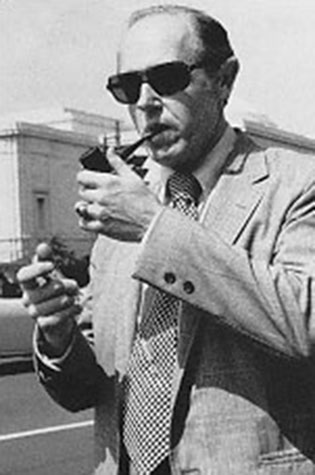
He had his fingers in several significant pieces of history that we know of, and probably others that we don’t. He was so successful that he is generally not even thought of as a criminal. He was C.I.A. officer Everette Howard Hunt, Jr. (Seen left in a photo from the 1960s.)

Hunt was in charge of the propaganda campaign accompanying the 1954 coup in Guatemala. The U.S. organized the coup, codenamed Operation Success, at the behest of the United Fruit Company to protect their holdings in Guatemala.

Hunt played a similar role in Operation Zapata, the invasion of Cuba in 1961. The C.I.A. initially assisted Fidel Castro’s insurgency against Fulgencio Batista, who had lost the support of the Cuban military. The scheme was to then replace Castro with another version of Batista. The flip-flop took on added urgency after Castro arranged to buy oil from Russia. President Eisenhower authorized the first black ops against Cuba in 1959. Zapata was supposed to take place before the 1960 elections so Vice-President Richard Nixon would be swept into the Oval Office on a wave of patriotic fervor. But preparations for the invasion bogged down, and Nixon lost the election. Zapata then became an operation against the incoming administration.

Hunt is best known for his role in the Watergate affair — the break-in at the Democratic Party headquarters in the Watergate Hotel. As I noted last month (“A Free Man,” The Chair-Herding Pictures, 12/28/2006), Hunt and senior C.I.A. officer James McCord were the key figures in the operation against Nixon.

But Watergate wasn’t Hunt’s only crime during Nixon’s presidency. During the Pentagon Papers controversy in the early 1970s, Hunt forged diplomatic cables to make it appear as though President John Kennedy was behind the assassination of Vietnamese President Ngo Dinh Diem, murdered less than three weeks before Kennedy was gunned down in Dallas.

Which brings us to Hunt’s most important and least publicized crime. On November 21, 1963, Hunt and Frank Sturgis (also of Watergate fame) arrived in Dallas to deliver the rifles used to kill Kennedy the next day.

Evidence of Hunt’s role emerged in the course of a libel suit he brought against Liberty Lobby. In 1978, Liberty Lobby published an article about a C.I.A. document concerning the need to arrange an alibi for Hunt for the day of Kennedy’s assassination. Hunt sued, and he prevailed at first. But by the time Liberty Lobby’s appeal came to trial in 1984, they had a lot more information to work with. Under informed cross-examination, Hunt’s C.I.A. witnesses crumbled. His only non-Agency witnesses were his three children, who were between the ages of 10 and 13 when Kennedy was killed. Hunt claimed he was at home with them on the day of the assassination, and together they watched the television coverage over the weekend. Yet by Hunt’s own account, his children didn’t remember that. In fact, when his children first learned of allegations of his involvement in the assassination, they confronted him and demanded to know if the accusations were true. His children were not called to testify on his behalf. The jury found for Liberty Lobby.

Shortly before Abraham Lincoln’s death, he wrote a letter in which he expressed his fear for the future of our country. As a result of the Civil War, “corporations have been enthroned and an era of corruption in high places will follow, and the money power of the country will endeavor to prolong its reign by working upon the prejudices of the people until all wealth is aggregated in a few hands and the Republic is destroyed. I feel at this moment more anxiety for the safety of my country than ever before, even in the midst of war. God grant that my suspicions may prove groundless.”

The huge increase in military spending brought about by World War II led President Eisenhower to warn us of “unwarranted power” wielded by the military/industrial complex. His successor was killed under conspicuously suspicious circumstances, and the war which followed was our longest war. Until recently, it was also our most expensive war. Today, we see increasing “corporatization” of the military and the government ostensibly for the sake of efficiency but actually to remove them from democratic control. In the face of massive debt, we see corporate figures with government titles spending obscene amounts of money for unarmored vehicles and voting machines that can’t count.

What we cannot see, though it certainly exists, is the small army of men like Everette Howard Hunt, Jr., ever ready to confuse power with patriotism.

____________________

Labels: , , , , , , , , , , ,

Friday, July 14, 2006

Remember the Maine

On Wednesday, 7/5/2006, Amy Goodman from Democracy Now! reported on U.S. government planning for intervention in Cuba upon the death of Fidel Castro.

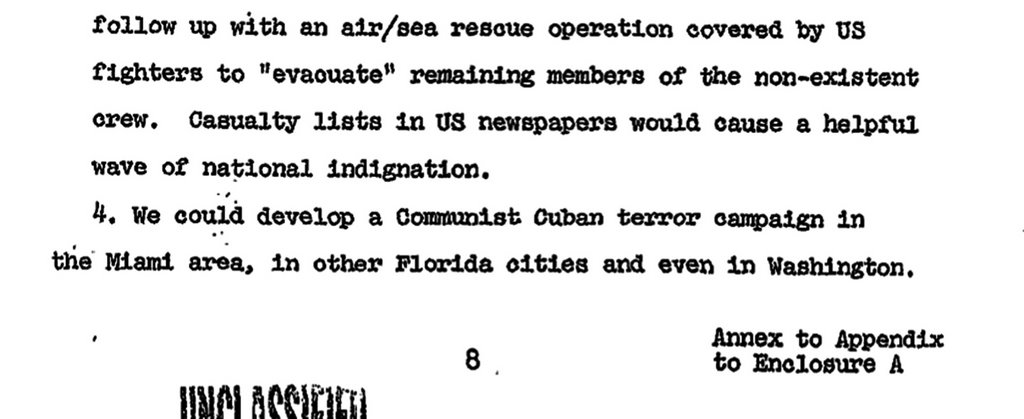
In 1962, the Joint Chiefs of Staff presented a summary of Operation Northwoods to Secretary of Defense Robert McNamara. An excerpt from that document appears above. The Chiefs outlined a number of plans to create a pretext for an attack against Cuba, including a “Remember the Maine” scheme. During Cuba’s war for independence from Spain, the U.S. sank one of its own ships, the Maine, in Havana harbor and blamed it on Spain. The public was outraged; the result was the Spanish-American War of 1898. That is how we acquired Puerto Rico and, for a while, the Philippines. In 1962, the U.S. military remembered the Maine and was considering some variations of the scam.

The Chiefs pondered a “Communist Cuban terror campaign” in the U.S. — shooting some people or staging bombings. With spectacular irony, they noted: “Exploding a few plastic bombs in carefully chosen spots, the arrest of Cuban agents and the release of prepared documents substantiating Cuban involvement also would be helpful in projecting the idea of an irresponsible government.”

Of course, the military was not the only federal entity developing plans to deceive the American public. The Central Intelligence Agency was thinking along similar lines, and some declassified material on their activities has surfaced. But for now, I want to focus on one item of Operation Northwoods — the downing of a commercial passenger plane and the loss of all aboard.

Witting passengers with fraudulent papers would board a plane. That plane would fly toward Cuban airspace, followed by a drone plane carrying a bomb. The passenger plane would descend below radar range and proceed to a military base in Florida. The drone would transmit a “May Day” message and then explode. Alternatively, a U.S. fighter could be “jumped” by MIGs from Cuba. In either scenario, the Navy could:

In 1959, a Marine radar operator defected to the Soviet Union. After he returned to the United States, he became the sole member of the Fair Play for Cuba Committee in New Orleans and then allegedly killed President John Kennedy. The Marine was killed by a Dallas nightclub owner named Jacob Rubenstein — aka Jack Ruby. In the investigation which followed, Ruby told the Warren Commission about a trip he took to Cuba in 1959, “during our good times:”

Was in harmony with our enemy of the present time. As a matter of fact, the U.S. Government was wanting persons to help them at that particular time when they threw out the dictator. [Fulgencio] Batista. (Warren Commission Volume 5, p. 202)

What? The U.S. government wanted people to help Castro overthrow Batista?

Fulgencio Batista lost the support of his own military and therefore the support of the U.S. intelligence community. The idea — in Washington — was to replace him with a transitional figure who would then be supplanted by another Batista.

Castro’s first offense was the purchase of oil from Russia. When U.S. companies in Cuba refused to refine the oil, Castro nationalized the refineries. This was followed by nationalization of other U.S. businesses, including establishments run by organized crime. President Eisenhower authorized covert operations against Cuba in 1959. Operation Zapata, the invasion at the Bay of Pigs, was supposed to be the “October Surprise” of 1960, vaulting Vice-President Richard Nixon into the White House. But the plans were not completed in time; the invasion was postponed; and Zapata was transformed into an operation to compel military action by the incoming administration. President Kennedy refused overt U.S. military aid to Operation Zapata in 1961. He refused to invade Cuba during the missile crisis of October, 1962; and he was planning withdrawal from Vietnam. Killing Kennedy in 1963 turned out to be far more cost effective than killing Castro.

On the day Kennedy was gunned down, a full-page, black-bordered advertisement appeared in the Dallas Morning News, listing a dozen loaded questions for the President. (Warren Commission Exhibit 1031, Warren Report, p. 294) The last question was this:

Why have you scrapped the Monroe Doctrine in favor of the “Spirit of Moscow”?

Promulgated in 1823, the Monroe Doctrine was a declaration of U.S. regional hegemony. Turning away from that creed, Kennedy opposed interests which had profited from Latin America and plagued Latin America for over a century. Meanwhile, similar circumstances — an illegitimate government, an agriculture-based economy, and drug traffic — existed in other locales of increasing U.S. involvement, Mexico and Vietnam.

Look at the broad picture. After a spate of assassinations in Mexico in 1994, former Mexican President Carlos Salinas (and strong supporter of the Free Trade Agreement) took an extended vacation abroad. His sister-in-law was arrested in Switzerland when she tried to withdraw $80 million from one of her husband’s various numbered accounts under false names. The Swiss had targetted the account for investigation of possible money laundering.

Salinas ended up in Ireland, where he granted an interview to a reporter from The New York Times (1/31/1997). He described a tremendous power struggle in Mexico, and added an amazing personal note. When his wife became pregnant, the couple went to Cuba so their daughter could be

“born in a country of dignified people who love their sovereignty.”

What on earth did he mean by that?! Isn’t Mexico a sovereign nation? Why didn’t he choose to have his daughter born in the United States?

Fidel Castro was born in 1926; he will certainly die one day. The contest for the sovereignty of Cuba has already begun in Havana and Washington, D.C.

Is there anything, anything at all, that we wouldn’t do gain control of Cuba?

____________________

Labels: , , , , , , ,