Friday, September 07, 2012

Unlike Father, Unlike Son


            George Wilcken Romney was born in Mexico in 1907.  When he was five years old, his family fled the revolution and moved to the United States.  They lived in Utah during the Great Depression and, like millions of Americans, struggled to make ends meet.  George Romney’s career in the auto industry began in 1939, when he moved to Detroit.  In World War II, he lead efforts to share production improvements.  In 1948, he joined Nash-Kelvinator, which became the American Motors Corporation six years later, with Romney as CEO.
            In 1962, he ran for governor in Michigan.  Naturally, during the campaign, his wife was interviewed.
             Interviewer:   You mentioned the people — why do some think he’s a man of considerable means who really doesn’t care about people?
Lenore Romney:   You know, we’ve only owned our home for the last four years.  He was a refugee from Mexico who was on relief, welfare relief for the first years of his life.  But this great country gave him opportunities.  His family were poor; he was poor; he said they lived for a year on nothing but potatoes.  He’s known what it is to have to work for every dime he’s had since he was twelve.

            Today, Lenore’s youngest son is running for the presidency of the United States.
            George Romney served as Secretary of Housing and Urban Development in President Richard Milhous Nixon’s first term.  Facing resistance from the President, Romney nevertheless wanted to increase housing production for the poor; he pursued open housing and desegregation.
            Today, George Romney’s youngest son is running for the presidency of the United States. 

            Well, you know what they say:  “Unlike father, unlike son.”

Labels: , ,

Tuesday, January 30, 2007

The Death of a Dangerous Man


One of the most influential criminals of our time has died of pneumonia at the age of 88.

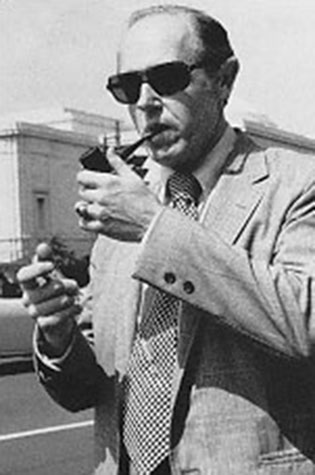
He had his fingers in several significant pieces of history that we know of, and probably others that we don’t. He was so successful that he is generally not even thought of as a criminal. He was C.I.A. officer Everette Howard Hunt, Jr. (Seen left in a photo from the 1960s.)

Hunt was in charge of the propaganda campaign accompanying the 1954 coup in Guatemala. The U.S. organized the coup, codenamed Operation Success, at the behest of the United Fruit Company to protect their holdings in Guatemala.

Hunt played a similar role in Operation Zapata, the invasion of Cuba in 1961. The C.I.A. initially assisted Fidel Castro’s insurgency against Fulgencio Batista, who had lost the support of the Cuban military. The scheme was to then replace Castro with another version of Batista. The flip-flop took on added urgency after Castro arranged to buy oil from Russia. President Eisenhower authorized the first black ops against Cuba in 1959. Zapata was supposed to take place before the 1960 elections so Vice-President Richard Nixon would be swept into the Oval Office on a wave of patriotic fervor. But preparations for the invasion bogged down, and Nixon lost the election. Zapata then became an operation against the incoming administration.

Hunt is best known for his role in the Watergate affair — the break-in at the Democratic Party headquarters in the Watergate Hotel. As I noted last month (“A Free Man,” The Chair-Herding Pictures, 12/28/2006), Hunt and senior C.I.A. officer James McCord were the key figures in the operation against Nixon.

But Watergate wasn’t Hunt’s only crime during Nixon’s presidency. During the Pentagon Papers controversy in the early 1970s, Hunt forged diplomatic cables to make it appear as though President John Kennedy was behind the assassination of Vietnamese President Ngo Dinh Diem, murdered less than three weeks before Kennedy was gunned down in Dallas.

Which brings us to Hunt’s most important and least publicized crime. On November 21, 1963, Hunt and Frank Sturgis (also of Watergate fame) arrived in Dallas to deliver the rifles used to kill Kennedy the next day.

Evidence of Hunt’s role emerged in the course of a libel suit he brought against Liberty Lobby. In 1978, Liberty Lobby published an article about a C.I.A. document concerning the need to arrange an alibi for Hunt for the day of Kennedy’s assassination. Hunt sued, and he prevailed at first. But by the time Liberty Lobby’s appeal came to trial in 1984, they had a lot more information to work with. Under informed cross-examination, Hunt’s C.I.A. witnesses crumbled. His only non-Agency witnesses were his three children, who were between the ages of 10 and 13 when Kennedy was killed. Hunt claimed he was at home with them on the day of the assassination, and together they watched the television coverage over the weekend. Yet by Hunt’s own account, his children didn’t remember that. In fact, when his children first learned of allegations of his involvement in the assassination, they confronted him and demanded to know if the accusations were true. His children were not called to testify on his behalf. The jury found for Liberty Lobby.

Shortly before Abraham Lincoln’s death, he wrote a letter in which he expressed his fear for the future of our country. As a result of the Civil War, “corporations have been enthroned and an era of corruption in high places will follow, and the money power of the country will endeavor to prolong its reign by working upon the prejudices of the people until all wealth is aggregated in a few hands and the Republic is destroyed. I feel at this moment more anxiety for the safety of my country than ever before, even in the midst of war. God grant that my suspicions may prove groundless.”

The huge increase in military spending brought about by World War II led President Eisenhower to warn us of “unwarranted power” wielded by the military/industrial complex. His successor was killed under conspicuously suspicious circumstances, and the war which followed was our longest war. Until recently, it was also our most expensive war. Today, we see increasing “corporatization” of the military and the government ostensibly for the sake of efficiency but actually to remove them from democratic control. In the face of massive debt, we see corporate figures with government titles spending obscene amounts of money for unarmored vehicles and voting machines that can’t count.

What we cannot see, though it certainly exists, is the small army of men like Everette Howard Hunt, Jr., ever ready to confuse power with patriotism.

____________________

Labels: , , , , , , , , , , ,

Thursday, December 28, 2006

A Free Man

President Gerald Ford died a free man at the age of 93, on the day after Christmas in 2006.

Ford attained his high position after President Richard Milhous Nixon’s first Vice-President, Spiro Agnew, resigned under a cloud of corruption investigations in his home state. Nixon selected then-Congressman Ford to be Vice-President. Nixon resigned under a cloud of suspicion in 1974, and Ford became President. He then granted Nixon a pardon.

Ford has been praised for his unpopular and supposedly courageous decision to pardon Nixon and “heal the nation.” But the nation wasn’t ill and didn’t need to be healed. The media huffed and puffed about a constitutional crisis, but no such crisis existed. Ford’s action served primarily to forestall public awareness of the Watergate affair and the involvement of the C.I.A. With one exception, all of the Watergate burglars were Agency officers or assets. The two men running the show, Everette Howard Hunt, Jr. and James McCord, were career intelligence officers with the highest clearance. The C.I.A. provided the burglars with money, disguises, electronic equipment, and lock-picking expertise. To this day, most people have no idea what Watergate was about.

Ford installed George Herbert Walker Bush as Director of Central Intelligence in the critical period preceding the House Select Committee on Assassinations inquiry into the murders of President John F. Kennedy and the Rev. Dr. Martin Luther King, Jr. Nixon’s chief-of-staff, H. R. Haldeman, noted that the C.I.A. obliterated a mountain of evidence connecting the Agency to Kennedy’s assassination. (Haldeman, H. R., with Joseph DiMona, The Ends of Power: Kissinger in the Nixon White House, New York, Time Books, 1978, pp. 39-40)

And Ford didn’t merely pardon Nixon for Watergate; Ford issued a blanket pardon for any crimes Nixon may have committed as President.

I can think of at least one crime Nixon may have committed as President: The U.S.-backed assassination of Chilean President Salvador Allende on 9/11/1973. Nixon’s economic efforts to “make the [Chilean] economy scream” brought hardship to Chile but failed to unseat Allende. The alternative approach, killing him, worked better.

Allende’s successor, Augusto Pinochet, recently died a free man while under investigation for “disappearing” thousands of “dissidents.” Some of the victims were foreigners from the U.S., Spain, or France. During a visit to France 28 years after Allende’s murder, Nixon’s Secretary of State, Henry Kissinger, was invited by the authorities to respond to certain inquiries. Kissinger promptly fled to Italy. Nixon died a free man in 1994. Henry Kissinger isn’t getting any younger; and he will most likely die a free man under a cloud of suspicion.


In 1963, 50-year-old Congressman Ford was appointed by President Lyndon Johnson to serve on the Warren Commission which oversaw the federal investigation of the assassination of President Kennedy. The Commissioners classified important evidence for 75 years. Commissioner Allen Dulles had served for nine years as director of the C.I.A.; he was fired by Kennedy after the Bay of Pigs fiasco. Newsweek magazine described Gerald Ford as “the C.I.A.’s best friend in Congress.”

The Warren Report became the most discredited document ever printed by the Government Printing Office, a record previously held by the Roberts Commission Report on the attack against Pearl Harbor.

When Indonesia was preparing to invade East Timor in 1975, their primary concern was U.S. opposition which might have led to the withholding of arms shipments to Indonesia. That December, Ford met Indonesian President Sukarno and gave him the green light. Ford then flew to Guam to deliver a speech on the anniversary of the surprise attack on Pearl Harbor — as Indonesia began the surprise carnage in East Timor. The death toll in East Timor, considered as a percentage of the total population, was worse than the slaughter visited upon Europe by Adolph Hitler.

Yes, Ford did grant amnesty to U.S. citizens who went to Canada to escape the draft during the invasion of Vietnam. But that lone positive gesture was more than offset by the damage he did.

Gerald Ford died a free man at the age of 93, on the day after Christmas in 2006.

____________________

Labels: , , , , , , , , , ,

Tuesday, November 14, 2006

Prohibiting Prohibition

As a police officer in 1966, Norm Stamper, by his own account, enjoyed drug busts. He liked kicking down doors for a half a bag of marijuana or even a single seed. At the academy, he had learned the importance of drug arrests; and he worked hard to bump up the statistics.

“But after about fourteen months on the job, having had a principled prosecutor slap me upside the head and question my understanding of the Constitution, I began to understand that the seventeen or nineteen-year-old kid I had in the back seat of my police car was not a criminal at all.”

Forty years later, Stamper has a valuable and controversial perspective.

“I think the Drug War has been arguably the single most devastating, dysfunctional, harmful social policy since slavery.”
—Retired Seattle Police Chief Norm Stamper

When the Nixon administration declared a War on Drugs three decades ago, Jack Cole was an undercover officer infiltrating groups of young people and college students. On weekends, when the kids were out of classes or off work, one of them might ask the others if they wanted to get high. Cole’s job was to ask that question if no one else did.

“If somebody simply passed a marijuana cigarette to me, they became a drug dealer. That hand-held marijuana cigarette would send that person to jail for seven years. Over a thousand young people went to jail as a direct result of what I did out there as one undercover agent, something that I’m certainly not proud of today.”
—Retired New Jersey State Police Lieutenant Jack Cole

The United States outlawed alcohol, and alcohol became a big money-maker for organized crime. Prohibition dramatically raised the level of violence on our streets as mobsters fought for control of the market. Our new prohibition, the drug war, has achieved the same result for a new generation of gangsters. Dealers don’t shoot their customers; they shoot other dealers. The innocent victims are the people who happen to get in the way of the bullets.


“Drug legalization is not to be construed as an approach to our drug problem. Drug legalization is about our crime and violence problem.”
—Retired Tonawanda Police Captain Peter Christ

Directly and indirectly, we all pay for the madness. The incarceration rate of black males in South Africa under apartheid in 1993 was 851 per 100,000. In the U.S. under drug prohibition in 2004, the incarceration rate was 4919 per 100,000. In many states, felons cannot vote; so the drug war is disproportionately disenfranchising the black community.

The huge amounts of money involved present the obvious potential for corruption of law enforcement. The huge number of arrests means more prisons, which has fueled a drive for privatization of prisons, which in turn has led to corporate influence in legislative and judicial processes. Private prisons hire lobbyists to push for mandatory minimum sentences to increase the prison population. We spend $69 billion on the Drug War every year, and we are nowhere near victory.

Syracuse city auditor Mitch Lewis studied the effectiveness of his city’s drug enforcement expenditures. He concluded that they weren’t effective.

“If we really want to improve our urban neighborhoods, the most important thing that we could do — the single most important thing that we could do — is end the war on drugs.”
—Syracuse City Auditor Mitch Lewis

Prohibition doesn’t work. It’s time to prohibit prohibition.


Want to learn more? Check out LEAP, Law Enforcement Against Prohibition, at:

http://www.leap.cc/

____________________

Labels: , ,