The Death of a Dangerous Man
One of the most influential criminals of our time has died of pneumonia at the age of 88.
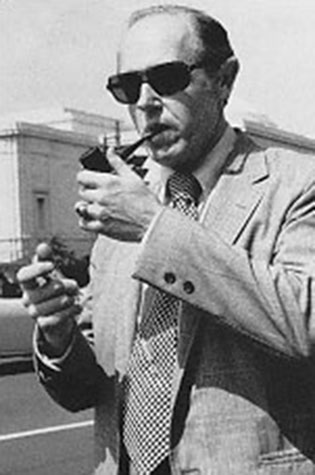
He had his fingers in several significant pieces of history that we know of, and probably others that we don’t. He was so successful that he is generally not even thought of as a criminal. He was C.I.A. officer Everette Howard Hunt, Jr. (Seen left in a photo from the 1960s.)
Hunt was in charge of the propaganda campaign accompanying the 1954 coup in Guatemala. The U.S. organized the coup, codenamed Operation Success, at the behest of the United Fruit Company to protect their holdings in Guatemala.
Hunt played a similar role in Operation Zapata, the invasion of Cuba in 1961. The C.I.A. initially assisted Fidel Castro’s insurgency against Fulgencio Batista, who had lost the support of the Cuban military. The scheme was to then replace Castro with another version of Batista. The flip-flop took on added urgency after Castro arranged to buy oil from Russia. President Eisenhower authorized the first black ops against Cuba in 1959. Zapata was supposed to take place before the 1960 elections so Vice-President Richard Nixon would be swept into the Oval Office on a wave of patriotic fervor. But preparations for the invasion bogged down, and Nixon lost the election. Zapata then became an operation against the incoming administration.
Hunt is best known for his role in the Watergate affair — the break-in at the Democratic Party headquarters in the Watergate Hotel. As I noted last month (“A Free Man,” The Chair-Herding Pictures, 12/28/2006), Hunt and senior C.I.A. officer James McCord were the key figures in the operation against Nixon.
But Watergate wasn’t Hunt’s only crime during Nixon’s presidency. During the Pentagon Papers controversy in the early 1970s, Hunt forged diplomatic cables to make it appear as though President John Kennedy was behind the assassination of Vietnamese President Ngo Dinh Diem, murdered less than three weeks before Kennedy was gunned down in Dallas.
Which brings us to Hunt’s most important and least publicized crime. On November 21, 1963, Hunt and Frank Sturgis (also of Watergate fame) arrived in Dallas to deliver the rifles used to kill Kennedy the next day.
Evidence of Hunt’s role emerged in the course of a libel suit he brought against Liberty Lobby. In 1978, Liberty Lobby published an article about a C.I.A. document concerning the need to arrange an alibi for Hunt for the day of Kennedy’s assassination. Hunt sued, and he prevailed at first. But by the time Liberty Lobby’s appeal came to trial in 1984, they had a lot more information to work with. Under informed cross-examination, Hunt’s C.I.A. witnesses crumbled. His only non-Agency witnesses were his three children, who were between the ages of 10 and 13 when Kennedy was killed. Hunt claimed he was at home with them on the day of the assassination, and together they watched the television coverage over the weekend. Yet by Hunt’s own account, his children didn’t remember that. In fact, when his children first learned of allegations of his involvement in the assassination, they confronted him and demanded to know if the accusations were true. His children were not called to testify on his behalf. The jury found for Liberty Lobby.
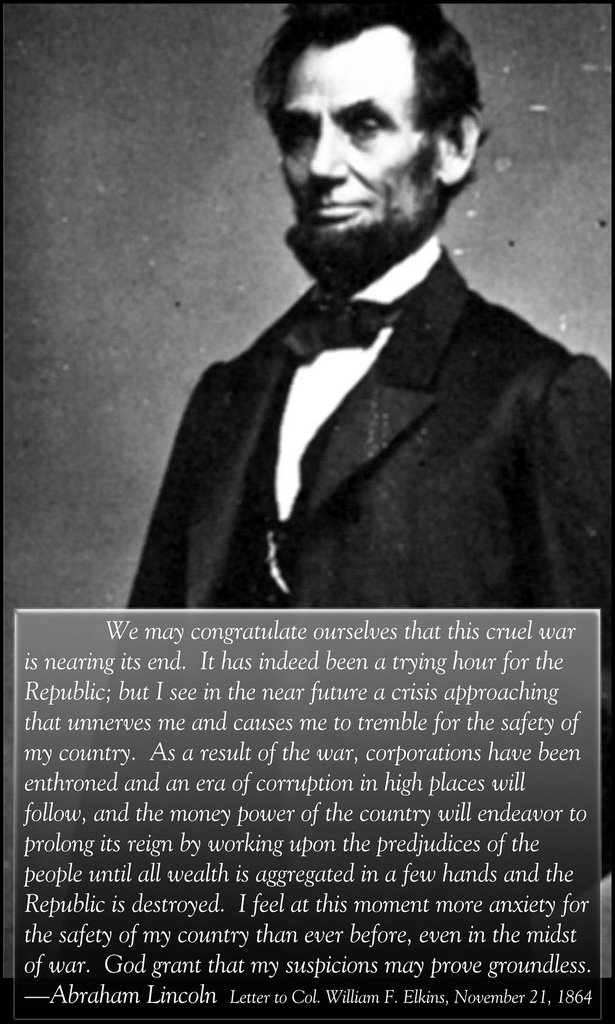
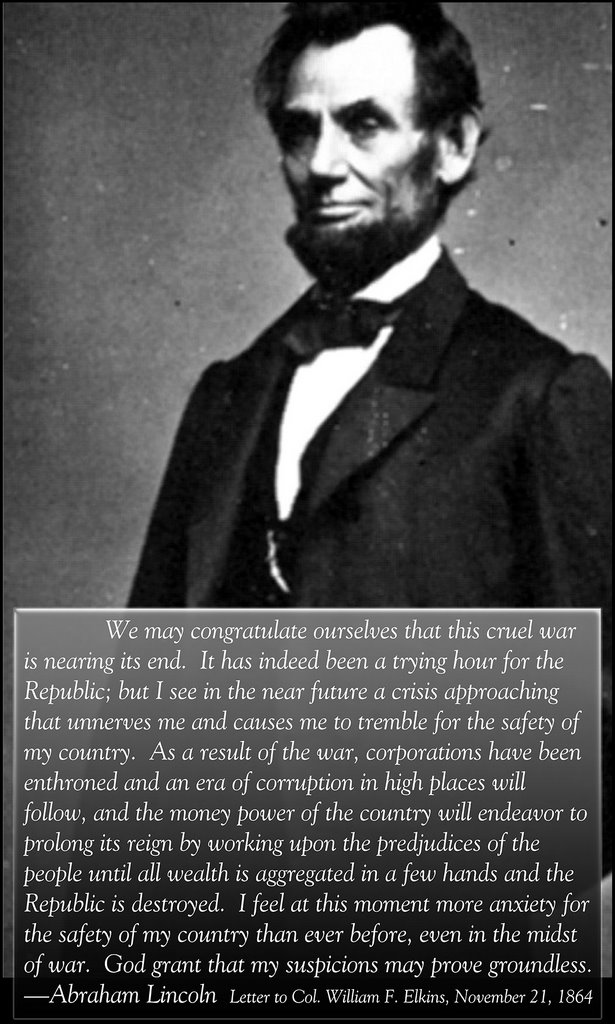
Shortly before Abraham Lincoln’s death, he wrote a letter in which he expressed his fear for the future of our country. As a result of the Civil War, “corporations have been enthroned and an era of corruption in high places will follow, and the money power of the country will endeavor to prolong its reign by working upon the prejudices of the people until all wealth is aggregated in a few hands and the Republic is destroyed. I feel at this moment more anxiety for the safety of my country than ever before, even in the midst of war. God grant that my suspicions may prove groundless.”
The huge increase in military spending brought about by World War II led President Eisenhower to warn us of “unwarranted power” wielded by the military/industrial complex. His successor was killed under conspicuously suspicious circumstances, and the war which followed was our longest war. Until recently, it was also our most expensive war. Today, we see increasing “corporatization” of the military and the government ostensibly for the sake of efficiency but actually to remove them from democratic control. In the face of massive debt, we see corporate figures with government titles spending obscene amounts of money for unarmored vehicles and voting machines that can’t count.
What we cannot see, though it certainly exists, is the small army of men like Everette Howard Hunt, Jr., ever ready to confuse power with patriotism.
____________________
Labels: Abraham Lincoln, Bay of Pigs, Dwight Eisenhower, Everette Howard Hunt, Fidel Castro, James McCord, John Kennedy, Operation Success, Operation Zapata, Pentagon Papers, Richard Nixon, Watergate
posted by Jerrold Smith at 10:15 PM
0 comments